
JJDP Community Programs, Part 1 - Safety Scoop Transcript
Introduction
[Music]
Kirsten Barber: You're listening to the NCDPS Safety Scoop, a podcast that dives into the stories of the people, programs and resources within the North Carolina Department of Public Safety. Each episode, we’ll give you the scoop from department personnel on how NCDPS enhances the safety of the people of North Carolina.
[Music]
Season 3 Episode 3
Kirsten: The Division of Juvenile Justice and Delinquency Prevention with the North Carolina Department of Public Safety is committed to the reduction and prevention of juvenile delinquency by effectively intervening, educating and treating youth. Before the 1800s, children accused of crimes were treated much like adults. Over time, incarceration was preferred over more extreme punishments, but the practice increased concerns about housing children with older offenders. In the early 19th century, there came a push to reform the justice system, separating incarcerated youth from adult offenders. Reformers also believed that treating child offenders was more important than punishing them. The framework for a separate court system for juveniles in North Carolina was established in 1868 and was later incorporated into the Juvenile Court Statute of 1919.
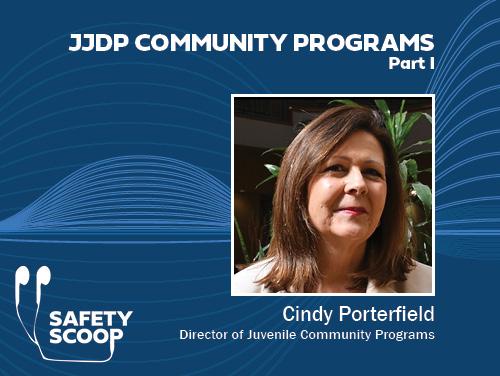
This division has three key pillars utilized for the successful treatment and rehabilitation of youth in the system. These include court services, facility operations and community programs. In this Safety Scoop episode, we’ll hone in on the community program section of the division which provides a comprehensive strategy to help prevent and reduce juvenile crime and delinquency through non-residential and residential contracted programs. This is part one of a two-part series on JJDP community programs. With so much to unpack, I'd like to introduce our first guest, Cindy Porterfield, Director of Juvenile Community Programs. With more than 20 years under her belt working within North Carolina's juvenile justice system, Cindy provides a lot of insight into the history of juvenile community programs and the partnerships that have been invaluable to supporting delinquent youth, strengthening families and protecting communities.
Cindy Porterfield: My name is Cindy Porterfield, and I'm the Director of Juvenile Community Programs. I've been with the department over 25 years; however, my experience in working with this population began well before 1999 when I came to the department.
Kirsten: Cindy, we are really excited just to have a conversation with you about the Juvenile Justice Community Program section within the Division of Juvenile Justice and Delinquency Prevention, so thank you for joining us today.
Cindy: Thank you for having me. I'm excited to be able to talk about the Juvenile Community Program section.
Kirsten: Well, we’re going to kick off this conversation with kind of a deep question, um, but I think it's important just to kind of expand a little bit more about your role. So, what drove you to choose a career within this field?
Cindy: Like I said, I was exposed to this population well before 1999. Uh, my professional years of work have been related to working with children with specific needs. I mean youth that have been involved in the juvenile justice system. My interest in this population really started in voluntary work when I was in college. I worked on campus at what is now C.A. Dillon. We called it a training school at that time. I worked with a female population, um, that used to be housed in a cottage there. This volunteer experience later opened the door for my first-time job working as a behavioral specialist, um, with the female population, and while I've, um, held many direct services positions in mental health services while serving some of North Carolina's children with the most complex needs and in numerous community-based programming models, my focus has always been work with youth. And that's required a really variety of skill sets to perform integrated work for this population, and it really set me up to be able to do this work in Juvenile Community Programs. This section here really offered an opportunity to be able to hone in on those skills and to develop a team that has the tools to do that.
Kirsten: Thank you so much for going into that. Next, can you provide an overview for our listeners of the Juvenile Justice Community Program section?
Cindy: Absolutely. I love talking about this because North Carolina really has a rich, rooted history in community-based programming. It began back in the mid-70s when the research at that time pointed to better outcomes for youth if they were served in the community, rather than sending them off to out-of-home placements. And it was the work of Ken Foster in what was then known as Community-Based Alternatives, which was a section in the Division of Youth Services at the Department of what was called Human Resources at that time. Um, that is now known as the Department of Health and Human Services, but Ken and his team really set the path for the development of our section and what it is today. The goal at that time was to actually remove status offenders from training schools, or what we call Youth Development Centers, and the establishment of specific community-based programming models was really the goal to move that population out of training schools into the community.
That began with about a $1 million appropriation from the legislature. Of course, we have evolved to where we are today because our job is to develop that comprehensive, research-supported, uh, continuum of services to prevent youth from entering our system, and it's our job here to offer those services or to develop those services that best match the needs of youth. Now, we have about $60 million that the legislature has appropriated to the section to position ourselves, really, to address specific, targeted populations to prevent delinquency or address at-risk populations, preventing them from entering the juvenile justice system or also address the needs of those youth that have become part of our system by diverting them or programming to address adjudicated youth or youth that are reentering our community from Youth Development Centers.
So, the work of the section is actually performed under two distinct legislative appropriations, one being the Juvenile Crime Prevention Council Fund, which is about $28 million, and then there is also another appropriation that is used for contractual or what we call intensive intervention services. So, it's through these services that we serve well over 22,000 youth each year, um, with approximately 1,500 youth being served through those contracted, intensive intervention services alone. So, 22,000 under the Juvenile Crime Prevention Council-funded programs being served by Juvenile Crime Prevention Council fund, and then about 1,500 being served through the state-contracted intensive intervention services.
So, this all comes about through the work of nonprofits and governmental entities. There are about 600 distinct program components that we have oversight over under the section which is done by over 300 nonprofit or governmental entities. So, there are nonprofits that actually serve youth with multiple components. By components, I mean an individual type of service, so you may have a nonprofit that has an umbrella of three distinct services that are funded, um, by us. So, we support the work of our court services colleagues and our facility operations colleagues, um, to help match kids to the right service to give them what programming they need to address certain criminogenic risks or needs that the youth and family may have.
Kirsten: You might have been a history teacher in a past life.
]Laughs]
Thank you, that was, uh, very comprehensive. But, um, I think you also laid out just what an endeavor this is, um, just to cover youth within North Carolina. Some of those numbers that you laid out, I mean, really, this is not something that can be handled by a few individuals. I mean, you said you partner with hundreds of non-profit organizations, so just wanted to kind of call that out because even that shocked me. I didn't realize how many people and how many organizations are involved in, uh, helping North Carolina youth.
Cindy: Absolutely, it is a partnership, and our partnership really begins with the local Juvenile Crime Prevention Councils, um, and the county governments. Those councils are part of an intricate, really deeply woven system in our state, a lot of which is envied by other states. We have a lot of states that look to us to look at how in–we develop this infrastructure to do this work. And this kind of goes back to the days of Community-Based Alternatives where there used to be Youth Services Advisory Councils established in all 100 counties, um, and then the Juvenile Justice Reform Act of 1998 really took those Youth Services Advisory Councils and formed them into legislative bodies with designated positions. And so, they're up to 26 members on those Juvenile Crime Prevention Councils which do the work at the local level and serve as an arm of the County Commission Boards. This unique structure within our state allows us to do continuum building at the local level.
Um, we use data generated from our own North Carolina [Juvenile] Online Information Network. That's NC-JOIN. That's the database which houses all of the juvenile services information. As youth enter into the juvenile justice system, they administer the risk and needs, uh, assessment, and we use that data in this section from the YASI (the Youth Assessment and Screening Instrument) to develop that local service continuum that is unique for each county. And so, in this partnership, we call for nonprofits to do this work, and so the JCPC is a very active body. They're governed by general statute, and what they have to do, they review the program of–of agreements that come forth as applications for the funding. Um, they move through a process of deciding which programs they wish to fund to build that continuum locally to meet that unique need as defined by the data, and then they move their recommendations through County Commission Boards and then finally to us for approval. And–and so, these JCPCs really serve as a conduit for educating the community and local nonprofits about delinquency in local communities, and also, they serve to kind of put together that local continuum to help us with our population as youth enter the juvenile justice system. And so, I have a team of folks here that help give oversight to educate communities, nonprofits, the JCPC, but to also provide technical assistance to make sure that programs are fiscally and programmatically functioning as they should to address our juvenile population needs. And so, it's an ongoing oversight and, um, movement toward doing best practices to serve our youth.
Kirsten: So, Cindy, can you tell us a little bit about residential and non-residential programs JJDP supports?
Cindy: Yes, I'm happy to do so. So, the section funds many types of programs and offers guidance, minimum standards of operation for its programs that we fund. Let’s look at this two ways. Let’s look at the residential and non-residential programs we support at the community level where JCPCs are funding. So, we have 22 different program types. Um, they fall into various domains of problem types. We like to look at them as clinical and assessment services. Those would be programs like psychological evaluations, um, comprehensive clinical assessments. The court services uses those in counties to help drive what the service needs are for youth as they come into our system. We also have skill-building programs. There are cognitive-based curriculum, anger management programs, parent skill building programs. And then even at the local level, we do have some residential models that are funded by the Juvenile Crime Prevention Council.
We have another domain called Restorative Justice Programs. Those are programs like teen courts, mediation, community service and restitution. And one thing JCPCs must do as part of the legislative requirement is they must fund, as a priority, disposition option programs, and so what you'll find is that community service and restitution programs are funded by JCPCs in all 100 counties. And then, there's another category called Community Day, and these are very limited across our state. They’re structured day programs that work very closely with county school systems to serve short-term and long-term suspended youth. So, that's on the juvenile crime prevention side.
In terms of non-residential and residential programs that are funded through our contractual intensive intervention appropriated funds, we fund residential program models through a couple of providers. There's Methodist Home for Children who's been a long-standing partner of ours. They serve us through providing, uh, several models, and each model is unique. However, Methodist Home for Children utilizes a model of care that is–that is, uh, consistent across all three of those program models. It’s a value-based therapeutic environment. That model helps children, um, with cognitive-based, uh, thinking. Now, there are 52 skills they work on. Uh, they also, uh, help move kids along from one service to another because they have a wide array of services within our own continuum and funding streams here in–in the section.
Eckerd Connects, another long-standing partner of the department, they provide short-term residential care, but in terms of non-residential services, AMI Kids is a partner. They provide functional family therapy in all 100 counties. And quite recently, we've grown a program to, uh, assess our youth with problem sexual behavior, and that program is called TASSK: Treatment and Assessment Services for Sexualized Kids. Children's Hope Alliance has been able to grow their program from one district out west to now cover 40 counties, and what’s unique about this program is that they've been a really workable partner. They’ve offered services in our Youth Development Centers to youth who have initially been served in the community and then possibly have been ad-adjudicated and committed while they're in treatment. So, we do sometimes, uh, have an opportunity to move our services right along with the child if the child is entering into facilities.
So, these contracts that I speak of offer an array of intensive intervention services for our youth that go deeper in the system. However, the Juvenile Crime Prevention Councils and their programs that are s-serving kids locally, they're really the first line in trying to address our juvenile population needs before kids get deeper into the system.
Kirsten: So, you've already spoke about this a little bit by proactive intervention, but these community programs and these 22 program types that you just spoke of, how do they fit into the overall picture of the Division of Juvenile Justice and Delinquency Prevention and meet the goal of providing the right service to the right child at the right time?
Cindy: Well, I think we have to first begin with the thought that our services here in this section are supported by evidence-based practices, research or they’re evidence-based programs, and one of the thing–the mechanisms that helps us understand serving the right kid at the right time with the right service is to make sure that the programs used to serve these youth are services that are effective. And so, the section leans very heavily into evaluation studies, and we want to ensure that we have a variety of services based on the needs of youth.
So, how do we fit in the overall picture? Well, I–I like to think of juvenile justice as a three-legged stool. There are services that are provided by our court services colleagues, services provided by facility operations and then the Community Programs section. So, between these three sections, we build that continuum of services for our juvenile population, but Community Programs actually tries to provide the support to our JJ colleagues by developing that continuum of services. We–we want to make sure that not only are–are we able to serve youth that have penetrated the juvenile justice system, but also services as youth re-enter the community. And so, we fit into this overall picture because we're doing the work on the ground, analyzing the data that is generated from our own data systems and then using it to help develop the services locally to meet court needs and our juvenile court counselors’ needs as they develop an individualized plan for youth.
So, we do a lot of collaboration with our court services colleagues. We generate strategies to address needs regionally. We have what's called multi-county program agreements that can stretch across judicial districts to help support service needs, and TASSK is a perfect example of that where we grew that program to a point where it crossed from a JCPC-funded program to a multi-county program to a state-contracted program. I think we serve to support Juvenile Justice, our colleagues and the court system as well as the overall continuum to help juvenile justice overall.
Kirsten: Thank you, and a few things stood out while you were answering my last question that I felt were really important. You mentioned evidence-based, um, that there’s data rooted in these programs that are provided and oversight. Can you just share why that's important? And I know that might be kind of an–an obvious question, but these programs and partnerships are not just built over even a handful of years but decades of work with the community.
Cindy: Yes, we are very rooted in this work. It's very procedural, cyclical almost in nature because funding cycles move from one fiscal year to another. General Assembly allowed us to have biennial budgets now, uh, with our JCPC programs. So, I think what's interesting here is that we lean into best practices. Because the general statute tells us that we have to evaluate the effectiveness of our programs, and so we have opted to lean into the research. Our work with, uh, the sentencing commission also helps us understand how our JCPC programs are effective. The sentencing commission does studies on the effectiveness of JCPC programs every two years, and so we have wonderful outcomes with our JCPC programs in terms of reduction of recidivism, and quite recently we've done a deep dive into our contracted programs to understand the effectiveness of these programs in terms of cost-benefit analysis.
Kirsten: So, I'd like to take a look at these community programs and Juvenile Detention Centers. Can you go through the benefits of appropriately diverting youth into these types of programs as opposed to deeper involvement in the juvenile justice system?
Cindy: Absolutely. Um, there are not only benefits for our youth if we prevent them from going deeper in the system, but there are also benefits to North Carolina taxpayers. A couple years ago, we had the privilege to engage in the Results First Initiative. That–that was an initiative supported by the Governor’s Office. We worked with the Pew Foundation and the Office of State Budget and Management, and so this project really focused on unpacking our state-contracted services. That was our focus: our Deeper End programs, our programs that serve our higher-risk kids. And we unpacked these programs, matching these program models against evaluated programs that are found to be effective. And so, we took our state-contracted programs, unpacked them, and then the Office of State Budget and Management, along with Pew, provided the formula to help calculate the cost-benefit of programs.
It was really interesting information that came out of this study. The study revealed that if we prevent one recidivism event for a high-risk juvenile, we save taxpayers $120,000. Now, be mindful of the fact that about 79% of that would be associated with the impact on victims of crimes, but that's pretty substantial, and it puts a monetary value to a criminal event. And so, other learnings that came out of that were individualized program cost-benefit analysis. We did the study by looking at cohorts: youth that are high risk that received one of our services, youth that are high risk that did not receive a service. And we found that youth that did not receive a service recidivated at about 55% over a 5-year period. And so, let's put some value to that in terms of youth getting one of our programs. So, what we found was that youth that received services in one of Methodist’s residential programs where the value-based therapeutic environment model is administered reduces recidivism by 26% and returns about $13 on every dollar spent.
We also found that in functional family therapy, for example, court-involved youth that were receiving that service recidivated 13% less. But the really revealing factor that we gained from this study with functional family therapy was where in the continuum the service was most impactful. And so, we looked at youth that were reentering the community and receiving functional family therapy, and we found that youth receiving the service at that point in the continuum recidivism was reduced by 69% and that we returned $9 on each dollar served. So, it affected now, in how we do our work, some policy, where best and what best service can be administered with youth that are leaving one of our Youth Development Centers. And so, we are very excited now to be able to use this data when we're asking for expansion funds because we know our programs are effective.
Kirsten: So, Cindy, what do these programs provide that a Juvenile Detention Center might not be able to?
Cindy: Kirsten, I'd like to say opportunities, opportunities for learning in less punitive environments. Any exposure to detention greatly increases the likelihood of future detention events for our youth, and our goal is to prevent exposure to institutional environments. So, one of the unique ways that we use our Crisis and Assessment Centers is for our younger population, youth that are 12 and under. If a youth comes to JJ and needs to be in detention, we like to ask local judges if we can use secure beds in our Crisis and Assessments Centers. We want to make sure that that population is not exposed to youth who have more serious offenses, and also since detention is really time-limited, the environment is really not conducive to providing a full-frequency and -duration of a program model to be administered.
But the section has been able to provide some services in facilities, and I speak to our programming to address problem sexual behavior with youth. We've had some youth that have been able to receive assessments while they've been in detention, and more recently we've been able to offer continuity of treatment for a youth who was awaiting commitment to a Youth Development Center while he was receiving services from TASSK. In that way, that TASSK service is being delivered now in the Youth Development Center, too, so that the service would not be interrupted.
One thing I pride ourselves on is that we are able to really work and be flexible providers in partnership with us, and it's because of that partnership are able to be flexible when we ask them to, um, to deliver services to our youth to make for continuity and to ensure that the full duration of service is delivered with that–without interruption.
Kirsten: Lastly, Raise the Age changed the landscape of juvenile justice in many ways. Can you tell us a bit about how your section and our community partners have adapted to serve older youth?
Cindy: The landscape has changed, and the average age of youth being served has shifted overall in our system. It's important to remember, however, that the Community Program Section has served 16- to 18-year-olds long before Raise the Age legislation passed. And so, we've been poised to serve this population. Before Raise the Age, about 20% of our teen court referrals were those that came from district courts. Savvy DAs were diverting our 16- through 18-year-olds who have misdemeanors, and they were saving them from all the collateral consequences of having an adult criminal charge.
We like to think that we’re forward-thinking here in this section. We know that Chapter 20 vehicle offenses are not part of, uh, the work of our juvenile court counselors; however, over the pandemic, we found an opportunity to sort of take on a population with our teen court. We got creative, and, uh, the district attorney down in Bladen, Brunswick and Columbus Counties thought that it would be a good idea to try to divert some Chapter 20 motor vehicle offense charges down to teen court. Our populations in our programs were being reduced because of the pandemic, and we turned the pandemic into an opportunity to really explore how youth that commit offenses with motor vehicles could be routed to a teen court model.
Now, I have to back up here and tell you that our juvenile court counselors cannot refer any youth for any motor vehicle offense, and really, motor vehicle offenses are really not in their purview of, um, of offenses that they take care of, but this pandemic and the environment provided an opportunity for DAs and judges to make recommendations to teen court and refer in that capacity. So, that's one beautiful story there that comes out of a pandemic that helped us understand how we could morph our programs and change our programs to meet our needs not only of the time, but also of a–a different population.
We’re also seeing the need for services to address this older population to help them with vocational skills, and we've developed transitional living homes and expanded upon them with a focus upon skill development in the vocational arena. Also, educational goals and independent living skills, and our newest opening was at The Farm in Wayne County, another Methodist Home for Children residential model. And this is a really interesting model in that it is a home located on a farm. We have a greenhouse to be able to teach the youth horticultural skills. Uh, we want to teach them some entrepreneurial skills to be able to, uh, grow things and then possibly sell at the local farmer’s market. There are plans to erect a chicken coop on The Farm. So, uh, Methodist has some wonderful thoughts about how they want to use their model there to generate really good skills for our kids when they leave transition–the transitional living homes.
We're also seeing youth with more complex mental health needs, and we need to learn to connect them with adult mental health services as they leave our system. So, our transitional homes and our newest housing-first model for youth is helping to ensure that continuity of treatment. This housing-first model that we've just begun to develop in our continuum is being developed because we're seeing an increase in homeless youth as they are exiting our Youth Development Centers. And so, this new emerging adult population is one that we're focusing on. We don't want to mix them with adults that are using an adult housing-first model. This is very unique for our emerging adult population. So, HEARTH, a program in Guilford County, uh, we were in the second year of funding that model, and also Haven House transitioning youth program located in Wake County. These two housing-first models are poised to accept homeless youth in our system or who have previously been involved in our system with their housing. We know we have better outcomes for our youth when we can address mental health needs and housing stability.
Kirsten: Well, thank you for going through all of that. I loved some of those stories that you shared of the different settings. You–you painted a–a beautiful picture, especially, um, of the–the one farm and the greenhouse and all the opportunities offered there, and just thank you to your team. Your work is never finished. This is, uh, an area that the work will continue on and on and on, but I did want to just close out with any resources that you want to share, um, where can people learn more about the work that you guys are doing?
Cindy: Well, I think our website definitely offers up information, uh, about the array of services. I really encourage folks who want to know more about juvenile justice to get involved locally. Juvenile Crime Prevention Council is a wonderful way to learn about juvenile justice and also impact their local communities by giving guidance to what is needed to address local populations. I think it's important to understand, too, that we're very accountable here in this section, and, um, we've had long years of learning. Um. It's been a joy, really, and a privilege to do this kind of work. There's been incredible amount of positive changes in juvenile justice through the use of research and best practices, and we in the section have been able to engage in those breast–best practices, so I think learning about juvenile justice locally, but also partnering up with our partners that do this work, we're always in the business of trying to recruit people to understand juvenile justice and to be a part of this work. It's an exciting field, and with the use of technology and the research that's going on now in the field, I really envision even–even better outcomes for our youth.
Conclusion
[Music]
Kirsten: This is the Safety Scoop, a podcast written, produced and edited by the NCDPS communications team. The mission of the North Carolina Department of Public Safety is to safeguard and preserve the lives and property of the people of North Carolina through preparation, prevention and protection with integrity and honor. Follow the department on social media for a closer look at ongoing initiatives and resources. We’re on Facebook, X and Instagram at NC Public Safety. If you enjoyed today's episode, be sure to subscribe to the Safety Scoop on your favorite podcast app. Special thanks to Communications Officer Matthew Debnam who provided information used in this episode. Stay tuned for part two coming later this month. I’m your host, Kirsten Barber. Thanks for listening.
[Music]