
JJDP Community Programs, Part 2 - Safety Scoop Transcript
Introduction
Jonelle Giulianelli: Who are we can be defined, some might say, as how we show up to difficult situations. Youth's setbacks, when addressed properly, can result in successes, and youth deserve to see themselves being successful.
[Pause]
[Music]
Kirsten Barber: You're listening to the NCDPS Safety Scoop, a podcast that dives into the stories of the people, programs and resources within the North Carolina Department of Public Safety. Each episode, we’ll give you the scoop from department personnel on how NCDPS enhances the safety of the people of North Carolina.
[Music]
Season 3 Episode 4
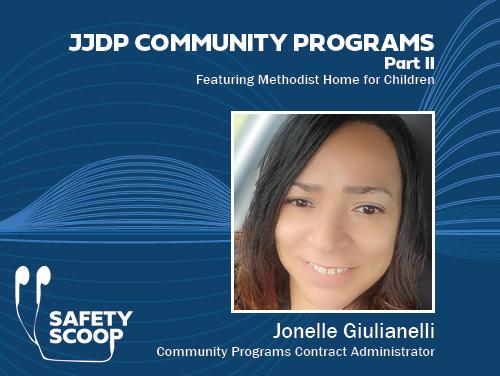
Kirsten: Hello, and welcome to the second installment of the Juvenile Community Programs podcast series. In part one, we had a discussion with Director of Juvenile Community Programs Cindy Porterfield, where she laid the groundwork on the history of the division’s involvement with community programs and what has led to successful partnerships that serve hundreds of North Carolina youth each year. So, if you haven’t listened to that one, hop on over to give part one a listen. In this episode, we get to speak with Contract Administrator Jonelle Giulianelli, who you heard speaking at the start of the episode. She'll speak more over the next half hour about her role with Community Programs and expand on what it's like managing partnerships across the state for justice-involved youth. Joining Jonelle is Ken Perry, who works for an organization mentioned several times in part one: Methodist Home for Children.
Methodist Home for Children is just one of the many service providers the Division of Juvenile Justice and Delinquency Prevention partners with to address specific, targeted populations or address at-risk populations in order to prevent youth from entering the justice system. Community Programs also assists in providing programming for youth that are already part of the juvenile justice system to pave the way for them to re-enter their communities. As Cindy stated in part one, there are more than 300 non-profits or governmental entities that help to provide programming or address specific needs of North Carolina youth and their families. There are about 600 types of services that are supported by JJDP community programs to help match kids with the right service at the right time. I really enjoyed speaking with Jonelle and Ken about meeting youth where they are with compassion, accountability and encouragement in order to assist youth with successfully engaging with their communities. Together, they share uplifting stories of strength, communities coming together and how setbacks have been transformed into successes. So, let's get to it.
Well, I am so excited to, uh, have two guests here with me on the Safety Scoop podcast for this episode, and we are going to be talking about community programs that, uh, assist justice-involved youth, members of their families and our communities within North Carolina. So, I just would like to turn it over to our guests to, uh, just kind of introduce themselves and, uh, then we will dive into how things have been over the last year or two. So, Jonelle, if you want to go first.
Jonelle: Absolutely! My name is Jonelle Giulianelli. I am with Juvenile Community Programs, and I manage the contracts for the Methodist Home for Children multi-purpose group homes, transitional living all throughout the state (um, that's eight sites total), as well as some State Fiscal Recovery Funded options for youth with independent living. Thank you for having me.
Kirsten: Thank you, and how many years have you been with the Department of Public Safety?
Jonelle: I've been with DPS for three and a half years. Originally from Pennsylvania, um, prevention and intervention work for the past 22 years. So, prevention work up in Pennsylvania and, um, moved to North Carolina about eight and a half years ago. I was formerly a JCPC-funded program coordinator and saw the value in working directly for DPS, so here I am.
Kirsten: Perfect. Thank you. One of our other guests is a member of the Methodist Home for Children. Ken, can you introduce yourself?
Ken Perry: Yes. Again, like Jonelle said, thanks for having me. I'm Ken Perry with Methodist Home for Children. I am the Vice President of Operations, and I've been with Methodist Home for Children for over 38 years, so I'm delighted to be here to share some of the great work that’s occurring with the partnership with DPS.
Kirsten: Um, well, this question is for both of you, and Jonelle, we’ll start with you. Why did you choose to go into this field of work, uh, working alongside justice-involved youth and the, um, programs that serve them and their families?
Jonelle: Really, uh, breaking the cycles. Um, we, most of us, within the service industry, especially juveniles, go into it because we see a need. Right? I saw a need, not only in my community, but within my personal life. And so, I believe we're all at risk, um, but I feel that it was important for me to show up in this way, um, for juvenile justice, particularly here in North Carolina because of the way that they address youth. Um, specific department set aside for justice-involved youth and their families, dealing with them on a continuum of services from prevention to intervention to deeper-involved intervention services. Um, I believe that that intentionality is how I wanted to, um, spend my time working with youth and families, and North Carolina was the correct place to do that for me.
Kirsten: Thank you. And Ken, what about you?
Ken: For me, I, um, my background is in sociology and criminal justice, so I always was in a helping mode, always wanted to help. I grew up in Newport News, Virginia, and a lot of folks helped me. Um, we always believed in that village, and so not only with my parents, but also the community folks. But also, one of the things that my parents instilled in me was about the importance of folks having a second chance, and I know that a lot of the young folks, um, you know, don't really become really adults until 25 when the mind is right in–in their responses to different things. So, I always think that things that happen in the youth, it takes a while for them to get to where they need to be in understanding that and making some changes in their lives, so I wanted to be part of that, be part of that effort to help them, um, change.
Kirsten: So, Jonelle, tell us a little bit about the relationship between the Division of Juvenile Justice and Delinquency Prevention and Methodist Home for Children.
Jonelle: The relationship, um, in–in my thoughts and opinion, is based on trust and mutual respect. There's a lot of accountability involved. Um, we hold ourselves accountable. We hold each other accountable. There are a ton of tough conversations that we need, um, to have at times, but I feel like it's really important to do so when you’re dealing with such a vulnerable population. Those kind of conversations are necessary. So, trust is paramount in this relationship, and it's been a long-lasting relationship, probably way before my time. Um, so the other really important thing to mention is that Methodist Home for Children makes my job really easy.
[Laughs]
They do very well with youth care, and they're very easy to trust. So, youth deserve to know that they're being intentionally cared for. DPS utilizes evidence-based practices in all of our contractual services, the Methodist Home for Children model of care being proprietary to who they are as an organization. Our youth are our future leaders, and pouring into them with intentionality is important. Um, modeling those partnerships and that collaborative spirit is also important to our mission.
Kirsten: Thank you. So, just wanted to have a bit of a conversation of why are community partnerships like this important to serving at-risk and justice-involved youth. Ken, I would love to start with the community part of that and just to get your insight on this.
Ken: Um, I think it's really important to have strong community partnerships. I know for Methodist Home for Children, we’ve been involved with juvenile justice over 30 years and providing different services, and we're kind of unique ‘cause we have a proven way of working with juveniles and helping them make change. And that's the whole purpose of why we’re in it and we do things that help them make some change and become better citizens. And a lot of times, when people think of the young folks, they tink–think of them as takers from the system. And what we try to do is build young folks that are great citizens, and they are givers back the–back towards–back in their community. And then, we also really believe that if we could stop them coming deeper into the sys–uh, system, then it’s good for the state of North Carolina. And–and being a citizen of the state of North Carolina, I want–want to do good things, um, to [unintelligible] for them.
But some specific things about Methodist Home for Children is that I think we have the know-how, how to. We have a proven record of working with juveniles and helping them make better choices in their lives. But also, I think, um, by this relationship, we really help expand some options for juveniles, for kids but also for judges. The judges are looking for ways to make the right choices for kids and families, and by partnership and what we do in our relationship with Juvenile Justice and the community, we just really give the judges some different options when they are trying to make some decisions about, um, juveniles.
Kirsten: Thank you for adding that and, um, I know so much work goes in behind the scenes of all of this. So, can you just go into a little bit what kind of services, specifically, partnerships like this with Methodist Home for Children, uh, what do they provide and roughly, um, if you can, how many kids per year does this partnership serve?
Jonelle: The cost-effective use of our state dollars is important with over $130,000 is the going rate now for a dose of programming at a Youth Development Center, what we call cost per child. Costs per child using community-based programs, um, are around $8,000, and cost per child using residential programs such as Methodist Home for Children are around $25,000. Over $130,000 for a dose of Youth Development Center, you can send a child to Harvard for that kind of money. Really important, cost-effective use of dollars is something that–that we value. We want to be good stewards of our state dollars.
Um, every year we receive allocation from the General Assembly. $29 million come through by way of the legislature for contractual services. Uh, we report annually on every penny of those dollars in our legislative report. Um, so, some of these numbers are related to that. The 22-23 cost per child, um, is what I am referring to, uh, so stay tuned, uh, for our annual legislative report, as well. Um, through those dollars and all three of those previously mentioned services (communities, contractual, JCPC-endorsed intensive intervention services), as well as residential care, uh, we serve about 1,500 youth in a fiscal year. And again, those numbers are roughly from 22-23 fiscal year.
Kirsten: The annual JJDP evaluation of intensive intervention services was submitted on March 1st, 2024. The report states that contractual and intensive intervention services have proven they are targeting the appropriate youth, providing cost-effective services and helping reduce the number of Youth Development Center commitments and detention admissions. You can find a link to view in the show notes. And just for, um, those who don't know the acronym, what is JCPC?
Jonelle: Oh, thank you for that, Kirsten. So, um, Juvenile Crime Prevention Councils are bodies of individuals appointed by the legislature to assess risks and needs of the community and also make decisions on how to allocate dollars. There's a lot of intentionality that goes into that and technical assistance from my area consultants, but the Juvenile Crime Prevention Council appoints individuals through their specific counties to decide how to handle those monies. They also are responsible for placing, uh, requests for proposals using their allocation from their county to combat ways to, um, address juvenile delinquent behaviors, um, through prevention, intervention and intensive intervention services.
Kirsten: North Carolina has a unique structure of local Juvenile Crime Prevention Councils. They serve as an arm of the County Commission Boards and are an active body and governed by general statute on what they have to do. They review the program agreements that come forth as applications for funding and serve as a conduit for education for non-profits and members of the community. To hear more details about JCPCs, please revisit part one.
Before I move on to the next question, Ken, did you have anything that you wanted to share as part of the services this partnership provides, or how many kids per year does this partnership serve?
Ken: I–I do, thank you. Methodist Home for Children, as I mentioned a little bit earlier, about being in this, our relationship kind of started over 30 years ago, and we operate 15 programs in partnership with Juvenile Justice. And–and based on our data, uh, fiscal year July 1 to June the 30th, June 30th of 2023, we’ve served over 580 juveniles in, uh, in the different programs. And those programs vary from the Crisis and Assessment Center, the multipurpose homes, the Transitional Living Program and then the JCPC programs. We have a vocational education job program, in-home service program to keep the kids in their home and provide services with them and their families and then even with therapeutic foster care, so all of those programs, again, give court counselors and judges expanded options they can use to kind of meet the kids where they are, the families where they are and make sure we have the right services for the right kid at the right time. So, that's really important. That's what makes, uh, North Carolina’s array of services and what we do so important. And for multiple years, um, we've seen the crime rate for juveniles go down because of having so many options for judges, so they can match them with the right, um, service, um, they might need.
Kirsten: What are the benefits of youth participation in these types of programs as an alternative to deeper involvement in the juvenile justice system? And Ken, we'll start with you.
Ken: I think one of the most important things for, um, because of these programs, one, is that I think they're less expensive than, um, really deeper end with the kids. At one point, the state of North Carolina had over 1,400 young folks in the Youth Development Center which is the high-cost end of the–of the service. And by having some options, uh, for them that's less expensive, one, we can deal with some of those early issues that we–or signs that we see that they might be to get in trouble. We can deal with those early on, and that's one of the reason why the Juvenile Crime and Prevention Council was started so that we can do some prevention service early on. So, that's one of the things. It’s less expensive that way.
We just, we also know that by having them throughout the whole state, we also can have the juveniles dealing with stuff closer to home so their families can be involved with them. But the biggest impact, I think, is that, one, having multiple options for them and also with a focus on for the young folks to make some behavior change in their lives. So, being real targeted or specific about what your purpose is and that purpose is for them to make some behavior changes, for them to learn some new things that they might need to do. One of the ways that we do that is using the what we call the Teacher-Family Model, which is a specific way that's evidence-based, a model of how best to deal with, um, young folks in programs.
And one of the things that the state of North Carolina did with the DPS and Juvenile Justice is they did some research on what works best for young folks, uh, the juveniles. How can they bring about some change? And one of the things they talked about was that the cognitive behavior approach that you have with them, so they could not only hear and see but also, they get to practice some of the things they need to do and to use some of those skills and learn some new ways of dealing with anger or aggression and even learning educationally. So, we love that they see the benefit of partnering with us, but also a lot of the kids and families have really benefit from being in [unintelligible] the JCPC program that we talked about earlier or any of the Transitional Living Program or a multi-purpose home or going for assessments, so they can have, again, be in the right–receive the right service at the right time.
Kirsten: And Jonelle, anything to add?
Jonelle: Yes, the benefit, um, in my thoughts were that youth are less likely to be involved in the adult system if they find positive ways to belong while they're in the midst of their behaviors. Right? Who are we can be defined, some might say, as how we show up to difficult situations. Um, youth setbacks, when addressed properly, can result in successes, and youth deserve to see themselves being successful.
Kirsten: I love that point and just hearing about all the support that is available for, uh, justice-involved and–and youth across of North Carolina. That's really encouraging and, uh, hopeful. So, without revealing the personal details of any particular youth, I–I’d love to hear what are some of the greatest success stories that you have seen emerge from this partnership. Jonelle, I'd like to start with you on this one.
Jonelle: Okay. Don’t mind me if I, um, read from–a little bit from the correspondence that was given to us. We have a young man that was committed to a YDC, um, comes out of the YDC and is at one of our Transitional Living Programs. So, that's part of their post-release supervision is connecting with a Transitional Living Program. Uh, youth in transitional living are 16 and up. They go through an interview process before admission to be deemed ready to be in the community, to–to work, to volunteer first, um, to create a resumé, to have a bank account. Youth within transitional living, all youth within our programs, have their own individualized service plans, uh, but within Transitional Living, Next track is–is slightly more advanced. Uh, so, they meet youth where they're at. Uh, Methodist Home for Children gauges what area of education first they need to grow on. So, this young man will be leaving the Transitional Living Center in June, um, and attending college. While he is in Transitional Living care, he was, um, awarded the opportunity to belong to a mentoring program, and he's–he's just doing well. He's being shown that, when addressed properly, his setbacks can become success.
Kirsten: What a wonderful story. Thank you so much for sharing. Ken, uh, anything you'd like to add?
Ken: Yes. One of the, um, one of the most exciting things about our program is that it is to see the young folks kind of progress and kind of internalize some of the things they learn from the program and then actually, uh, apply it. One of the things that we have with our model is that we create an environment (we call it a therapeutic environment) where they can actually learn different things. And then, it's a therapeutic environment, but it also is value-based, and one of the things that we teach the young folks when they come in the program is six values, and one of them is around compassion. How do you have compassion with someone? Because what we know from the research is we're talking about criminogenic behavior, and that means something like if a young person in a situation, they do something, they have no remorse for doing it, and part of breaking that cycle is for them to have some remorse and then kind of recognize that.
And one of the things when we travel down to the program, we always observe the interaction with the kids, with each other as well as with staff. And one of the things when we was there, um, at one of the programs, we saw them, the kids, was playing basketball, and one of the young, uh, the guy on the other team got hurt. And the players on the other team stopped and waited and made sure that young man was okay, and when you asked him that question, “Why did that occur?” And–and he clearly said that it was more important for us to check on him to make sure he's okay than for us to win the game. And that's what you really want to have happen.
And that's when you know it's kind of working because they are able to demonstrate and use, uh, compassion. So, that was one of the biggest success stories, just to view that young person who previously would not have cared. It would be more important to keep going on with the game, but he actually stopped so he could see that another human being was being hurt. So, that's what we know that the connection with teaching them a new skill and him being able to extend that around having some compassion was really important for him. And that's what I was talking about earlier, about part of what the program does. It helps the young folks make some changes, and we were able to see that on display. Not that someone initiated that, whatever, that day. That's been internalized to him at that point.
Kirsten: Well, you guys have made it to the end.
[Laughs]
Um, I hope you're feeling good. Any final thoughts or anything that we missed that you guys kind of want to go over? Uh, Jonelle, you're shaking your head yes, so I'll let you have the floor first.
[Laughs]
Jonelle: Absolutely, thank you for that opportunity, first of all, to just to be present. Our youth deserve us to shout their successes from the rooftops. I am truly proud of the partnership that we have with Methodist Home for Children and all the ways that we are able to impact, um, and I also would like to thank, um, Secretary Buffalo; Deputy Secretary Lassiter; my director, Cindy Porterfield, um, Director of Community Programs; my supervisor, Demetrius Vic, uh, for nurturing these partnerships before my time in order to make all of this happen. If these partnerships result in the ability for youth to feel more empowered in life and to move forward as our future leaders, then, um, win for everyone. So, thank you for the opportunity.
Ken: And I would–I’d like to share, uh, too, that, you know, I had mentioned a little bit earlier, uh, that at one point in the state of North Carolina there was over 1,400 young folks in the Youth Development Center, called the YDC, and one of those things that shifted was the legislators. We didn't get a whole lot of additional dollars, but they did provide some additional dollars, but they did allow for the dollars that we were getting to reuse them, and they moved to more of the community-based programming. So, you can catch the kids early on and doing our [unintelligible], putting everybody in the top end where it costs a lot. So, instead of 1,400 young folks in the Youth Development Center, today it’s probably less than 400, so you can see that’s 1,000 slots that… And all of that cost now was shifted to the community programming which, again, gave the–that gives the judges a lot more options for them, as well as the local folks knowing what's best for them and how to deal with the young folks in their particular community. So, um, that's been a huge change, and–and that's what can allow for the state of North Carolina to have some sustained excellence and a lot of kids being treated well and getting the services that they need, particular early on.
Jonelle: Thank you, Ken, for mentioning that, um, and I’ll–I'll place more context around. Um, 1978 Community Based Alternatives, um, began through legislature with a million-dollar appropriation. One-million-dollar appropriation.
[Laughs]
Um, so, we've grown that, and since, uh, December 2019, since Raise the Age has been enacted, we are certainly, um, working alongside a–a more complex youth. And, um, so we definitely have tried to be mindful with how we use our appropriations, um, in these strong partnerships.
Conclusion
Kirsten: Fantastic work. Well, thank you guys for joining me, um, and I’m real–I'm really excited to share this with everyone. So, appreciate it.
[Music]
Kirsten: Appreciate the time.
Ken: Thank you.
Jonelle: Really appreciate you, thank you for your partnership.
Ken: No–no problem. You all take care.
[Music]
Kirsten: This is the Safety Scoop, a podcast written, produced and edited by the NCDPS communications team. The mission of the North Carolina Department of Public Safety is to safeguard and preserve the lives and property of the people of North Carolina through preparation, prevention and protection with integrity and honor. Follow the department on social media for a closer look at ongoing initiatives and resources. We’re on Facebook, X and Instagram at NC Public Safety. If you enjoyed today's episode, be sure to subscribe to the Safety Scoop on your favorite podcast app. Special thanks to Communication Officer Matthew Debnam, who provided information used in this episode. This is the final episode of a two-part series on JJDP community programs. I'm your host, Kirsten Barber. Thanks for listening.
[Music]