
Podcasting Program Empowers Youth to Share Their Stories - Safety Scoop Transcript
Introduction
[Music]
Kirsten Barber: You're listening to the NCDPS Safety Scoop, a podcast that dives into the stories of the people, programs and resources within the North Carolina Department of Public Safety. Each episode, we’ll give you the scoop from department personnel on how NCDPS enhances the safety of the people of North Carolina.
[Music]
Season 3 Episode 9
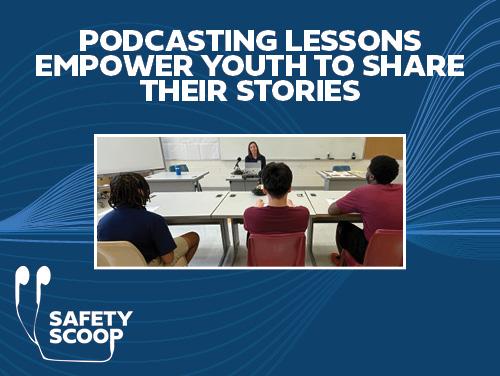
Kirsten: For this episode of the Safety Scoop, I traveled to Cabarrus Juvenile Detention Center to speak with three youth in secure custody who were part of new programming that was rolled out over the summer. These three individuals were enrolled with nine of their peers in an eight-week digital media class. Since I rarely get to talk shop at work, I had to get them on the podcast to learn from them. No, they hadn't heard of the Safety Scoop, but I'm so thankful they agreed to sit down and chat with me.
Throughout this episode, you'll also hear from Cabarrus Youth Development Center and Juvenile Detention Center Director Peter Brown as well as Regional Principal Dr. Monica Curry. These JJDP staff members will provide context to the new partnership between Beatties Ford Vocational Trade Center and the facility and why they felt it was important to expand course offerings for the juveniles in their care. Let's start out by hearing from Director Brown and Dr. Curry on what led to this new curriculum in the facility.
Dir. Peter Brown: Well, what I’ll say is that, um, I’ve got a great partner in–in Dr. Curry, and she understood and, um, was very receptive to my vision which was I wanted to increase opportunities for various kinds of programming in detention. But I wanted them to be engaged in, um, in some activity, and I wanted it to be, you know, uh, value-added. Because when a juvenile comes to a YDC or JDC, my feeling is this, is–is that, you know, you want to make this a value-added experience; in other words, you want to leave here with more than you came. This was an opportunity, a vehicle, to–to do that, to create some programming.
And so, I did reach out to, um, Beatties Ford Vocational Center in Charlotte and, um, ask them to call me and just to discuss what kinds of opportunities they would have available. And I also had to think about staffing. I had to think about space. I had to think about safety and security. There's a lot of different things that are out there, but you’re not necessarily–you're not necessarily, um, positioned to do everything. So then, I turned it over to Dr. Curry, and then Dr. Curry began to have her own conversations with, um, Beatties Ford Vocational. So, that's when we–that's when she identified the podcast thing. We wanted to make it a summer session, a complete summer session, so we sort of dove-tailed it in with what we would be doing here normally in the YDC/JDC during the summertime, as well. And so how did you end up on the–with the podcast?
Dr. Monica Curry: Well, uh, the Beatties Ford Road Vocational Center, um, has a lot of different programs. They offer a lot of skilled-trades programming throughout the year. So, we–we took the summer tech program, which consisted of podcasting, and they also added, uh, record producing. So, they said our students, if they went through this eight-week program, they would be certified in podcasting and record producing. So, we were able to identify a total of 12 students, and so the 12 students participated in this eight-week program in which the instructors, uh, from Beatties Ford Road came in twice a week. They provided the, um, instruction, like from 12:00 to 4:00 p.m. on those days.
Dir. Brown: Right, and what I would add, just to piggyback on what Dr. Curry is saying, is–is that—and this is the power of partnership and collaboration—because we’ve worked together for many years and we share the same vision, we just want these kids to be exposed to the most that they can be exposed to. And like I said, everything is being value-added, and so what I see my role as specifically… Hers is specialized. Hers is to implement and to craft it. I see my role in terms of support, as being able to, uh, identify and remove any barriers that's going to ah–not allow or make it more difficult for her to do what she's trying to do.
Because when we implement these programs it’s–it's going to look different here. Okay? It may look different here, but that doesn't mean that it’s–it can't be–we can't have the same value, that the kids can't get the same opportunities. It's just that in the construct of it may be a little different in a confined facility, but it can happen, and that's what we do every day. And that's like what, as I said, this is the–the power of our partnership and–and collaboration and mutual respect for each other. ‘Cause she–she’s the best.
Kirsten: Dr. Curry, as a principal, what is the–the value of these partnerships with these trade programs, and why is it important to think outside the box? You're–you’re talking about your vision, so why is it important to think outside the box, um, so that students have the ability to learn these skill sets that, um, don't always come in the classroom or aren’t always taught in the classroom?
Dr. Curry: It’s very, very important to think outside of the box, and–and that's something that when I come to work every day, I'm always thinking, “What can we do on a daily basis to help promote student success beyond the classroom here, beyond what we can provide here?” I'm always thinking ahead. And so, what's been very successful here at–on this campus, this past summer, Director Brown allowed me to be very, very creative and think outside of the box in terms of our summer programming. And so, this past summer, we were able to do, like, a flipped campus, um, with the YDC in the mornings, JDC in the afternoons. And my primary focus was those students that were 16 years and older were going to, uh, earn a certification in something, some type of vocational program.
Kirsten: Now the conversation shifts over to the students: C, K and T. Please join us as we discuss podcasting, music and other subjects. We talk a lot about the Beatties Ford course they enrolled in, which they shared gave them something to look forward to every week and apply themselves. The class pushed them out of their comfort zone at times and helped them hone skills they may not have even known they had. All right, we're about to start. Everyone feeling good?
C: Yeah.
Kirsten: All right, well, thank you guys. I'm really excited to have you on the podcast, and I just want to hear a little bit about the program that you guys have been a part of, uh, about podcasting. So, let's talk about your class. By a show of hands, who enjoys the class? Okay, we've got three hands raised.
K: Yeah.
Kirsten: So, T, tell me what you enjoyed most about the class.
T: Well, what I enjoyed most about the class is that we got to use cameras. We learned how to make beats and work on books. Well, I actually started, um, working on the book, it’s a little [unintelligible] book, um, and the teacher that was teaching the class, he showed me little things, little websites to go on to, you know, publish my book after I finish, or he showed me other, um, websites to help me edit.
Kirsten: Very nice! All right, C, tell me about the class.
C: I liked it ‘cause, really, before I started the class, I ain't really have nothing that I was passionate about, nothing that I really liked to do. And so, when I started the class, the teacher, he showed us how to make, produce and, uh, edit beats, and that's what I real–I liked most about the–the program. ‘Cause like I said, I ain't have nothing that I was passionate about, but now I feel like that's something I–I could end up doing. Yeah.
Kirsten: So, kind of the post-production side.
C: Yeah.
Kirsten: Editing and… Interesting. And K, what did you enjoy most?
K: I enjoyed the class because it gave us something to look forward to all year and, like, keep our mind, like, to not get in trouble and stuff ‘cause we got to look forward to that every Tuesday and Thursday, and for most of us, it's already stuff that we want to do. And the, um, teacher, he was just, like, showing us, helping us, like, multiple ways to do what we already wanted to do and stuff. So, I, that's why I liked the class.
Kirsten: Very cool! So, K, we’re going to stay on you. Tell me about some of the projects that you did in the class.
K: He showed us how to make beats. Like, we did a project on creating our own book and, like, going on, uh, AI to come up with book covers and stuff and ChatGPT to, like, basically summarize our story and stuff, and it was cool.
T: Yeah.
Kirsten: Very cool. Any of the other projects that, uh, T or C, you guys want to talk about?
T: Yeah, I really liked, um, the cameras. He showed me how to use cameras. And why I say that is because, before I got into, uh, the situation I'm in now, when I was on the outside, I actually wanted to start my own YouTube channel. And, um, that's why I like the fact that he showed me how to use it, so I'm going to get out of here, go to go get me a camera and just start. You know, ‘cause I know what to do now, how to use cameras and stuff like that.
Kirsten: Dr. Curry gives her perspective.
Dr. Curry: The first week, when I walked in, they were doing podcasts, and they were doing, um, camera work, everything. I mean, it was just… It was phenomenal. And so, um, they–they learned all of the operations of, um, using a camera, doing the podcasting, um, and then they actually started making music. And, um, because they–they love music and… But they–they ler–also learned the ins and outs of the, uh, music industry and record producing industry. So, that was something great that the–the teacher was able to inform them and educate them on. You know, it's good to–to know how to rap and make a song, but do you know what all is involved in record producing and what you need to know to be successful?
And so, that–that took place, um, during the summer, and then at the end, I was–I was fortunate enough to–to see that they had added… The, um, the Vocational Center had added another component of graphic design, um, visual arts, and so the students all were able to learn how to create their own visual products like, um, cartoon characters, and along with that was a story. So, they all had to develop their own storyline that matched their pictures. And so, I thought that was, um, extremely, uh, successful to have all three of those components, uh, being taught to the students this summer.
Kirsten: C, we'll start with you this time. What kind of podcast—or if there's a YouTube channel or anything else—that you enjoy listening to or watching?
C: I like listening to the–and watching–the, uh, Joe Rogan podcast and as well as the Mike Tyson podcast. Yeah, ‘cause I really learned a lot off–off there, like, what they was talking about and stuff on the podcast.
Kirsten: K, what about you?
K: I'm more into podcasts like the Joe Budden, the Raw Room, ‘cause it, like, tells us about every–everyday life and stuff. Yeah, so, things that we got to know in the–in this world.
Kirsten: So, T, you were agreeing with him. Is there anything else that–that you enjoy?
T: I, actually, uh, the podcast that I listen to on the radio, the Amanda Shield show; I actually enjoy her show. You know, she let me know everything.
Kirsten: So, do you guys enjoy listening to one person talk or kind of an interview? So, I think the–the Joe Rogan one like you brought up is more of an interview-based style, C.
C: Yeah, I like those because I get different opinions on different situations, and it's not just one biased opinion that somebody has. So, I like different opinions.
Kirsten: T and K, what do you guys think about that?
K: I like the um, like, interview-type podcasts. I like communicating with others, so, like, I can relate to it.
T: I agree with him.
Kirsten: So, K, you just brought up communicating with people. Do you feel that being part of this class has helped you build upon your communication skills?
K: Yeah, most definitely. My communication skills, it used to be bad but, like, I ain't really know how to, like, hold a civilized conversation. But, like, being in his podcast and, like, being around them and working towards that, even though that wasn't the main goal, you still working towards that when I ain't not knowing it.
Kirsten: T, what about you? Any skills that you feel you’ve built upon?
T: Honestly, uh, that’s something I'm still working on how to, you know, have a good conversation with others. Always, I was the quiet person in class, you know, so I ain't used to talk a lot but…
Kirsten: But listening skills are also important. So, even if you're quiet, having the ability to–to listen and to gain information, I think is still a very valuable skill to have.
T: Yeah, I'm that type of person. You know, just sit back and listen.
Kirsten: Definitely. C, what about you?
C: Uh, to be honest, I'm a real, I would say “shy.” Like, I like communicating, but it's hard for me to communicate, in a way. I'm like T. I’m the real laidback, quiet type of person. I like listening more than I like talking ‘cause you, to be honest, in my opinion, you gain more off of listening than talking.
Kirsten: Director Brown shares his thoughts.
Dir. Brown: They’re working together, and often in these settings they’re working with juveniles outside of their pod. Um, they're meeting different kids, um, and it's a setting where they–they have to have shown and demonstrated the responsibility to be there. So, it's something that creates the guardrail, that creates the, um, yeah, th-the guardrail and–and the parameters that make an–an–an, um, an incentive that makes them want to continue. And–and that translates into how they–how they're doing on the unit, um, how they do in the afterschool classes, so I definitely have seen that growth. We see that all the time. Yeah, of course, it's going to be different for every kid, but, um, it's movement, and that's what it's all about: moving in the right direction.
Kirsten: Okay C, since you said sometimes it’s hard to open up and talk to other people, what do you find hard about that? I know that's a hard question.
C: Yeah, it really is, but, um…
K: Are you shy?
C: Yeah, to me, it's just being shy. Like, it's–it's hard for me to communicate and open up to people, and I don't know why. It just is. I've always had that problem. But yeah, to me, it's just being shy.
T: About the same; same with me.
Kirsten: If you guys want to talk amongst each other, do you feel like being an introvert or being shy has held you back from certain things in life, from maybe taking risks or from making friends or something like that?
C: [Unintelligible] …you know, and that's why I'm trying to work on it because you never know, with you being shy. Just give something a shot, you know, on something different, you know, make new friends, jobs, you know.
T: Yeah, to me, I mean, yeah, it’s held me back a little bit, but, um, as of friends, I feel like that just comes naturally to me ‘cause I'm a–I’m a real likable person, so a lot of people, they just, um,like they–it just comes to me, in a way.
K: Some people, yeah.
T: Yeah.
K: Quiet people.
T: Yeah. Yeah, in my opinion, I like laidback people, like–like me, that just listen instead of talking.
Kirsten: Yes. Well, thank you guys for your honesty with answering that. I know it wasn't an–an easy question. Okay, so let's pretend for just a minute: If you were to have a dream podcast that is already out there, and you're managing it, what would the theme of that podcast be?
T: It'd be a lot of different things. I–I want to talk about what people want to hear, so, like, things that's going on in life now or sports, you know, good food, bad food, stuff like that.
Kirsten: Kind of a current events-type podcast, okay. Would you have guests on, or would it just be you talking to your listeners?
T: I picture it I’d do guests, and then it'll be like one day, just me by myself, just the things I have to talk about, you know. I’d have guests on the show just to hear what they got to say about things, and the guests would really be, like, my listeners, you know, that's going to come out and give me their opinion on things, you know, stuff like that.
Kirsten: Okay, so that would be a great way to build, uh, an audience base is to get audience participation in it! Okay, anyone else have an idea? K?
K: Yeah, I’ll say my podcast would be like, I’ll have, um, some guests sometimes, but most of my episodes, I’ll probably be by myself. And I'll just, like, it's like a lot of crazy stuff out there going in the world every day, and I'll just give my opinion on it on my podcast and stuff.
Kirsten: Opinion-based commentary. Alright, C?
C: My podcast, it would be like the Joe Rogan podcast. It would be, um, based on conspiracy theories. That's what I like. And, um, I feel like most likely I would have guests ‘cause I don't see myself talking on the podcast by myself. I feel like I would be talking to myself. You know what I’m saying? So, by having other people, guests on the show, it would, uh, keep the conversation going. ‘Cause I feel like if it was by myself, I feel like I would run out of things to talk about.
Kirsten: So, I feel like you guys may have thought a little bit about this. So then, for those who would have guests, C and T, who would your dream guest be on your podcast?
[Giggling]
Kirsten: I know, another big question.
T: I watch sports. I watch sports. I like football and basketball, so I’d do my favorite players. Football, I’d do Tyree and, um, Lamar Jackson. Uh, basketball, I want Kyrie and Kevin Durant.
C: Uh, me, I feel like it’d most likely be Mike Tyson because he’s gots a lot of wisdom. He's a smart man, so I–I feel like, you feel me, we'll have a lot of stuff to talk about and stuff that I relate to.
Kirsten: For those listening, we’ve got some names thrown out there. Let's–let's put them on speed dial.
[Teens laugh]
Kirsten: Let's get them on our–on our guys’ podcasts. We've talked a little bit about what's hard with podcasting, right? You know, putting yourself out there. Um, if you're–if you're shy, having to go out and speak to people. Um, but what do you think is–is fun about podcasting or doing something like radio or voice acting?
C: The recording, you know, being published. Listeners listening. You know, you never know who listening. But I'll say the most fun part to me is, like, editing. Like, you can really edit however you want.
T: Yeah, to me, I'm a camera-shy person, so, uh, yeah, I feel like the editing w-will most likely, uh, fit me, to be honest, editing. So, when we did that podcast with the, uh, Beatties Ford people, that's what I was mostly doing was editing and making the beats, and then, yeah, like, editing and recording and stuff. So, that's–that's what I like to do.
Kirsten: And a lot of the big podcasts have a team, so you don't have to be the person that's in front of the microphone. You can definitely be…
T: Yeah.
Kirsten: Yeah. So, for some of your projects, you guys were doing the behind-the-scenes work? Okay, so can you take me through maybe one of the things that–that you did in the–in the class kind of from start to finish, T?
T: One thing: w-we was making music. That's what we enjoyed the most. You know, we have a load of rappers in here, so while they rapping, I’d be recording. Um, as many of you know, after the music done, we had make a–a, like, a little music video, you know. That be dope. I like that. Really, the main thing we was doing was making and producing music. So, um, when we would make the music, we would make the video, and after we would go back and edit whatever was, um, like, was not fitting in. If somebody didn't want a beat and then, yeah, we was doing that, editing. And I was, like I said, I was really the one editing and stuff. So, that's what I like to do.
C: I’ll say, when we were learning about, like, different camera lenses, how by zooming in on the camera and stuff like that. We learned that, like, what you making the beats and stuff, like, what you–you feel like we used to doing, like, where you tap ‘em and, like, add base to it. Like, one little tap could change the whole beat and stuff like that. It was just like [unintelligible] stuff.
T: It was dope.
Kirsten: So, you–you guys have your–the–the surveys that you did at the end of the class in front of you, and I think everybody said it was an excellent experience. So, if there was someone out there wanting to learn more about everything that you guys learned in the class, what advice would you give to them? T?
T: Don’t be shy, you know. Ask questions. Talk to people. You know, just give it a shot.
C: Yeah, I’ll say the same thing. Most definitely, don't be shy, and ask a lot of questions. Because when I started the program, I was shy. I wasn't really talking too much, but as, like, we started going forward in the program, like, I kind of started opening up, asking questions, and, yeah, I learned how to do a lot of stuff in that program. So, the more you do it, the more you'll like it. Yeah.
K: Yeah, I–I really, basically, I’ll say the same thing.
Kirsten: Here's Dr. Curry again.
Dr. Curry: So, I think it was a worthwhile experience, uh, because since then, several of the students who participated in the program have been released and have gone back to their communities, and they have–they have reached out to Beatties Ford Road and to try to enroll in some of their programs. So, I think our vision worked out, you know, um, what we–we achieved, what we wanted to achieve and accomplish. And I just–I think this is a great partnership that we have with them.
Just yesterday, I was talking with the executive director. We have a student that’s about to, uh, be released at the end of this year that’s going back to Charlotte Meck. He's going to be going back with his high school diploma, and he's interested in one of the skilled trades, uh, programs. And I'm like, “Is there any way that we can go ahead and start the application process with him? See what we can get in terms of funding and, uh, have this person, uh, join your–your group?” And–and he said, “Absolutely.” So, just opening doors for other students. And I tell the students all the time, when they participate in these types of projects, try to do your best. Be successful because you're opening doors for other people, other students, your other–your classmates and other people that are coming through the YDC and the JDC to be able to take advantage of.
Kirsten: I appreciate everyone who participated in this episode of the Safety Scoop, and special thanks to C, K and T for their openness to sharing their experience and stepping out of their comfort zones. We look forward to seeing you pursue your passions and to hearing your voices on one of many streaming services.
[Pause]
Conclusion
[Music]
Kirsten: This is the Safety Scoop, a podcast written, produced and edited by the NCDPS communications team. The mission of the North Carolina Department of Public Safety is to safeguard and preserve the lives and property of the people of North Carolina through preparation, prevention and protection with integrity and honor. Follow the department on social media for a closer look at ongoing initiatives and resources. We’re on Facebook, X and Instagram at NC Public Safety. If you enjoyed today's episode, be sure to subscribe to the Safety Scoop on your favorite podcast app. Special thanks to Communication Officer Matthew Debnam who provided information used in this episode. I'm your host, Kirsten Barber. Thanks for listening.
[Music]