
Providing Mental Health Support for Public Safety Professionals - Safety Scoop Transcript
Introduction
Kirsten: Please note that this episode's topic includes conversations where suicide, self-harm, depression and other subjects related to mental health and mental health treatment are mentioned or alluded to. Some content may be triggering for listeners. Due to the theme of this episode, it is recommended for adult listeners only.
[Pause]
May is Mental Health Awareness Month. Since 1949, Mental Health Awareness Month has been a cornerstone of addressing the challenges faced by millions of Americans living with mental health conditions. The North Carolina Department of Public Safety understands that personnel across the state, whether sworn or civilian, may face certain situations at work that can impact their mental health, their physical health or their relationships with family and friends. Help is available for those who need it, not only within the department, but for all public safety professionals and first responders across the state.
The Responder Assistance Initiative, or RAI, meets the needs of North Carolinians by providing a sustainable continuum of wellness resources that connects North Carolina first responders to an integrated safety net of peer teams and trusted professionals. I can't think of a better topic for May. Housed under the Division of Emergency Management, RAI services are confidential and provided as a no-cost benefit to NCDPS sworn and non-sworn employees and their families, as well as first responder agencies across the state.
In today's episode, I'm joined by two mental health professionals. Together, they outline the myriad of services available for those who need it and have taken the first step in asking for help. Though our conversation is just under 30 minutes, I was very moved by the insight they shared and at some times lost for words, as you may notice. I hope you enjoy this impactful conversation. Please listen to the end to hear resources, encouragement and contact information, and as Jodi says multiple times in the episode, if you need assistance or are curious about the services RAI provides, it all starts with a conversation and a willingness to ask for help.
[Music]
Kirsten: You're listening to the NCDPS Safety Scoop, a podcast that dives into the stories of the people, programs and resources within the North Carolina Department of Public Safety. Each episode, we’ll give you the scoop from department personnel on how NCDPS enhances the safety of the people of North Carolina.
[Music]
Season 3 Episode 5
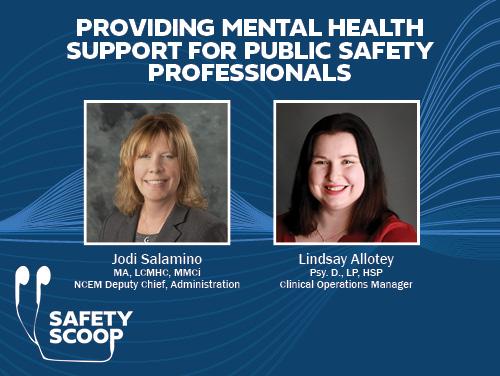
Kirsten: So, welcome back to the Safety Scoop, really excited to introduce two new guests to the podcast today who are with the Responder Assistance Initiative. So, we have Jodi and Lindsay, and I would just like to open it up to you guys to introduce yourselves. Jodi, we’ll start with you.
Jodi Salamino: Hi, everyone! This is Jody Salamino. I am the deputy chief of administration for North Carolina Emergency Management and also a licensed clinical mental health counselor in North Carolina. My career in public safety started in the ‘90s when I worked for the Michigan Department of Corrections before returning to get my education in counseling and eventually my license. I've spent the last 30 years in support of law enforcement, first responders, military, in both clinical and leadership roles, and the last four years with NCDPS, uh, Responder Assistance Initiative. I've had the great honor of working alongside some amazing people over the last four years as a licensed mental health professional team lead and most recently, uh, their deputy director, serving under Director Chad Jordan. It's been an incredible opportunity, and I'm looking forward to how we use this time to talk more about those services.
Kirsten: Thank you. And Lindsay?
Lindsay Allotey: I am Dr. Lindsay Allotey. I am a licensed clinical psychologist, and I am the clinical operations manager for the Responder Assistance Initiative. I have been with the Responder Assistance Initiative since the start of the program back in April of 2020, and it has been an amazing experience that I've been so excited to be a part of, and I'm happy to talk more about it today.
Kirsten: All right, thanks you guys so much for joining me on the podcast. So, I would just like to start out, um, at the beginning with the origins of the Responder Assistance Initiative. Can you take us through how the program got to where it is today? Um, Jodi, can we start off with you?
Jodi: So, Responder Assistance Initiative was actually rolled out under a–a grant program, and the North Carolina Department of Public Safety knew a long time ago that a strategy was needed to really provide a comprehensive integrated behavioral health support system to the DPS employees. And at that time, under a grant program, it was a federal grant program that began in 2019 that was for two years, managed by the Governor's Crime Commission. Those state funds provided the initial funding to develop and implement what at that time was the Integrated Behavioral Health Services Program. That was designed as, a–an opportunity to integrate and provide good access to medical and non-medical behavioral health support, um, to all DPS staff members and their families. There was a really strong focus on serving those who work in a high-stress environment, um, such as, you know, Emergency Management, law enforcement and the exposure that they had to threats of violence in the workplace. And so, that program stood up with 20 full-time employees, and they built the program to meet that particular need.
Lindsay: So, the initial intention of the program was really to provide mental health and behavioral health support to those who are faced with high-stress, work-related jobs and so really focusing on the State Highway Patrol; Juvenile Justice counselors; Alcohol Law Enforcement officials; uh, the Department of Corrections at that time, as well, was included under DPS, so they were part of our services; as well as State Capitol Police. And it was a really interesting time because right as we came on board, um, unfortunately, the world kind of shut down due to COVID. We had some initial challenges at that time both getting our information out there and letting people have an awareness that we weren't just here for COVID purposes, uh, to provide additional support during that time, but that this was going to be a long-standing grant program that was going to be an additional benefit to their employment.
And so, over the course of years, um, we were able to stand up the program, really get our message out there, really speak to other individuals and really start having people come to us for services, for mental health treatment and trainings, for how to deal with stressors on the job, how to help develop coping skills. How do you navigate difficult things both in the workplace and in your home so that you can have better work-life balances? And we were doing great, and then we got to the point when the legislature had decided that the Department of Adult Corrections was going to separate and become its own entity again outside of the Department of Public Safety. And so, at that time, just like with everybody else, there was a lot of uncertainty and a lot of discussions around what was going to happen with the program. Where exactly were we going to land?
Once the decision had then been made that when the Department of Adult Corrections separated, that they would be standing up their own program and we would be moving under Emergency Management. So, once we moved under Emergency Management, our focus really shifted to first responders and those who are still remaining under the umbrella of the Department of Public Safety. Our title at that time for Integrated Behavioral Health Services didn't really reflect our mission or goals and what our new direction for the program was going to be. And so, we underwent a rebranding experience, um, and came out and are now known as the Responder Assistance Initiative, which is really capturing what our goals are, who–who we’re serving and what we're trying to do for that population.
Jodi: Yeah, and we do actually still provide a significant amount of support to the SBI as well. And then of course, as Lindsay was saying, broadening out our scope to provide resiliency coaching, peer training and some other services to state, local and municipal law enforcement, first responder and telecommunicator agencies.
Kirsten: Thank you both for going through that. I think you painted a really great picture of how this service has evolved over time and how it's working right now under the Department of Public Safety. So, just wanted to learn a little bit more. Who exactly does the Responder Assistance Initiative serve?
Jodi: Currently, we’re serving all DPS employees and their immediate family members. As we are expanding our services to the rest of the state, as I mentioned earlier, to be able to include local, municipal and other state law enforcement agencies (firefighters, EMS, first responders and telecommunicators), we’re doing a graduated extension of our services. And so, every employee under Public Safety is eligible. Their immediate family members are eligible for all of our services, um, and then we are rolling out some limited opportunities to those in the community. So, for example, it might be peer training, it might be critical incident support and maybe some individual counseling, and of course we do a lot of wellness coordination and training as well.
Kirsten: If we can, I'd like to kind of dive a little deeper into these services like peer support, individual counseling and these other services. Lindsay, would you be able to specify what each of those entail?
Lindsay: Yeah, absolutely. So, I think the best way to look at it is a continuum of services. You know, everybody is at different points in their life. Everybody's dealing with different stressors, and when you're dealing with different stressors and navigating different things, the level of support or assistance that you need is–is going to vary. Sometimes people need a lot of support, and sometimes people just need an ear to listen to and help them figure out what’s the best course of action. And so, our services really represent that whole continuum of care.
So, if you think of it from that perspective, we really start with our peer support. And so, our peers are first responders who have been a first responder. They’re retired or they're currently still, um, active in service, and they just know what it's like to go through it. And they’re professionally trained. They have a lot of skillsets to be able to listen to the individual and really help them identify, like, “Hey, this is normal, you know? You're not alone. You're not the first person to go through this. You know, here’s what’s helped others. Here's what's helped me through this experience.” Or sometimes what we really get that's helpful is sometimes they'll say, “Hey, you seem to really be struggling right now. I know a clinician. I know somebody who can really help you with this who has a different set of skills, and we've worked with them.” And they'll do what we usually call a warm handoff where they help introduce that individual to one of our clinicians on the team to get them connected for services.
Uh, the other thing that our peers do is they're really working hard to build out peer teams with other departments. Local municipalities, other agencies like local fire departments or police departments are really trying to build up peer support teams and wellness programs, and so they're really working with those individuals to help them start that up. And they also do a lot of training, helping them learn, you know, “Here’s the gold standard of how you do these interactions. Here’s the best practice for how you can incorporate these things into your workplace and your teams and how you interact with each other. And how do you address these issues that come up?”
Additionally, they're a really big hand in what we call, um, schisms or crisis debriefs, and that's usually after a critical incident. They'll come in, and they'll provide support, and they’ll assist, uh, leadership and command with setting up further debriefs as needed to allow the–those who have been involved to come process the situation, identify what they may experience or what they may not experience moving forward and as well as resources that are available to them. Jodi, is there anything you'd like to add on the peers?
Jodi: Um, only that they’re–they’re such an integral part of the work that we do. Oftentimes they're the biggest conduit to help-seeking behavior in this population. As we're trying to break down stigma and some of the challenges associated with people seeking help, our peers have been an exceptional partner in being able to–to do that because they are people that walk and talk the same way. They've been in those situations, they've experienced similar critical incidents, they've been in those lines of work before, and they can relate. And so, oftentimes they are the front line, again, to breaking down that barrier of help-seeking behavior.
Lindsay: Very well put, fully agree.
[Laughs]
We are nothing without our peers and the support and assistance that they provide us, um, so we're very lucky to have a great group of peers and individuals who work well with us and really help us.
So, the next step in the continuum of care, uh, we have what are called wellness coordinators. And so, what they work to do is… They're really doing a lot. Some of the listeners may have even seen some of their emails with, like, wellness tips. They’ll write articles to put out in the newsletters. They help do trainings on stress first aid or program briefs. And they're also really, really great at helping coordinate resources, so if an employee’s having difficulty finding a primary care doctor or finding a local resource for whatever their need may be, they work hand-in-hand with that individual to help identify the resources in their community that they may not have been aware of. And they're really phenomenal people who really help and, you know, support our program, both the clinicians, the peers and the individuals we serve.
Jodi: They’re definitely silent warriors, sometimes behind the scenes, too, when they're not out front, um, providing these types of services. When people ask for support from our wellness coordinators, they–they don't simply check a box. They do a lot of research. They do a lot of hands-on vetting of different resources and making sure that we're providing people with exactly what they need at the time of need.
Lindsay: And then from a clinical standpoint, uh, we offer individual services, we offer couples counseling and we also offer family sessions. And so, this allows a full spectrum of services for whatever the–the need may be because we definitely know that oftentimes, what individuals experience on the job, no matter how hard we try, we do bring some of that home. And when we do bring some of it home, it does impact those who we live with, and it can lead to issues within our relationships, within our family systems, and it's just nice to have that additional support to come and meet the need of what the concern is of the employee. So, they can receive these services in person, um, at one of our locations. We are statewide, so we do have offices in Wilmington, we have offices in Greenville, Raleigh, Fayetteville and Asheville. And if they are not local to those offices, we do offer telehealth so that way they can still access our services to remove those barriers.
Kirsten: Thank you both so much for going, uh, into that extra detail on the services. I think it’ll be really helpful, uh, just for those listening to understand the full scope of everything RAI has to offer. Jodi, I–I’d like to ask you the next question. How is RAI different than an employee assistance program?
Jodi: That's a great question. We actually get asked that question quite a bit. I think in many ways both programs fill a vital role, but what separates them is our ability to have a full spectrum and continuum of care, meaning care from—we talked about the peers—through wellness coordination all the way through the clinical piece. And so, a lot of times with EAP, there may be some limitations in terms of the number of sessions or the type of services that a person can receive, whereas with RAI, we don't set limitations necessarily based on a structured model. When we work with somebody who needs clinical care, we’re establishing that relationship, and basing the–basically the treatment on what the person needs at that time. And it’s after we do assessments. It's after we have an interview with that person to determine need and to determine their goals and what's most important for them. Our clinicians are all highly trained and highly experienced to not only provide the clinical interventions, but they also do assessment and diagnosis if that's appropriate. Lindsay, did you want to add anything?
Lindsay: Yeah, I would add, too, that I think the biggest one of the–some of the biggest differences between us and EAP is that typically EAP will cover your–cover for three sessions free, and then your insurance will have to be used, whereas for us, we don't have a set number of sessions. We serve the client until the need has been met, and they report an increase in their ability to function and navigate their day-to-day activities and they no longer need services. As well as we don't charge anything, so we do not bill through insurance, we don't need their insurance and there's no cost to them receiving any of our services.
Kirsten: Thank you. Lindsay, as a healthcare provider, where do you see RAI making the largest impact amongst the public safety and first responder community?
Lindsay: I definitely think our largest impact comes from the quality of clinicians that we have on our team. The best feedback that we get from our clients is that we have a cultural competence and knowledge of the realities that they face and that we recognize that, and we're equipped and able to address their concerns. Unfortunately, some of the first responders who come to us have not had the best experience with mental health professionals out in the community and oftentimes are concerned about trying to protect them from the realities that they face on their job. That doesn't really allow them the opportunity to process what it–what they have gone through. And so, from our program, have our clinicians having that confidence piece, having the knowledge, having the skillset that the clients are expressing that they don't feel that need to protect us during sessions, and they feel the opportunity to actually come in and process those difficult things that they go through and have those open discussions and that they can really have that space to work through those concerns and traumas and difficulties that they go through on a day-to-day basis and have the support and build the skills necessary to navigate that and have an understanding of how and why it's impacting them and how and why it affects their relationships and their home lives. No matter how much they try sometimes, it just kind of lend–blends over. They’re developing that understanding, that knowledge, which is invaluable to them, and then they’re taking the skills and they're applying it and they're reporting progress and improvement in their functioning and their ability to handle their stressors.
And so, for me, hearing those things, hearing the feedback, seeing the improvement in the lives and functioning of the clients that we serve and the people who put their lives on the line being able to be supported and have that space, that is the biggest impact for me. And reducing the stigma associated with coming to mental health is also really cool. Uh, we hear a lot of our clients come to us and say, “Yeah, I'm telling people they need to come because it's been so helpful and beneficial for me and, you know, I really encourage people to reach out, and I'm able to talk about these things now, and we're able to discuss these things, and we're able to, you know, acknowledge that, hey, these things do have an impact on us, and it's okay that they have an impact on us. And here's how I'm handling it. How are you handling it?” So, for me, those are the wins, and those are the–the best part of this job, really, is just seeing the changes and hearing the positive impact it's having for them in their lives.
Kirsten: So, Lindsay, you did just share some success stories. Jodi, do you have a story you could share?
Jodi: I think as individually and as a team, we have definitely had some pretty incredible stories. But I don’t want anybody to think that these are our stories. One of the greatest privileges that we have is when somebody asks us, “Can you help me?” And then they're willing to let us walk briefly in their story, in their personal story, a lot of times on the darkest day of their life, and they invite us into that. And so, when we've done this for as long as we've done this, and we've been invited into those stories, they're all extremely important. I think some of my favorites are those who, when they do come to us on their–on their worst day and they don't think they're going to make it to the next day or to the next week, or they want to quit their job because they just don't think they can get back behind the badge, or they just don't think that they can get back out on the road, and then they go through this transformational process.
It's very strength-based because a lot of times, when people experience these traumatic events, it’s very easy to get overwhelmed and lose track of their inner strength and the coping skills that they generally would use. So, once they're able to reconnect to those skills, once they're able to learn new skills, once they're able to process through these horrific events that happened to them, and they come back to us and–and they want to–they want to be done. You know, they w–nobody wants a–a life sentence of counseling. And they say, “Hey, I think we’re ready to be done,” and “Thank you,” and “I don't want to leave my job,” or “It’s really cool because this time last year I was really thinking about killing myself,” or “I was thinking about filing for divorce,” or “I was thinking about leaving the job.” When we hear that they've made different decisions, and those decisions are improving their life, that is the greatest story that we can take forward because we know they're going to share that with other people, and we know that their successes and their healing is going to transfer to other people who are hurting who can then ask for help. To me, that is the greatest story that I can offer you.
Kirsten: Uh, Lindsay, anything to add?
Lindsay: I don't think there's anything that needs to be added to that. I think Jodi said that perfectly.
Kirsten: I would agree, I–that was just so beautifully put, and I am just thrilled as an–as an outsider looking in and hearing about all of the lives that have been positively impacted by this service. Final question, um, before we close out the podcast. Uh, Lindsay, we’ll start with you. Any message you would like to share with public safety professionals, first responders or their families to close out the podcast?
Lindsay: Yeah, I think the–one of the biggest misconceptions about mental health counseling or therapy in general is that you have to be in a state of crisis, or you have to have all these issues or serious things going on in your life that you need help with, that you have to come. And I just try to tell everybody that is not what therapy is and that's not what we're here for, you know? We offer a non-judgmental space that allows individuals and families and couples to come and talk about some hard things, but also talk about the small things because sometimes the small things are your biggest stressors in life. And you know, just having that space and getting a different perspective or having someone that you can just talk to them about what's going on and just have a moment to see something from a different point of view that you might not be able to see is really beneficial. You could have a small thing going on, but it can lend itself to bigger issues.
And so, I really just encourage people to just come see what the space is like. Explore it, call us up, ask us questions, you know? You don't have to come and talk to us for an hour. You can call us and just say, “Hey, I'm just curious what this would look like. How is this process goes? You know, what can I talk about, or what can I not talk about, or what would this experience be for me?” And you know, we can have those conversations. It's–it's not something that you have to be in a state of crisis to come receive help. There's a lot of things that you can learn and–and put into your daily lives that are beneficial and helpful, and I really hope people and the world continues to, um, reduce the stigma around mental illness and mental health treatment and really continue to normalize that, hey, we all need some additional support and help. And that's what we're here for.
Jodi: Yeah, well done, Lindsay.
Kirsten: Jodi, any–any other final thoughts to add?
Jodi: I want to ask that everyone who's listening to this podcast, whether you are in a leadership role, whether you're on the front lines, I want to ask you to help us help you. And that's really a call to action to take care of each other. We have a responsibility to look to the left and look to the right and be able to recognize when somebody is needing help and to guide them to getting that help. And if you are someone listening to this podcast now, and you're worried about how you're going to take the next step, if you're worried about what it's like to ask for help, you have to start somewhere, and I would encourage you to start simply by calling our number, simply by talking to a peer. Just get started. And we're here, we care and we want to help. And so, I'm asking everybody who's listening to this to take care of each other and, like Lindsay said, help us break down that stigma of help-seeking behavior so that you don't have to continue to suffer. Suffering is optional, and there's help available to you.
Kirsten: Thank you both so much for sharing your insight and for just opening up the Responder Assistance Initiative through this podcast and sharing how just starting a conversation can really help an individual take that first step into, uh, self-care or any other treatment options that they have. Jodi, you mentioned that they could call you. Is there a…
Jodi: Yes.
Kirsten: Is there a number we can put out there for folks to call?
Jodi: Yeah, absolutely, and just remember your confidentiality is extremely important to us, and we do protect that when you call to access our services. We do want to hear from you, so you can call our toll-free line, and that number is 866-731-6901. And when you call that number, it’s going to prompt you to leave a message. It’s not a crisis line, so I want to be clear about that. When you’re calling and you're seeking information about our services, you're asking for help, and we will have one of our on-call providers return your call the same or next business day between the hours of 7:00 a.m. and 7:00 p.m., Monday through Friday.
Kirsten: Thank you for, uh, everything that you provide to individuals in the public safety and first responding professions.
Jodi: Thank you. It was really great to work with you today.
Lindsay: Yes, thank you. It's been a really fun and wonderful experience, and I hope the information reaches at least one person out there who can reach out and get some help that they may need.
Conclusion
Kirsten: The goals of the Responder Assistance Initiative are to: remove barriers with accessing care in the first responder community; increase first responder resiliency and readiness in North Carolina; also, prevention and early intervention resources for the responder population; standardized best practice protocols for peer support; clinical and spiritual intervention. Thanks again to Jodi and Lindsay for joining the podcast, shining a light on mental health and wellness and sharing encouragement for all those in public safety careers.
[Music]
Kirsten: This is the Safety Scoop, a podcast written, produced and edited by the NCDPS communications team. The mission of the North Carolina Department of Public Safety is to safeguard and preserve the lives and property of the people of North Carolina through preparation, prevention and protection with integrity and honor. Follow the department on social media for a closer look at ongoing initiatives and resources. We're on Facebook, X and Instagram at NC Public Safety. If you enjoyed today's episode, be sure to subscribe to the Safety Scoop on your favorite podcast app. I'm your host, Kirsten Barber. Thanks for listening.
[Music]