
SHP Caisson Unit: Honoring the Fallen - Safety Scoop Transcript
Introduction
[Bagpipe music]
Kirsten Barber: What you're hearing is a funeral procession for a fallen law enforcement officer in Charlotte, North Carolina. The procession moves down a stereotypically bustling road in the downtown area, now closed off and lined with mourners. As the bagpipers and drummers lead the way, what follows is a powerful sight that really cannot be described until you see it yourself.
[Music stops]
The North Carolina State Highway Patrol Caisson Unit transporting the flag-draped casket of the fallen is a haunting yet beautiful tribute as the hero is transported to their final resting place. The unit is led by a team of black Percheron horses, each mounted by a uniformed member pulling the caisson wagon. Three additional Patrol members follow: two walking alongside the back wheels of the caisson and one closely behind. A fifth horse led by a uniformed member on foot follows at a distance, donning a riderless saddle with boots in the stirrups facing backwards. This is not the first mission this team has deployed to and, unfortunately, will most likely not be the last.
[Theme music]
Kirsten: You're listening to the NCDPS Safety Scoop, a podcast that dives into the stories of the people, programs and resources within the North Carolina Department of Public Safety. Each episode, we’ll give you the scoop from department personnel on how NCDPS enhances the safety of the people of North Carolina.
Season 3 Episode 6
Kirsten: In this episode of the Safety Scoop, I get to speak with two members of the Caisson Unit on site at their barn. Tucked away in the small town of Stedman, just east of Fayetteville, sits ten acres of land where the Caisson Unit’s horses and equipment are housed. The 5,500-square-foot barn which is next to the open pasture framed by pine trees has a space for each of the unit's horses to call their own. A few steps away is the garage which keeps the unit’s 64-foot-long horse truck and the caisson trailer. We did record outside, so you may hear the occasional sound of the outdoors or farm life. I had a great time meeting the horses and hearing more about the services this team provides.
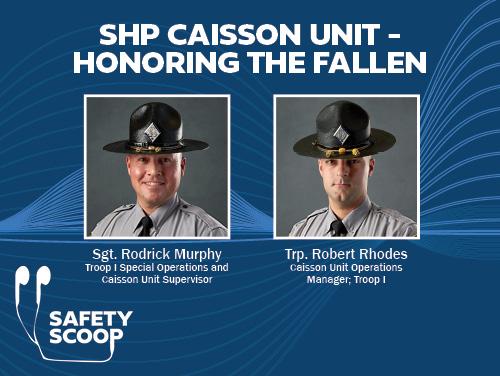
Well, we are here in the Caisson Unit garage recording a very exciting episode of the Safety Scoop. Really excited to be with both of you, so thank you for taking the time out of your day, Trooper Rhodes and Sergeant Murphy. I want to start out and let you all kind of introduce yourselves and your role within the Highway Patrol as well as the Caisson Unit. So, Trooper Rhodes, I will start with you.
Trooper Robert Rhodes: Yes, ma’am, thank you for being here and coming to the farm and meeting the horses. I've been a trooper since 2013 with the State Highway Patrol, and I've been with the Caisson Unit since 2016, and I have the opportunity right now, it's my position on the Highway Patrol and with the Caisson Unit, to be the, uh, barn manager/horse trainer, manual labor guy. It's my job and my opportunity to, uh, get up every day and take care of the horses and make sure that they're healthy, make sure they're clean, take care of the trucks, the equipment and keep everybody ready to go, uh, in the time of need when we're requested for a funeral.
Kirsten: And Sergeant Murphy, introduce yourself to our listeners.
Sgt. Rod Murphy: Uh, yes, ma'am, my name is Rod Murphy. I’m a sergeant with the North Carolina Highway Patrol. I'm the sergeant over our Crash Reconstruction Team out of Troop B-Boy and in charge over our Caisson Unit. Uh, my job is to…basically the logistics side of the Caisson. When we get requested for funerals, to make the phone contacts and contact Trooper Rhodes to make sure he's aware and getting our team ready for, uh, travel and going to do a mission.
Kirsten: Well, just wanted to know a little more about how you guys were introduced to the Caisson Unit and started to get involved with it. So, Sergeant Murphy, what led you to be part of the Caisson Unit?
Sgt. Murphy: I’ve been on the unit since 2017. Being with Troop I’s official operations, my former sergeant was over the Caisson Team, and I was able to go with him some to help caisson practice, to see some missions and it got me very much interested in being a part of it. Growing up as a farm boy, uh, my daddy was a farmer, I've always been the love for animals. We always had cows, and we've always been around horses, so I’ve always loved it. And the more I was around it with my sergeant, the more I loved it. And I finally joined the team in 2017 and, um, been on it ever since and enjoyed it ever since.
Kirsten: And Trooper Rhodes?
Trooper Rhodes: Yeah, so growing up around horses and, uh, my dad being in the Marine Corps, uh, Honor Guard and drilling military, uh, drills and ceremonies, there was always an interest to me. And then when I got on the Highway Patrol, I–I learned that we had the Caisson Unit, and when I first got the opportunity to get on the team, I applied. And I've been on the team ever since, and I absolutely love it.
Kirsten: Sergeant Murphy, what services does the Caisson Unit provide?
Sgt. Murphy: The Caisson Unit provides services for law enforcement officers, fire, EMS personnel that are killed in the active line of duty. We also provide services for former sitting governors of the state of North Carolina. Law enforcement, fire, EMS killed in the line of duty contacts the–either myself or someone with the Highway Patrol requesting our Caisson Unit. They will contact me, uh, let us know about the request, and I have to do it by the chain of command up to my troop captain, all the way up to the commander colonel of the Highway Patrol, to get it approved. Then when it's approved, I start the logistics part of the paperwork and making the phone calls and getting up with Trooper Rhodes. He starts the process of getting our horses prepared by washing them, getting them cleaned up, and our trucks and trailers, getting everything washed. Everything is very neat, clean, shiny as we go to do these, uh, services.
Kirsten: And do you just perform services in the state of North Carolina?
Sgt. Murphy: No, ma’am. The state of North Carolina and any states surrounding the state of North Carolina, uh, we will go to those States.
Kirsten: How far have you traveled for a service?
Trooper Rhodes: I know the furthest I've been was Valdosta, Georgia. It's about 16 miles north of Florida. But we do the funerals in all the surrounding states, and as long as the requesting agency gives us plenty of time, uh, notice. Now, we understand funerals. Nobody's planning their timing of a, uh, funeral service, but if we've got to go all the way to Nashville, Tennessee, we've got to know well in advance ‘cause it's probably going to take us two days just to travel to, uh, to do the funeral service or to get to the–the town. And then we–we like to do a rehearsal with the agency, uh, requesting, and then after we do the rehearsal, the next day will be the funeral service, and then we've got to travel back. So, because the troopers that are on the team are from all across North Carolina, we have to have time to prepare, we have to have time to, uh, get everything clean, get everybody to the barn and then travel to the location.
Kirsten: Trooper Rhodes, why are these services important?
Trooper Rhodes: It dates back to the Civil War era timeframe is where we get our caisson wagon. And that's how we conduct our services, is a presidential level of–of funeral service where high-ranking officials in the military and, uh, former presidents in Arlington National Cemetery are carried by a caisson wagon to their burial site. And so, we like to give officers and, uh, other first responders that same honor and privilege when–when they're killed or die in the line of duty.
Kirsten: North Carolina's Caisson Unit was started in 2006. A group of troopers were sent to Arlington National Cemetery and were trained under their unit at the time on how to run and perform what are referred to as “missions.” The unit's first mission was in 2008 to honor the life of a fallen Patrol member. In the beginning, the unit had two horses and has grown to a team of eight. Sergeant Murphy shared that he was astonished at the rate the unit has grown since 2008 and how it has flourished over the years to take part in 117 services. The unit is recognized well beyond our state, with Sergeant Murphy even sharing that they have seen people pull off the road in order to take a photo of them either traveling or while participating in processions. There are only three caisson units in the nation: two of them operating in Arlington and the one in North Carolina.
I just want to make sure people understand how the Caisson Unit is associated with the Highway Patrol and the Troopers Association and just kind of define where it sits.
Sgt. Murphy: The–the horses, the horse truck and trailer, the caisson truck and trailer, all this stuff is owned by the North Carolina Troopers Association. Uh, this is a separate entity of the Highway Patrol. The troopers, of course, work for the Highway Patrol. Uh, we have a great working relationship with Colonel Johnson and the Troopers Association that he allows troopers to–to ride these horses and do these funerals, and that the Troopers Association allows us to use their horses and their trucks to go do it, so that's an awesome working relationship we have. Like I said, when we get a request for funerals, I send everything up my chain of command to Colonel Johnson, he approves the missions, and I let the president of the Troopers Association know that we've been requested for this funeral and we're getting ready to go do this. I keep everybody in–in the chain, in the link of what's going on.
The Troopers Association Caisson Unit is a non-profit organization. We work solely off of donations. Being a 501c3 non-profit agency, um, or business, if you will, um, everything is funded through donations and fundraisers and the t-shirt sales, um, any other merchandise. You know, $5,000 donations are great, but even $50 donations are even better because it's those donations are what get us through the–the week. You know, just 40 bags of feed will last me about a month, and that's around $1,200 every single month that we're spending on just the grain. Um, so, it takes a lot to keep moving along and, you know, business partnerships, business relationships, relationships with legislators and other officials at the state level is how we've been able to be successful, and how we have some of the equipment that we have now is through these contributions, and we wouldn't be able to do any of this without–without it. Um.
We do these funerals at no cost to the family. It doesn't cost the agency or the–the visiting state any money. Uh, they call us, and we show up, and it's because of our relationships, because of our fundraisers and because of community involvement that we're able to do this.
Trooper Rhodes: And if we get requested—today being Wednesday—if we get requested to do a funeral next week in Georgia or any state outside of North Carolina, if I take ten troopers with me to do this mission and we're gone four days, you're looking at six to eight thousand dollars expense just to do this funeral, and it all comes from donations. But we’re able to do that.
Kirsten: Thank you for putting that in perspective. I think it’s really important for people to note that. So, we are actually recording the podcast next to the trailer where you transport the caisson or the wagon that people will see during these ceremonies that you attend, and I see you have, uh, in memory of plaques against the side. How many missions or how many names are on the side of this trailer?
Sgt. Murphy: Our last mission would be 117.
Kirsten: Now we get to talk about the horses.
[Laughs]
Which you say are the stars of the show.
Trooper Rhodes: Yep.
Kirsten: How many horses do you have at this point, and how do you acquire the horses, um, that you guys use?
Trooper Rhodes: Uh, today we have eight horses on the team. Uh, they have been given by donations, and we have purchased some. So, we're able to purchase these horses with money donated to us.
Kirsten: And Trooper Rhodes, since you are the primary caregiver of these horses, can you kind of take me through almost a day in the life…
[Laughs]
…of what your days look like, um, working alongside these horses.
Trooper Rhodes: Yeah, so I–I wake up around six o’clock in the morning, and I get up, walk over to the barn, and I'll pick the stalls if they weren't picked the night before. I’ll top off water buckets. I’ll give them hay. I give them grain. I, uh, will bring in the horses. A lot of the times, I just open the gate and they all run right into their spots. They know where their bedroom is. And, uh, sometimes they get a little squirrely, and they like to get a extra bite of food from one of the other horses. I'll shut all the doors, and I will clean out the breezeway. Then throughout the day, I will work one or two of the horses throughout the day just to keep them exercised to keep them ready for funerals when we're requested.
I'll do truck maintenance. I'll go to the feed store. I'll go, uh, pick up hay. Some days I spend hours in the lawn mower and on the tractor cutting grass, keeping things maintained and cleaned around here. I may go to different meetings. Oftentimes I’ll end up going to training in Raleigh with the Highway Patrol because as a trooper, I still have to maintain those certifications and training.
In the evening time, somewhere around three/four o’clock, I'll start my evening chores and prepare for the evening feed where I'll put grain back in their stalls ‘cause the horses stay inside all day to stay out of the sun. It helps keep their hair from fading. So, I’ll grain them in the evening, and then I'll put hay out in the pasture. I'll make sure the water trough outside is full and clean. I'll let the horses out to the pasture, and they get to go outside and run around and stretch their legs and roll, you know, be a normal horse. And then I'll clean the stalls again in the evening time, maybe top off our clean water buckets, and, uh, that's about a normal day.
Kirsten: These are big horses.
Trooper Rhodes: Yeah.
Kirsten: How much would you say that they eat a day?
Trooper Rhodes: So, the horses each are getting about ten pounds of grain a day and then about a half to three quarters of a bale of hay. So, if you imagine a bale of hay is close to 50 pounds, if they're eating half to three quarters of that, they're eating about 20 to 30 pounds of hay every day on top of their 10 pounds of, uh, grain.
Kirsten: I’d like, if we can, to introduce the horses even though people can’t see them. I know they have their own personalities, so Sergeant Murphy, can you start off with introductions of “the girls” which are the horses you say are typically seen pulling the caisson. There is 16-year-old Isabel, Nelly and Peggy who are 17 and Rosie who is 18. Uh, just share a little bit about what makes them special.
Sgt. Murphy: Yes, um, when I took over this unit as the supervisor, my–my intentions were to try to keep it all females, but when we started looking for other horses, we found these two really, really good young men that Robert will talk about later. But our–our four main girls are our four ones that get ridden and they actually pull the caisson/wagon. Um, we call it the–the off and the near. So, our two in the front will be Nelly and Isabelle. Uh, Nelly's going to be the leader of the gang. Um, she's the boss, and she basically calls the shots in the pasture and tells them what they're going to do, and they just follow her doing it. Um, but Nelly’s a good horse. Um, we have to have a good rider on Nelly ‘cause, well, sometimes she can be a little stubborn, but–but, uh, she's a beautiful horse, does an absolutely wonderful job in our funerals. And then Isabelle will be to her right. Uh, Isabelle's a little spunky. Uh, Isabelle sometimes will do a little dancing. She gets a little hyper, but, uh, she does an absolutely beautiful job.
Behind Nelly to your left would be Peggy. Peggy is, uh, one of our bigger girls. She's going to push around 2,000 pounds, and she's a really g–really good horse, really laid back. If anybody wanted to ride any of these eight horses that had never ridden, Peggy would be the first one I’d put you on. Her sister Rosie will be to the right. Uh, Rosie's a good horse. She's a little bit more spunky than Peggy, but, uh, she's not quite as spunky as Isabelle or Nelly. Those four girls together are our team horses, and they actually pull the caisson. So, anytime you see our unit coming down the road or coming up to a church or coming up to a graveyard, those are the four girls you're going to see. And then Trooper Rhodes will talk about the other four we have.
Trooper Rhodes: Yeah, and then there's Nell. Nell is, uh, our oldest girl. She's 20. She's a shorter Percheron, uh, compared to the rest of the, uh, the girls, and she's been used the–the last few years with the team. She's our longest serving horse on the caisson, and, uh, her position right now is the cap horse. Uh, she carries the saddle without a rider and the boots backwards to symbolize the officers looking back on their family and agency, uh, they're looking back on them. Nell is pretty laid back. She's easy going. You can tell she's the older of the group. She just kind of keeps to herself, and she likes to eat.
And then we’ve got three new geldings on the team. The three new males are Judge, Mayor and Major. Uh, Judge and Mayor came to us from a farmer in Kentucky. These two geldings came to us, they're 5 years old. They are really smart and, uh, well trained at pulling a plow, uh, but the last few weeks I've been working with them a lot to get them saddle broke and get them ready because when we ride, not only are they pulling the caisson, but they're also being ridden, and in the horse world or in the draft world, that's–that's unusual. So, getting a draft horse to understand the rider sitting on top of you, uh, just like in any other western cowboy movie, is also pulling the wagon. Judge is the, uh, he's the leader of the three males, and, uh, he's trying to get, uh, Miss Nelly to understand that he's–he's going to be the boss. Nelly’s–Nelly’s not having it. Um, it's fun to watch them in the pasture play. But Judge is a little–a little loud, a little pushy. And then there's Mayor who's just a clumsy kid that follows his–his brother Judge around and, uh, does what he says.
And then there's the, uh, the newest horse, uh, Major. He's the Percheron-Lipizzan cross. He's 12 years old, and he has the longer mane and a longer tail. He was actually donated to us from a family and kid in Georgia, um, who got in contact with us after we did a funeral for the Georgia State Police in March. She learned what we did, and she got in contact with us and had a beautiful horse, and, uh, she brought him to us last month in, uh, April. And, uh, he's been doing very well for us ever since.
Kirsten: Well, now that we've learned a little bit about the horses, let's learn about the people. Who on the Highway Patrol gets to be part of this unit, Sergeant Murphy?
Sgt. Murphy: It's, uh, strictly voluntary. If anyone is interested in the unit, they can fill out an application and contact me, or either contact Trooper Headquarters. As of right now, I’ve got twenty on the team, and what they'll do is they fill out a application. Me, myself and Trooper Rhodes will review the application, and then we'll bring them into a training that we have and see how they're going to fit in, number one, with our Caisson Team, and see if they're willing to put in the effort and the work. Because there's a lot of work that goes into this Caisson Unit in as far as, you know, cleaning our horses, cleaning stalls, feeding the horses, cleaning our trucks, cleaning our trailers and then riding. They’ll have to get riding [unintelligible]. We've even gone as far as to say now, if you even want to be on the team and never want to ride, I'm fine with that. Just to be able to be on the team and show up and help us do manual labor and then go do the missions and be a wheel walker, we're absolutely fine with that. And we have some guys on the team that they're great with that. They don’t ever want to ride; they just want to be part of the team.
Kirsten: So, no riding experience is necessary.
Sgt. Murphy: No riding experience is necessary. No, ma’am.
Trooper Rhodes: And I'd like to add to that. So, the other aspect to being a member of the Caisson Unit is–is being committed. Obviously, nobody's planning a funeral for their coworker today. If we get a phone call that an officer’s been killed in Atlanta or in Nashville or in, uh, Virginia somewhere or anywhere in North Carolina, we have to kind of stop what we’re doing and–and start to prepare to leave our shift workers, to leave our families, and to come to the barn to travel to wherever this funeral is going to be at and to be a part of this officer's funeral. And, uh, being committed and being available is key, and that's where having people on the–on the unit that don't have horse experience is all right because of the 20 people on the team, somebody's got to want to ride. Well, there's five horses that are going to be ridden.
Sgt. Murphy: Yep, um…
Trooper Rhodes: Of the 20, we like to get some of our better riders, uh, because every time we do a funeral, it’s in a new location, and sometimes the horses, they're not accustomed to the slope or accustomed to the flags that might be along the side of the road, or if there's, uh, a group of motorcycle riders that comes through, the horses have to be prepared, and we’ve got to have good riders on those horses when that happens.
Kirsten: You guys have shared so much, and I really appreciate it. Just talking about the missions, um, you know, without sharing too many personal details, has there been a mission or–or just something that during your time serving has been really impactful, stuck with you?
Trooper Rhodes: Well, um, I–I don't remember very many of the funerals that we've done just because we do so many of them. Uh, like we said earlier, we're up to 117 funerals since 2008, and, uh, since I've been on the team in 2016, I'd be, uh, I–I'm getting close to 50 funerals myself. So, it's hard to remember all of them, but, uh, Trooper Kevin Connor’s funeral was–was tough for me. The four riders that rode for Trooper Connor’s funeral had all worked with him. We were all Troop B guys, and we all worked with, uh, Trooper Connor, and, uh, you know, seeing his family and seeing the crowd of hundreds and hundreds of people, the tears, the emotion, the weight of–of knowing that you were carrying a buddy and carrying a shift worker, another trooper. That was–that was extremely significant for me. And I'll never forget that day. Trooper Connor’s family, no different than every other name that–that's on that–that trailer, but for me that–that funeral was, uh, pretty significant.
Kirsten: And Sergeant Murphy, what about you?
Sgt. Murphy: Um, the ones that would stick out, um, they’re all… By all means, they’re all terrible. They’re all sad. It's just an honor for us to be able to do that funeral for that hero, as I call them, uh, to give him that last ride to either a graveside or to the church. But the worst, whenever it's going to be, when they wear the same uniform you wear. Uh, that's the hardest ones, and to do ones in our own state are very hard. And I–I like to tell people—I don’t mean it mean, by any means—but when we go do these services, we give the families opportunities to come meet these horses and to come meet the troopers, and I'm–I'm fine with that. We just try not to get too involved with this stuff because we're there to do a job, we're there to do a mission and then we're there to get back to our families. If we start getting too involved and too much involved with these families, that's more it puts on me, that's more it puts on Trooper Rhodes, that’s more it puts on my troopers there. And now we're involved, and we kind of become personal with this stuff, and we try not to do that.
Kirsten: To that point that you just mentioned, I mean, how do you all take care of each other? How do you keep the mental health aspect of it to stay positive? I mean, this is a very heavy part of your role with the Highway Patrol, so how do you guys take care of each other?
Sgt. Murphy: Uh, we try to look out for each other. A trooper will pick on another trooper faster than anybody, but if that trooper needs somebody, the first one to come be here is another trooper. We’re a brotherhood and a sisterhood, and it all starts at Camp Garner in Raleigh. I–I try to keep an eye on my guys and my girls to see if they're being bothered, but you know, it is sometimes you can't tell because we're all hard-headed. I’m hard-headed, too. We have a MAD program that offers assistance to troopers that they can go sit down and talk with somebody and to try to get things off their chest, and I do offer that to the troopers that it is there. I get through it with faith because, again, you're seeing this basically when we show up, it's a good thing/bad thing. Something bad’s happened, but we're there, and it's a good thing that we can offer them this tribute to give them the ultimate, um, send off because of the sacrifice that that person made.
Trooper Rhodes: Well, and it's a trooper’s professionalism, I think, is–is a huge part of how we–we deal with this because we're–we're very mission-driven, uh, individuals as troopers, and, uh, we're–we’re never there to attend a funeral. We're there to do our part, and our part is a very little part that we hope will have a huge impact on the family and the audience that–that gets to attend the funeral. We try and stay focused on what it is our purpose is there for that day. That's to perform and give this officer or, uh, fireman or EMS worker the, uh, the–the best service that we can possibly provide for ‘em and, uh, staying focused on that alone, I think, is what helps us detach the emotional aspect of the funeral. Um, but man, I'm telling you there's something–there's something about when you–when you turn that corner, you're coming under the awning and the family is there and you can hear the tears and you can hear the family, uh, you know, whimpering, and the mother’s saying, you know, “That's my baby,” and it–it does get to you sometimes.
Um, but I think with the group of–of troopers that we have that are on the team, you know, we all–we all see it, we all hear it, and then we come back to the truck and the trailer and, you know, we decompress as we're taking the tack off of the horses, as we get changed and back into our–our personal clothing. That 5, 10 minutes in the trailer, um, talking about how–how tough that was, you know, the emotions, they can be overwhelming, but we do a pretty good job and, unfortunately, as State Troopers, you know, we–we deal with a lot of death, um, investigating, you know, fatal collisions, uh, quite regularly. We–we do deal with this kind of stuff on a regular basis. Um, there's no doubt it's more impactful when it's another officer, especially when they're killed, you know, because somebody senselessly didn’t want to go to jail. It’s tragic when there’s car wrecks and officers are killed, um, but the fatal assaults, those–those definitely are tough.
Kirsten: Do you ever retire horses, and if so, what happens?
Sgt. Murphy: We do retire horses. Um, we do offer it to troopers that have been on the Caisson Unit or are on the Caisson Unit. When that trooper takes possession of that horse, they are no longer funded by the Caisson Unit nor the Troopers Association. That's all on the trooper now. Or we have donated them to rehabilitation farms. Uh, we do have one he spoke of earlier, about N-Nell, gonna be 20 this year, um, the oldest one on the unit. Hopefully, the end of this year is going to be her last year on the team. Now, I'm not happy to say that, I'm just saying I'm hoping that the new boys are going to step in and take up their roles that we’re asking them to do, and then we can retire her and give her the opportunity to go live her life in a pasture somewhere and live the rest of her years in a pasture and just enjoying life.
Kirsten: Um, so, closing thoughts, but first, who’s your favorite horse? Trooper Rhodes, we’ll start with you because I know you guys have favorites.
[Laughs]
Trooper Rhodes: Well, prior to the–the three new guys, um, and me having them here every day, um, and getting to s–getting to know their personalities, um, Isabelle has always been the favorite. She's the funnest to ride, she's the funnest to, uh, to watch out in the pasture, and she's always been my favorite. But I will say the, uh, the new guy, Major, is, uh, growing on me a lot. He's a fun horse to ride. He’s a little pushy and got to–got to learn his manners, but Major is–is definitely my–my–quickly becoming my new favorite now.
Sgt. Murphy: Well, that's funny ‘cause mine is going to be Isabelle, too. She's hyper, but she's beautiful. Doing missions, we've seen her start doing a little dancing like she's ready to go, and you're holding her back. She's just ready to go, but it's just beautiful. It's absolutely beautiful. Now sitting on top of her, your–your heart’s about to beat out of your chest, but, um, it’s just beautiful to see. She's fun to ride, she's got some spunk to her and, uh, she's a beautiful horse. But it don't matter which one you–you put me on, I’mma ride either one, but yeah, Isabelle's… I have not had the opportunity to ride Major yet, but, uh, he's a good horse, too.
Kirsten: Well, any last things that you would like to share with our listeners?
Sgt. Murphy: Again, I appreciate you being here. I appreciate you doing this for us. But, um, if they've never experienced it, I would encourage them to YouTube us (Caisson Unit on YouTube) and see how we do funerals. And if you've never seen it in person, it's hard for me to describe what emotions it–it puts you through being able to see this and the services that we provide with these beautiful horses. I try to describe it as the last thing we want you to hear is… Just about every mission, we do we have a bagpipe. And I love to hear the bagpipes. They're beautiful, but we always ask them to stop playing right before we come into the church, or we come into the funeral or the grave site. Uh, the last thing you hear is the wheels on the caisson.
[Horse hooves clip-clopping]
You hear the chains on the caisson, and you hear the horses’ feet. That's a sound that I can never describe it as good as what it sounds and the actual emotions that it will put through your body to hear this and see this.
[Horse footsteps fade out]
Again, this, it’s not something we want to do. Unfortunately, it's going to happen the world we live in. And when it does happen, we take absolute honor and pride to be able to do this.
Trooper Rhodes: Yeah, uh, in closing, I just would say thank you for the opportunity to, uh, educate everybody and the listeners on what it is that we do. I think it's really important to say again, uh, the Caisson Unit is funded through donations only. There is no re-occurring money in the state budget to keep this moving. Uh, everything comes through donations and single, um, time contributions, you know, building relationships with the community and businesses and public education on how this works and how we're able to continue to–to move forward is–is really important. I would ask everybody, go and visit us on Facebook or Instagram. The website is nctacaissonunit.org. It's a privilege to have you here and appreciate it.
Sgt. Murphy: Thank you so much.
Kirsten: Of course!
[Horse hooves and horn solo]
[Pause]
Conclusion
[Theme music]
Kirsten: This is the Safety Scoop, a podcast written, produced and edited by the NCDPS communications team. The mission of the North Carolina Department of Public Safety is to safeguard and preserve the lives and properties of the people of North Carolina through preparation, prevention and protection with integrity and honor. Follow the department on social media for a closer look at ongoing initiatives and resources. We’re on Facebook, X and Instagram at NC Public Safety. If you enjoyed today's episode, be sure to subscribe to the Safety Scoop on your favorite podcast app. Special thanks to Trooper Rhodes, Trent Creed and Wilbert Darcus for submitting audio to be included in this episode. I'm your host, Kirsten Barber. Thanks for listening.
[Music fades]