
Stories from Women in Emergency Management - Safety Scoop Transcript
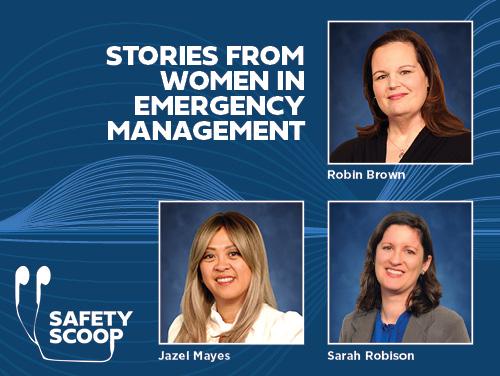
Introduction
[Music]
Kirsten Barber: You're listening to the NCDPS Safety Scoop, a podcast that dives into the stories of the people, programs and resources within the North Carolina Department of Public Safety. Each episode, we’ll give you the scoop from department personnel on how NCDPS enhances the safety of the people of North Carolina.
[Music]
[Pause]
Season 3 Episode 2
Kirsten: Welcome to a special Women’s History Month episode of the Safety Scoop! Not only are there several amazing guests you get to hear from, but you’ll also notice a new voice in the mix, a guest host who was pivotal in the development of this episode. Meet Meredith Hemphill, a writer with the communications section of the department, who will co-host this episode with me as we dive into the stories of women in the emergency management profession. Here’s a bit more about the history of women in emergency management.
Meredith Hemphill: Traditionally, the fields of public safety and emergency management have been heavily white, male, and ex-military. There has been progress towards greater diversity, exemplified by Deanne Criswell’s appointment as the first woman to head FEMA, but it has been slow going. In 2021, DataUSA reported that only 33% of emergency management directors in the U.S. are women. Today, we’ll meet three women at DPS who are nudging those trends in the right direction.
So, to start with, could you please introduce yourself, tell our listeners how long you've been with DPS and a little bit about what your role is?
Robin Brown: Sure, my name is Robin Brown. I am the Area 10 Coordinator for North Carolina Emergency Management’s Central Branch Office, and what that means is that I'm the primary liaison between state EM and my assigned counties which are Alamance, Davidson, Durham, Guilford, Orange and Randolph. So, I've served in this position since 2021, but I actually joined the division all the way back in 2008, and I've had the opportunity to work in a couple of different sections over the years.
Meredith: Are there any unique emergency management concerns to that particular area of North Carolina?
Robin: I think one of the most unique challenges in our branch is just how varied the programs are in the jurisdictions of our local partners. So, for example, there are 33 counties in the Central Branch, and they absolutely run the gamut in so many different ways. Some are very urban, some are very rural, some have very large populations and some have very small. And I'm talking to the tune of, you know, 1.1/1.2 million people in Wake County versus somewhere like 17/18,000 in some of our smaller counties, like maybe Northampton.
And the capabilities in those programs run the gamut as well, so some counties have an entire county department that's dedicated to emergency management, and that comes complete with a team of five or six employees. Many of them have municipalities within their jurisdiction that have their own EM programs, and then some counties have one person for emergency management or maybe even share that person with another function like the Fire Marshal's Office or Risk Management. So, it's really important for our team that we are able to kind of pivot and provide the level of support that all of these different partners need regardless of what that support might look like.
Meredith: So, what does your work look like during an emergency versus the, like, preparation/prevention phase?
Robin: Ah, the proverbial “gray skies and blue skies.”
Meredith: [Laughs]
Yes.
Robin: Out in the branch offices, we have the really unique opportunity of we get out in our counties during daily operations, so we really get a chance to build those relationships with our local partners and not just in the emergency management programs, but with their local partners as well. So, routinely, we interact with folks from social services, public health, um, other public safety partners like fire, law enforcement, even animal services, and we do this as we attend everyday kinds of meetings, planning meetings, emergency plan reviews, other planned events like that. Festivals and just other kinds of things going on in the communities. And those relationships are absolutely key when the wind starts blowing or the water starts rising, right? So, we talk a lot in emergency management about phases, and here in the branch offices, we have a unique opportunity because we're present for all four phases. You know, we're here with those local partners through every bit of it.
Meredith: How does the work your team does fit into the division’s mission of preparing for and responding to all hazards?
Robin: One of the unique opportunities that we have on our team is being out with our counties. We go out and do plan reviews. We work with them in daily operations through every single phase of emergency management. We’re there as they review and revise their emergency operation plans. We help them build their capabilities with grant opportunities to acquire new equipment and resources. We train and exercise with them. We help them navigate the process of federal mitigation programs and then support them through their response, such as facilitating mutual aid, being an extra pair of hands or eyes, serving as a walking and talking rolodex of resources that are available to them and then walking with them along that road to recovery as those gray skies begin to clear again.
Meredith: Well, Jazel, thank you so much for joining us. Please just introduce yourself and a little bit about what your role is.
Jazel Mays: So, uh, my name is Jazel Mays. I have been with North Carolina Emergency Management; March 14th will be my two-year mark. But at DPS as a whole, I have been with DPS since 2014. So, I was with, actually, the Controller's Office first, then I went over to Highway Patrol; from Highway Patrol to NCEM.
What I do with Emergency Management is I’m their accounting specialist or, uh, manager for accounts payable, and I manage everything as far as invoices, travel, keep the lights on, if you would.
[Laughs]
Just paying out all our different programs that we have, uh, from the grants to our operations to our logistics, pretty much almost everything that I touch in EM is just basically money.
Meredith: I imagine that probably most people, when they're thinking “emergency management,” they're not thinking “accounts payable.” Can you kind of explain for people why that's an important part of the Emergency Management?
Jazel: Why it's important that we have the Accounts Payable section is we pay out a lot of our counties requesting for reimbursement and also for anything that has, like, just disasters. We have a lot of going back to, like, Matthew, Florence, we have all those payments that we have to give back to the community whose service the storm. So, we have to reimburse back the counties of which they service for us. And there's other things, you know, normal business. That's, like, really in a nutshell of what Accounts Payable does.
Meredith: Uh, so, we've heard that you recently led a project to build some–a financial software tool for Emergency Management’s accounting that, apparently, was revolutionary, so could you tell us more about that?
Jazel: Oh, my gosh! Okay, so when I started with Emergency Management two years ago, I was brought into a meeting. They basically asked, “How's it going and everything?” An-and I think I was a little bit too bold…
[Laughs]
…to tell management and say that our AP processes are lacking it's–it's, uh, capability. Basically, it's slow, and I mean it was, like, snail, and it was hard to process invoices and to even locate invoices. So, it was so hard. So, the birth of REMIT—Record of Emergency Management Invoices and Transmittals—so the name is REMIT—asking management to see if they will buy in into creating efficiency, as far as processing invoices, looking up invoices. You know, we have so many Cost Centers. Cost Centers is basically our–our [unintelligible] funds in different accounts. So, and then, these different Cost Centers, they’re governed by different program managers, and they could be millions of dollars in–in those different pots of money, if you would.
All right, so, um, I–I said, “If we could build…” And I–and it was just an ask, and they kind of looked at me crazy for a minute, but when they started noticing that they–that they're really getting into it to find some things, they just couldn't. So, the–I finally got the–the green light to say, “Hey, Jay, let’s build a–a–a database that will help NCEM to direct forward to a better place." So, here we are with REMIT, and the vision was, it was only supposed to be for accounts payable purposes. This thing has evolved now to… And it’s–and it’s branched out from AP to budget to grants to our purchasing book. We're still working those, but it is on its way to a better place. So, the efficiency is amazing with this, and they're–now there's so many people that were trained.
And it also helped our program managers not to duplicate work so much, and with this, it has pushed us to a better process of just making sure that we're managing our funds correctly and properly. It's amazing. It really is. And it–and, um, everyone in Emergency Management has been pleased with it, and so has leadership, and that, to me, having that one little vision, that little fire to now has gone really big and it goes out, and I think there's even, like, a-another agency that wants to look at it to be able to–for them to utilize it and have a better way of processing and viewing and make sure their funds are being utilized correctly. I can't wait to see what it will evolve to in the next few months, years, how we can better NCEM as far as processing and paying out all of our invoices and–and such.
Meredith: I love how excited you are about all that.
[Laughs]
Jazel: You know, we have to keep that in a tight check and make sure that we're–we're–we’re utilizing funds appropriately.
Meredith: Nice to meet you, Sarah. To start with, could you please introduce yourself?
Sarah Robison: My name is Sarah Robison. I've been with the Department of Public Safety for over two years with Emergency Management, and I’m part of the Hazardous Material Team under Emergency Services. So, our team has a diverse background between prior fire, Hazmat technicians, Department of Defense explosive ordnance technicians and then I'm the first scientist to be brought on, um, and I have an environmental compliance and regulatory background.
In general, the State Emergency Response Commission delegates chemical inventories and emergency planning to different divisions, and so depending on the state, some are under Emergency Management and then others are in Environmental Quality. So, it's been beneficial for our team to have both skillsets. And then my particular role is the Risk Management Program Coordinator. I’d kind of like to clarify that ‘cause even within emergency management, there’s various versions of risk management. When we refer to hazmat, it's the EPA’s risk management program. Um, it's the chemical accident prevention program for facilities, and these facilities store, um, certain toxic or flammable substances in large amounts.
In North Carolina, we have around 240 of these facilities, and, um, we’re unique in that we are the third-largest chemical manufacturer in the country after Texas and Louisiana. So, we have some pretty fascinating facilities in our state. Um, there's two RMP coordinators for North Carolina, and the other is under Division of Air Quality and compliance management. Our role is to partner with the local responders, so local fire, the county emergency management and the local emergency planning committees, um, to assist in coordination, um, emergency planning and exercises with the chemical facilities.
Meredith: So, what is the Risk Management Program, and how does it keep North Carolinians safe from hazardous substances?
Robin: So, each facility, they develop their own risk management plan, and the key components of those plans, the first is to identify the potential effects of a chemical accident at their facility, and then the other aspect is they identify what steps the facility’s taken to prevent the accident. This can be anything from employee training, um, doing routine preventive maintenance and equipment inspections. And then, the emergency response procedures, should an accident occur, is the third major component of that program, and that's where we partner with, um, the local fire departments or the local hazmat teams (there’s about 25 of those in the state), or under Emergency Management our department has seven Regional Response Teams that are supported that, in the event there's not a local hazmat team or, um, they might need additional support, we have the seven Regional Response Teams throughout the state to support exercise training or in the event of a chemical accident. And that's really unique, like, looking around the country, there's only a handful of states that provide that service.
When we think about just chemical planning in general, though the goal, of course, is to keep the chemical in the process tank, either that, the tanks, the pipes, anything that the product is in, but in the event that it does get out, what are the procedures in place? What are the emergency planners? How is that going to impact the public? Um, and that's where you get the county emergency operation plan in place and often chemical annexes so that they–everybody kind of understands their roles and responsibilities.
We have a lot of changes going on right now, um, under this program. So, in 2019, they had a new Final Rule and then last week they put out the Safer Communities by Chemical Accident Prevention Final Rule. That is the first rule that the EPA’s released that's been the most proactive safety provision for chemical facilities in history. It requires stronger measures for prevention, preparedness and public transparency. The other really interesting thing that the–that the EPA just pushed out last week is increasing the public awareness. They, now, on their website, they published, um, a public data tool, and that allows not only the public, but also emergency managers to have additional information on the facility: what chemicals, um, they have as part of the process, what their health and safety items are and then what the emergency response procedure is for that facility.
I was recently listening to the Martin Luther King observance program. Kirsty Jones, the Chief of Staff for the North Carolina Executive Branch, she made the statement about “what we learn is what we eat and what we breathe, what we touch and what we absorb affects our lives. Now, you don't have to work at the Division of Environmental Quality, um, to know what environmental justice means. It means if you don't want it in your backyard, don't put it in my backyard.” And she also made the comment that North Carolina, um, has ranked for two years in a row as the number one place, um, to do business by CNBC. And she, at the end of her talk, just described, from everything she was saying, how, as public servants, can we apply this information to our daily work?
North Carolina, we’re at a very unique place as far as we're growing. We have some of the top fastest growing cities in America, um, we have new industry coming throughout the state and then our population growth is booming. So, it's a really unique opportunity, um, for that partnership between our industry, local responders, um, zoning and planning, to look at our existing facilities and how we can understand the hazard of that facility and then any new chemical facilities to make sure that we're planning appropriately for population growth around that facility and to be able to reduce potential for public impact, um, with new facilities being built. And this will also just help increase public awareness for what the chemicals are in their community, um, as well as process safety. Our industry partners do an excellent job in maintaining their systems, and their goal is to–to never have the chemical get out of the containers. Accidents at chemical facilities are far less common compared to, like, transportation or other incidents. We just want everybody to understand what to do in the event that there is a accident near their communities.
Meredith: So, I hear that you do some work with chemical safety education. Could you talk a little bit about that?
Robin: So, our team gives training and various outreach, from attending the local emergency planning committee meetings, also supporting various conferences that they provide. We're going up and giving training at the North Carolina Emergency Management Association Conference this month. And then giving detailed classes and training out. Uh, we put out basic hazmat planner 101 courses last year, and we're going to continue that approach this year. As well as database management for chemical inventories, providing additional training for emergency managers on reviewing chemical inventories or identifying facilities that might not have filed their chemical inventories yet.
So, we’re getting feedback on additional trainings, and so we're going to work on developing those in the next year. So, our Regional Response Teams also provide a lot of outreach, and that's pretty common for them to do, um, anything from just going out and explaining what the program is and what their resources and capabilities are all the way up to providing support for full-scale exercises. We partner, uh, with Air Quality and some of our other SERT partners to provide trainings at industry or association meetings and conferences. And then, of course, we partner with other states, with their, um, emergency planning and Community Right-to-Know Act programs and their state emergency response commissions to collaborate and share ideas. The goal, of course, is just to continue to increase hazmat planning and, um, public access to chemical information.
Meredith: Now that we have gotten to know Robin, Jazel and Sarah, we wanted to dive deeper into their unique perspectives on their emergency management roles and get their opinions on working in a field with lots of remarkable women, but where at times they may be the only woman in the room. According to UN Women, a project of the United Nations devoted to global gender equality, research has shown that when women are involved in disaster prevention and response, it leads to better outcomes. Yet women remain underrepresented in these careers, but as you’ll hear from our guests, the atmosphere is changing, and improvements are being made.
Uh, so, what would you say is the most rewarding part of your job?
Kirsten: Sarah starts.
Sarah: Having the opportunity to provide hands-on, one-on-one training with new emergency managers or hazmat planners and equipping them with tools and resources so that they can do their local chemical plans, um, that's probably the most rewarding part is equipping them and training them.
Kirsten: Robin shares her thoughts.
Robin: Oh, the people! Hands down, no question, the people. We talked a few times already today about relationships and partnerships and, honestly, that's my favorite part of the job. Uh, much like I never really saw myself in leadership, I also never really saw myself as a people person until I got into this field and started interacting with local and state and federal partners and just response professionals everywhere, and it's infectious. It really is. Um, to know that there are currently public safety professionals across this state who think of me when they need help and who consider me a resource or a trusted partner, that's everything to me, and that's why I do what I do.
Meredith: So, you’re all working in a male-dominated field. What has that been like? Has it presented any particular challenges?
Kirsten: Robin starts.
Robin: I think that anytime any particular group is underrepresented in a larger whole, of course there are going to be inherent challenges there. I prefer to look at those challenges as opportunities to make things better. And so, I mentioned earlier I've been in this business, or one very similar to it, since very, very early in the 2000s. I actually started my career in 2001, and looking at how far we have come in 23 years, looking at just the sheer balancing of the numbers from then to now and how we are starting to see closer to equal numbers of women in leadership and in positions of influence and decision-making positions, that is so… It's inspiring, and it makes me want to stay in it and keep working to make that even more equal than it is now. Like I said, we've made great strides, and I love to see that progress, but I still think we have room to do better.
Kirsten: Jazel shares her thoughts.
Jazel: It is, and you’re right, it’s a, you know, male-driven agency.
[Laughs]
If you would. I fuh–I feel like all the leadership that I work with have that respect. I have not had any, you know, um, feeling of any less than they are, but I think working with them and understanding what they need to get done and to collaborate with them, I think we stand the same, and I think that’s just what I believe in. Treat everybody with the same respect, you know, and you will stand the same.
Kirsten: Sarah's next.
Sarah: It–it was a little intimidating at first. I'm very thankful for the supportive team that I work with. There's a handful of us, and we definitely build each other up. We enhance each other's skillsets. We recognize that we have different backgrounds and capabilities, and we've all been encouraging each other. We've been taking a lot of naw–a lot of new projects on, um, this past year, and so it's–I'm very thankful for a supportive team. But then, there's also several seasoned women responders and emergency managers that I've been able to connect with and receive advice from, as well as since I started, only two years in, there's been a handful of new county hazmat managers that are ladies, um, and we collaborate and get to bounce ideas off each other. And then, looking at the local emergency planning committee, we have over a dozen ladies that oversee their county’s program.
And so, it's definitely a growing field that women are a part of. Women have come a long way in the past few decades. One of the recent North Carolina Emergency Management Association Conference, they had a women panelist, and she described when she started that there was only a handful of women in emergency management, and now, when you attend conferences and you look around at large events, it’s–it looks–it’s around a third of the people present are women. So, there's been a lot of growth over the past two decades, and it's exciting to see.
Meredith: What advice would you give to a girl or a young woman who’s interested in pursuing emergency management as a career?
Kirsten: Jazel answers first.
Jazel: It's a rewarding place to be with Emergency Management. You know, if–if people do need to, like, learn about it, I didn't know anything about emergency management, but now that I'm in this two years now, I've learned to embrace what emergency management is all about and that we are the–we are the people that will go out there after the storm to help our counties, our cities. We go out. Our EMAC resources go out there, and it's amazing. Not everybody will know about that. Come join this wonderful group of people.
Kirsten: Sarah's next.
Sarah: Thinking about what interests them and what they’re passionate about, there's so many different a-avenues and opportunities in public safety and emergency management. If you prefer to be hands-on and out in the field, there, I mean, there's being a hazmat technician. There's several women on the hazmat teams that I've met. Or being a hazmat planner. But then, just looking at emergency services, there's–there's search and rescue. Um, there's forestry. You know, if you're more of a person that likes to–to plan and teach, then you can work into becoming a planner or working with natural hazards and becoming a trainer. There's different staff that work more with the public on post-disasters, focusing on the recovery side.
So, I’d really encourage them to look up the different Emergency Management sections and see what they’re interested in. They could ask, um, and reach out to–to staff, um, and to be able to shadow, or there's internships opportunities on both the county and state level. So, there's lots of opportunities available, especially for young ladies interested in this career field.
Kirsten: Here's Robin.
Robin: Find your people. Like we talked about earlier, for me, it's always going to come back to the people, to the relationships. And when you come into this field, particularly as a young woman, it can be very intimidating. When you look at back historically at kind of where we are right now, we talked about how it's generally been very male-dominated, but it also tends to be more-experienced people. Emergency management ends up being a second career for a lot of folks. And so, coming into this as a young female can be extra intimidating when you factor in just basically what you're facing. So, find your people. Uh, find folks that you can connect to, who display those qualities of leadership and of decision-making and people that you can respect and, therefore, you can kind of become that respected colleague in the future. I–I think having that safety net of those folks that I know are there if I need to call is absolutely the most valuable piece of my rolodex.
Meredith: After speaking with these remarkable women, I noticed a theme in how they responded to being a woman in a man's world, so to speak. The key seemed to be building strong relationships at work whether that was through mentorship or female friendships. Any journey, no matter how daunting, is easier to walk together. We would like to close out this episode with some final thoughts from Jazel on her last few years with Emergency Management and how she has found empowerment while working in several male-dominated professions at NCDPS.
Jazel: Well, just Emergency Management has been so good to me from when I came in and that's… I’m getting a little emotional. Um. The support that I received from day one and to the times that I felt like I was alone, but I wasn't, and, um, leadership has been there for me. And I can't thank them enough. And they see me as an asset to them, their agency. I feel like I've worked really hard to get where I am today. Anybody can do it.
Conclusion
Kirsten: Thank you to Robin, Jazel and Sarah for sharing their stories with us. There are so many more women throughout North Carolina Emergency Management who we could talk to and get their insight on careers with emergency management. In 2024, North Carolina Emergency Management is once again hosting the HERricane experience with Durham, Wake and Orange Counties. This experience is reserved for high school-age women who want to learn more about key public safety and emergency management careers. The event will take place in August, but the application period closes mid-April. Check out the link in the show notes for more details.
[Music]
Kirsten: This is the Safety Scoop, a podcast written, produced and edited by the NCDPS communications team. The mission of the North Carolina Department of Public Safety is to safeguard and preserve the lives and property of the people of North Carolina through preparation, prevention and protection with integrity and honor. Follow the department on social media for a closer look at ongoing initiatives and resources. We’re on Facebook, X and Instagram at NC Public Safety. If you enjoyed today's episode, be sure to subscribe to the Safety Scoop on your favorite podcast app. Thank you to Meredith Hemphill for providing research and cohosting this episode of the Safety Scoop. Justin Graney and Brian Haines also provided information used in this episode. I’m your host, Kirsten Barber. Thanks for listening.
[Music]