
What Does the Future Hold for VOCA? - Safety Scoop Transcript
Introduction
Kirsten: You're listening to the NCDPS Safety Scoop, a podcast that dives into the stories of the people, programs and resources within the North Carolina Department of Public Safety. Each episode will give you the scoop from department personnel on how NCDPS enhances the safety of the people of North Carolina.
[Music]
[Pause]
Season 2, Episode 15
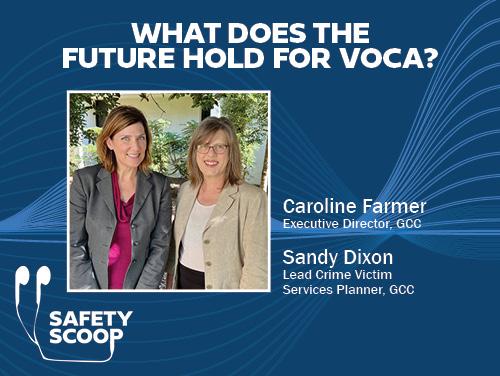
Kirsten: Well, glad you guys are here today, and so for everyone listening, in today's podcast we welcome two members of the Governor's Crime Commission, or GCC, as you'll hear us call it throughout. We have Caroline Farmer and Sandy Dixon, and they will be sharing a forecast for federal Victim of Crime Act funding in the state of North Carolina.
Carolina Farmer: My name is Caroline Farmer. I am the executive director of the Governor's Crime Commission. I have been with the state for 24 years now, so getting up there. I’ve been with DPS for two, so I’ve had the privilege to join those folks working in service for a long time.
Sandy Dixon: Hi, I'm Sandy Dixon. I'm the lead crime victim Services Planner at the Governor’s Crime Commission. I have been with DPS since 2012 and with the state for 25 years and working in crime victims’ services in some form or capacity for 31 years.
Kirsten: The Governor's Crime Commission is the chief advisory body for the governor and DPS secretary on crime and justice issues. Commissioners include leaders in state and local government, as well as private citizens, and these commissioners are appointed by the governor or the legislature. GCC distributes federal criminal justice funding from the US Department of Justice on behalf of the state. Overall this year, $41.5 million was awarded to 243 grant recipients. Most of that money is Victim of Crime Act funding, or VOCA funding: federal funding for organizations that support crime victims. Things are changing, and Caroline and Sandy are here to answer questions as we look to the future.
So, Caroline, the first question is for you. What is VOCA funding, and how does it impact our communities?
Caroline: In 1984, Congress passed the federal Victims of Crime Act, and that created the Crime Victims Fund. That fund is filled with money from prosecutions, mostly, from the US attorneys across the US–lawsuits and so forth–and it's not tax dollars, it's just mostly fines and things of that nature. And so that fund is what is pulled in to help provide grants to the states to make sure that crime victims are supported, and they give us specific rules about the types of coverage to make sure that we are doing an even job of covering sexual assault, domestic violence, children and underserved populations.
You know, the impact on the community with VOCA is pretty significant. It is people who have been going about their daily lives and through no fault of their own become victims of crime. And so, having funding and making it so that we are providing a net to try to capture those people when things get rough is really what the VOCA fund is about. For example, we fund in Buncombe County the Child Advocacy Center, and it is there to help with child abuse. It's got a team of advocates, therapists and a community educator to help make sure that those children have a productive life and can deal with the trauma that they have incurred.
You know, in Orange County we give money to the Rape Crisis Center, and they help with services related to rape, and the money that we provide through VOCA helps provide with staff, workshop support, groups therapy and so forth. In Guilford we're helping with the elder justice victim advocate in making sure that some of those folks, as they’re getting older, who become victims have additional support to make sure that they can work their way out of that victimization. And you know, we're doing crisis intervention in Pitt, Beaufort, Martin, Washington and Moore counties. This money from VOCA does supply for safety planning, shelters, support groups, et cetera. So, you can see that VOCA has a broad spectrum of support that it provides across the state, and these are just examples of the kinds of things that we’re doing with VOCA funds.
Kirsten: That's really nice to hear about all the different examples that VOCA funds and the GCC are using to help members of our community. Next, I'd like to ask about, I've seen reports of federal funding strains, so what do you guys see happening? Can you elaborate for our listeners?
Sandy: The crime victim's fund is dwindling. That’s the big news story right now. Back in 2015 is when we started to see it climb, the fund from prosecutions. There were some very high-profile prosecutions that the US Attorneys did, and in 2023 it went from, you know, the height in 2017 of $13 billion and now it's down to $879 million.
So, just to give you what that means for us at North Carolina, that means that in 2015 it started going up. By 2018, we were at 100 million dollars we were giving away to all across the state, doing legal services, medical services, you know, the child advocacy centers, rape crisis, the domestic violence shelters, and then this year we are going down to below $40 million. So, from 100 to 40 in 5 years. So, that's a 59% decrease in funding that we are seeing in just five years, and next year everything that we're hearing from the federal government is that this is going to be decreased to another 40%. So, it’s going to be down to $23 million that we're going to be providing subrecipients or organizations across, so $100 million, it’s going to be down to $23 million for next year.
Kirsten: So, what will this mean for organizations that have grown up with this funding or received it in the past?
Caroline: It's going to be scary. They are going to have to look for alternative funding. I mean, an organization that we gave $100,000 to in 2018, and I’m just using an example, would be getting $23,000. That's a–that's a massive cut in staffing, in services and being able to actually do a quality job of helping people through a very traumatic time. So, for rural organizations, that's probably going to mean that some of them will close, and a regional organization is going to have to step in, and that means someone who is a victim might have to travel a county or two counties over to get the services they need. And some of these folks don't have cars. They don't have the capability to get to those locations, so that's going to be a problem.
You know, we've already heard of organizations who are aware of this upcoming change, and they are making decisions now. They're making the public aware of all the different ways this is going to affect them. For example, Orange County Rape Crisis Center has already put out a press release and spoken to the public about laying off staff and calling for local funding. And with the decrease in federal funding, it is going to be a burden on the local communities to help out. So, examples like that are popping up across the state where they're going to have to make very tough decisions. With inflation, with the more expensive gas, the more expense of food and trying to provide services, this is a difficult job to help victims. I mean, Sandy knows, she's been in this victims’ services world for 31 years. So, you're now decreasing salaries for people that are devoted and passionate about helping others, but yet we're not providing enough funding to make sure that they continue in those careers. Medical Services, forensic nurses, legal services, making sure that your children have protection: these are the types of things that we’re going to see a decline in funding. They’re expensive, but important. Yet without additional funding, we're not going to be able to meet those needs.
Kirsten: How is the Governor's Crime Commission responding to this crisis?
Caroline: We're staying in close communication with the VOCA Center at the national level. We are attending all of the meetings that they're having about the different types of solutions that other states have come up with. We want to make sure that those organizations that we’re supporting who do victim services have as much information and as much funding for as long as possible. I’m glad to say that Sandy and our team are raising awareness. They're making sure that all those that we give funding to are aware of the decrease in VOCA funding that’s coming for next year. They’re making sure that those elected officials at the local level that are sub-grantees know about these things, and our sub-grantees are the organizations that we provide grant funding to. So, we want to make sure that all the public knows about the decrease in funding. Sandy, why don’t you fill in?
Sandy: Right, so to Caroline’s point, we are trying to determine how to prioritize what we fund for the next application cycle. So much so that we–we actually went back, we knew this was coming as far as reductions, and did a survey several years ago and has been ongoing and has just been completed of a crime victims’ needs assessment, and so we'll be studying the results of that assessment. We’re also going to be sending out surveys to the organizations that we fund to get their feedback on how they think we could assist them in handling some of these cuts that we're expecting. We are looking at all different options from whether or not we prioritize continuation projects versus new projects or organizations or agencies that we fund. We are looking at putting limits on how much people can apply for, the organizations can apply for. We are looking at different line items that maybe we cannot allow at this time. We're also focusing on staffing since a lot of these services are very staff heavy as far as, you know, it requires people in a personal communication and personal services, and so that can’t really be done in any other way than through staffing.
Kirsten: What action should organizations currently receiving VOCA funding take?
Sandy: Well, I think one of the first things that an organization can do is talk to the staff at GCC and let us know what the–what their questions are, what the concerns are, how this will impact them. They also can certainly explore other funding options: local funding, state funding, foundations, other different fundraisers they can do within their community. Also looking for donations of time and in-kind items. That can be very helpful to offset some of their expenses. We recognize that the federal government is probably not likely going to be able to solve this problem immediately, and so we're expecting this for perhaps this year and–and the following federal fiscal year, so making their plans now would be very helpful.
Looking for partnerships within their own community. Are there ways that they can offset, unfortunately, some of the layoffs they are having to do by utilizing other organizations to contract with and provide services that maybe they cannot at this time? there is often a connection between, for example, suicide prevention and substance abuse relative to those are coping mechanisms for a person to deal with their criminal victimization, and so maybe those service providers could step in and provide some additional services to those crime victims service providers. And there's mental health counseling that perhaps, maybe they can't do now, but they could reach out to some other organizations to do. And, I guess, back over to Caroline.
Caroline: Yes, so, well, I would say that organizations that are receiving funding now and really anybody who's listening to this can raise awareness. If it's an organization that's currently receiving money, I would want to make sure that they are talking to their local elected officials, their county’s/city government. I would want to make sure that they are talking to other providers in the area, make sure that if there's any consolidation that needs to happen. Raise awareness! I love the fact that Orange County did a press release about the fact that they were going to have to make cuts at the Rape Crisis Center. I don't want this information to be hidden until it comes time and people just don't have the funding. We need to talk about it now and start thinking about solutions.
Kirsten: So, as this new reality, as you said, kind of comes to fruition, what can the public do to help out with this?
Caroline: I would say that anybody listening here that is not one of the victims’ service providers, I would encourage you to find out who the crime victims’ service providers are in your community. Who's doing the domestic violence support? Who's doing the sexual assault support? Who's doing the child advocacy? Knowing who in your immediate community needs help is critical. I would also encourage you to reach out and find out what they need help with because every community is different. Every community has different support systems already in place, but if you ask, most of them will tell you what they need, and making sure that they know that they're not alone, that what they do is important, helping out to do volunteer work.
Victims need support. We want to make sure that the organizations that provide that support have our local state employees, the public out there doing volunteer work and supporting in ways that they need help. And if you're a victim, or if you know someone who's a victim, reach out to the resources in your community. Be a referral for those folks. Educate Congressional and local representatives. Make them understand this side of the representation. They may not be familiar with organizations in your community they represent.
Sandy: I think the thing's victims telling their experiences. These service providers telling the community what it is they do. It’s really important.
Caroline: There is a tremendous value of services and passion by the people that are doing this work. Your GCC takes pride in being able to support these critical organizations, these critical services. And VOCA is the main means that we are able to support that. And so, as it declines in funding, we want to make sure that those organizations still thrive.
Kirsten: Well, I appreciate you both coming out today to share this information with our listeners.
Caroline/Sandy: Thank you!
Kirsten: Again, the Governor’s Crime Commission distributes federal funding to organizations working to advance criminal justice in North Carolina. Their mission is to enhance public safety, reduce and prevent crime as well as improve the North Carolina criminal justice system. Many grants awarded by GCC help victims of crime, justice-involved or at-risk youth and law enforcement. The data shared during this podcast was pulled from a June 2023 report. To learn more about the Governor's Crime Commission, go to ncdps.gov/gcc.
[Pause]
Conclusion
[Music]
Kirsten: This is the Safety Scoop, a podcast written, produced and edited by the NCDPS communications team. The mission of the North Carolina Department of Public Safety is to safeguard and preserve the lives and property of the people of North Carolina through preparation, prevention and protection with integrity and honor. Follow the department on social media for a closer look at ongoing initiatives and resources. We’re on Facebook, X and Instagram at NC Public Safety. If you enjoyed today's episode, be sure to subscribe to the safety scoop on your favorite podcast app. I’m your host, Kirsten Barber. Thanks for listening.
[Music]