
Evaluating North Carolina's Criminal Justice System - Safety Scoop Transcript
Introduction
[Music]
Kirsten: You’re listening to the NCDPS Safety Scoop, a podcast that dives into the stories of the people, programs and resources within the North Carolina Department of Public Safety. Each episode, we’ll give you the scoop from department personnel on how NCDPS enhances the safety of the people of North Carolina.
[Music]
[Pause]
Season 3 Episode 1
Kirsten: Hello everyone, and welcome back to the Safety Scoop! After taking a break in January, we are back for season 3. For our return listeners, thank you for your continued support and encouragement as we share stories from across the Department of Public Safety. For those of you who may be new, we are so happy you are here and interested in learning more about how the department keeps residents and visitors of North Carolina safe.
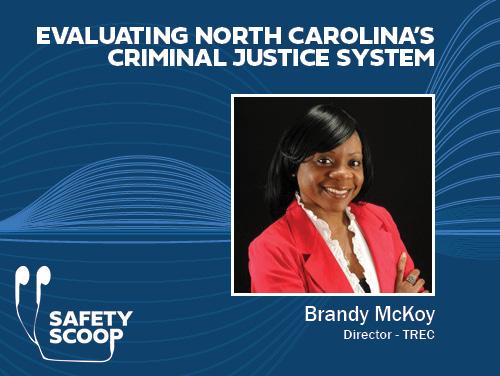
I'm thrilled to start off our first episode of season 3 by shining the spotlight on an initiative that is still in its infancy but is making great strides throughout the state. Today, I get to speak with Brandy McCoy, the director of TREC, otherwise known as the Task Force for Racial Equity in Criminal Justice. Established in 2020 by Governor Roy Cooper, the task force focuses on addressing existing policies and procedures that disproportionately affect communities of color and developing solutions to ensure racial equity in North Carolina's criminal justice system. Originally housed within the North Carolina Department of Justice, the task force found a new home in the Department of Public Safety at the start of 2023. I'm excited to introduce you to Brandy, and the task force, and to hear about what has been accomplished in the last year and what lies on the horizon.
Well, let's just start out: tell us a little bit about yourself, your role and what you've done in your time here at DPS.
Brandy McCoy: Well, I have been with DPS since 2013, originally hired as a Criminal Justice 2 Planner with the State Highway Patrol. From there I was promoted to the Budget and Grant Supervisor in 2017. And then in 2023, when TREC was transitioned over to the Department of Public Safety, I was asked to serve as the role of the TREC Director. So, I have thoroughly enjoyed my time at DPS and all the various roles that I've been able to be a part of since being hired.
Kirsten: What is TREC?
[Both laugh]
Brandy: Very good question. So, TREC stands for the Task Force for Racial Equity in Criminal Justice, and this task force was created as a result of the murder of George Floyd in 2020. Governor Cooper, through Executive Order 145, created this task force to look at North Carolina's criminal justice system and just kind of figure out where we had some racial inequities in various parts of the system. And so, this was 25 members that were appointed to really come together and look at our criminal justice system as a whole and make recommendations as to how we can make it a more fair and equitable criminal justice system in North Carolina.
Kirsten: When you say the system and the criminal justice system, let's take a look at that across the state, and really, what does that entail? I mean, what do people need to know are the different parts of our criminal justice system in North Carolina?
Brandy: Yeah, absolutely. We're looking at anything from the executive positions or the executive portion of the system all the way down to the legislation and some of, like, the local policies at the local level. And so, one of the things that has been very instrumental in TREC from its inception is the way that the committee has kind of broken down some of the recommendations and the committees that they fall under which tie directly to various points of contact within the criminal justice system.
Kirsten: With the transition of TREC from the Department of Justice to the Department of Public Safety came additional changes and terminology. Brandy clarifies how the task force has evolved over the years.
Can you take us through when you say TREC 1.0, what does that mean, and how is it transitioned to this now 2.0 TREC that we have now?
Brandy: Absolutely. So, the Task Force for Racial Equity in Criminal Justice was established in 2020 from Executive Order 145, and it was at that time that the co-chairs of TREC was Attorney General Josh Stein and Justice Anita Earls. And given the co-chairs, TREC reside with the Department of Justice, or what I may refer to in this interview as DOJ. And so, the 25 members that were appointed for this TREC committee basically looked at TREC as a whole and our criminal justice system as a whole and said, “How do we create a more fair and equitable criminal justice system in the various components of the criminal justice system?” Again, such as executive and judicial and legislative.
And so, the members of this group took about two years and, though many meetings and lots of conversations, came up with 125 recommendations that they proposed would make North Carolina have a more fair and equitable criminal justice system. Now, when I talk about these recommendations, these recommendations varied across the spectrum because this group looked at the system as a–as a whole system, so some of these recommendations may have fallen under the judicial. You know, responsibility for the courts. And then, some of them may have fallen under policies and procedures to improve law
enforcement practices, and then some of them were legislation changes that needed to be made to make our system more fair and equitable. But again, TREC 1.0 under DOJ took those two years, and they looked at our system and came up with 125 recommendations.
It was the committee's responsibility to provide the governor a report at the end of each year to pretty much let not just the governor but North Carolinians kind of what was going on with TREC and what TREC was doing when as far as looking at this criminal justice system as a whole. And so, the original executive order was scheduled to run through the end of December 2020. When the members released a report to the governor, it was some great recommendations, included in this year-end report. And so, the governor wanted the work of TREC to continue. He didn't want it to just be a committee to come and put recommendations together, and then no actions were done to look at the recommendations as a complete system and–and move forward with implementation.
So, in December of 2022, he did another executive order, Executive Order 273, basically extending TREC’s work and saying, “We want you to take these 125 recommendations, and let's look at the implementation phase of these recommendations.” And so, that was the creation of TREC 2.0 in which TREC was transitioned from the Department of Justice to the North Carolina Department of Public Safety. And so, when you hear me say “TREC 1.0,” I’m really referring to when it was housed under DOJ, and then if you hear me say “TREC 2.0,” the transition to DPS under the extension of the new Executive Order 273. But again, with this extension, Department of Public Safety was now the new house of TREC, and then the co-chairs was still Justice Anita Earls, and then, now, the governor appointed Secretary Eddie Buffaloe to be the new co-chair of TREC who’s also our Secretary of the Department of Public Safety.
Kirsten: You’ve given us the background of TREC 1.0 and 2.0, but are there any differences between the TREC before 2023 and what it is now?
Brandy: I can say yes and no. So, originally, again with TREC 1.0, that was a 25 members were appointed to be a part of TREC 1.0. With the extension of TREC and now transitioning over to DPS, that new executive order created 27 members that were appointed to address TREC. So, that is one of the changes that we've seen. I will say when it was with Department of Justice, TREC 1.0, some of the structure of TREC we did not change. Again, when they created the 125 recommendations, those recommendations pretty much fell into one of four categories, and so TREC 1.0 split basically the work of the recommendations into four committees. These, you had your executive committee, judicial committee, legislative committee and then you had your local policy committee. Those four committees came out of TREC 1.0 based upon the recommendations and where the recommendations fall.
TREC 2.0, we decided to keep those same committees because TREC 2.0's focus was implementation. We knew that TREC 1.0 came out with 125 great
recommendations, but now it was trying to basically look at implementation of these recommendations falling within one of those four committees. And so, we had a planning meeting at the beginning of 2023 in which DOJ worked with DPS staff to transition TREC from DOJ to DPS. 125 recommendations is a–is a lot of recommendations, and it's a big undertaking, and we knew that we wouldn't be able to address all 125 recommendations in the span of 2 years. But what the committees wanted to do was look at, you know, two or three recommendations that they felt like they could implement within the 2023 year. And so, our planning meeting again kicked off in January 2023 where DOJ transitioned TREC to DPS, but we also allowed our members to really talk about what the implementation projects or initiatives for each of their committees was going to be for 2023.
Kirsten: These 27 members were appointed by Governor Roy Cooper and include attorneys, DAs, deans at universities, community activists, members of law enforcement, legislators and other professionals. According to Brandy, all TREC members believe in the mission and are dedicated to the end goal of the task force which is to ensure a fair and equitable criminal justice system for all in North Carolina. Committee members meet at least once a month, and all four committees meet to report on progress and provide feedback quarterly.
You mentioned that the task force originally released 125 recommendations, so where does the current task force stand with these recommendations?
Brandy: We just released our year-end report for 2023 to talk about the 125 recommendations and the status of each of those recommendations. I am happy to say that we have really done phenomenal work when it comes to TREC over the last 3 years, and as the publishing of our most recent report, 24 of the 125 recommendations have been marked as successful. And so, to me that's a win, you know? Over a three-year expanse we were able to identify 125 recommendations to make our North Carolina criminal justice system more fair and equitable, and 3 years into the project we are able to mark 24 of those recommendations as successful, to me is a win for the state of North Carolina.
We do realize that there's still more work to be done, and so there are a lot of our recommendations that are, you know, in progress or partially successful. And even if it's in progress or partially successful, you know, it is still initiatives that we're looking at kind of moving forward to this successful status from the year-end report. But I would encourage anyone who would like to just, you know, get to know more about the recommendations and the status of them to take a look at our most recent report, and at the very end of the report you can find the recommendation chart listing all 125 recommendations and the current status of them.
Kirsten: Can you take us through the last year of TREC? What are some big accomplishments, and were there any challenges that you faced last year?
Brandy: I think that’s a great question, and I may be a little biased as a TREC director, but I feel like we made great strides in 2023. It was a bit of a learning curve for us as we transitioned TREC from DOJ to DPS because again, for the first two years DPS wasn't heavily involved in, you know, TREC, and so when we found out that TREC was now going to be residing within DPS, it was a time for us to really work with our partners at DOJ to make sure that it was a successful transition. And so, when we talk about, you know, our year 2023, it’s hard to believe that the first 12 months of TREC went by so fast because it just seems like it was just 2023 when we were sitting in the planning meeting and really talking about implementation and what we were going to do throughout the course of the year.
I will say it was at our planning meeting in 2023 that we talked about TREC Recommendation 4 which deals with the violence prevention initiative for the state of North Carolina and looking at more violence prevention community programs throughout the state of North Carolina. Well, during our planning meeting of 2023, a resolution was brought to the committee, and basically the committee voted to adopt a statewide Office of Violence Prevention. Once the committee or the TREC members voted on that resolution and it favorably passed, Governor Cooper enacted Executive Order 279 which created a statewide Office of Violence Prevention in North Carolina, and so that was a big win. And, you know, one of TREC’s big successes for the 2023 year. For those that don't know, the Office of Violence Prevention is a partnership with DPS and the Department of Health and Human Services, and the purpose of OVP–Office of Violence Prevention–is to use a public health approach to impact statewide strategies to reduce violence. That is one of our greatest accomplishments. Our OVP director, Doctor Gerard Tate, was hired in July of 2023 and just has hit the ground running making great connections throughout the state and working with our partners to really look at violence prevention as a whole throughout the state.
One of the other accomplishments I want to talk about came out of the executive committee, and this committee was tasked at looking at early intervention and use of force, and those relate directly to TREC Recommendations 34 and 35. And under the direction of Secretary Buffaloe, he’d advised that we create a work group of DPS law enforcement entities. And so, when I talk about DPS law enforcement entities, I'm referring to State Highway Patrol, State Capitol Police and Alcohol Law Enforcement. But again, Secretary Buffaloe, under his direction, convened a work group of individuals from all of these entities to look at the use of force and early intervention policies within their entities and challenged his group to come up with a consolidated and standardized policy about reportable use of force in early intervention. So now, instead of having three separate policies from three different law enforcement entities, we now have one standardized DPS policy for use of force and early intervention that those law enforcement entities are using in their daily practice. That is a huge win because, again, that was one of the–or two of the recommendations that came out of the–the recommendations during TREC 1.0.
And so, if we talk about a different accomplishment, the judicial committee, they looked at re-entry. And for those of you that don't understand what re-entry is, basically re-entry looks at some of the struggles that the offender population face when they’re released from prison and reintegrated back into society. And so, we've had some conversations about successful re-entry and some of the challenges that these individuals may face and what we could do as a committee to kind of help curve some of these barriers or fix some of these challenges. And so, one of the projects that the judicial committee decided to do was hold a re-entry simulation. And this simulation is basically an exercise that give individuals a little sample or a little taste of some of the barriers that this population may face when they are released from incarceration and returning back to their communities. Some of these challenges could be, you know, or barriers, could be barriers to housing or employment or just simply, you know, getting a driver's license. And so, the judicial committee really want to bring more awareness to this issue and look at ways that we can partner with various organizations throughout the state to look at re-entry as a whole. We took this idea, and we hit the ground running, and we had great partners. NCCU was a partner and provided the space for us to hold the re-entry. The North Carolina Department of Adult Correction (DAC) was a great partner because they have a whole division dedicated to re-entry, and so we worked with those identified partners and put together this re-entry simulation and brought various stakeholders throughout the community to come together to spend about an hour, an hour and a half kind of walking in the shoes of someone who has been incarcerated and returning back to their community. And so, that was definitely a win for the judicial committee. They are looking at doing additional re-entry simulations in 2024, and possibly doing two more in 2024: one in the western part of the state and then one in the eastern part of the state.
The last kind of success that I want to mention is just our legislative committee. This committee decided to look at some hot topics in the state of North Carolina and host some bipartisan panel events to just bring more awareness to several issues within the state of North Carolina. And so, in 2023, this committee successfully held two bipartisan panel events. The very first one they held in April of 2023, and the topic of this one was driver license restoration. And they brought panels around the state and around the country together to talk about some of the issues and some of the barriers that come to driver's license restoration and just bring more awareness to this issue as it relates to legislation as a whole. The second one we held was in the fall, and that was around October. And that one was around the topic of juvenile life without parole. We brought various experts around the–the state as well as around the country and even having individuals who were formerly incarcerated as juveniles take part in this panel and really just bring some attention and awareness to some of the issues relating to the juvenile life without parole issue. Again, just wanting to highlight some of the successes that we had. Again, our report lists a whole lot more, but I just want to bring awareness to a couple that have been very instrumental to the success of TREC 2.0 in 2023.
Kirsten: Wow, sounds like it was a very busy year!
Brandy: Very! [Laughs]
Kirsten: But thank you for going into those three accomplishments that you listed, and I know there are many, many more that people can check out in the report. Something that stuck out to me a lot when you were going through these different accomplishments was it's not just the committee. I know people may think that, “Oh, there's only 27 people sitting around in a room talking” about ways to improve things that an average North Carolina citizen may experience, but it’s not. It sounds like it’s so much more. There’s community involvement and people that are involved with organizations to assist people facing re-entry or any other challenges that life may throw at us. And so that's–that's really interesting to hear the different types of community involvement that you guys have been able to bring on as part of this new initiative within DPS, TREC 2.0, and how you have plans to continue that. So, that's really encouraging and interesting to hear as someone who's not, you know, involved in this every single day. So, now that you've talked about some accomplishments from 2023, what is in TREC’s pipeline for 2024?
Brandy: So, TREC has a very busy year. As I mentioned earlier, we have completed 24 successful recommendations out of the 125, but we're not stopping. You know, we have 11 months left in this year, and we still want to hit the ground running. We have a very energized member who is really supporting the work of TREC and believes in the work of TREC and really want to make the North Carolina criminal justice system more fair and equitable. So, as we released the 2023 report, we did have a TREC planning meeting. We started a 2023 planning meeting, as I mentioned before, and so we felt like it was just the right thing to do to have another kind of planning meeting and kind of kick off our 2024 year. We held our kickoff meeting in January 24th of 2024 to really look at all of our accomplishments that we had done and figure out what we need to do to kind of keep the momentum going for the remainder of 2024. The four committees, you know, had the opportunity to take some time at these–at this planning meeting and sit down and really look at what goals that they wanted to implement or projects and initiatives that they wanted to implement for 2024.
One of the committees that I want to–to highlight–I didn't really get the chance to talk about them in our major accomplishments–but our local policy committee. Our local policy committee really looks at kind of local level, what’s being done kind of in our community, any grassroots type of thing and how it can kind of make North Carolina’s system more fair and equitable. And so, this group has really taken ownership of a couple of projects that they are very instrumental in, you know, seeing completed in 2024. They started looking at these projects in 2023 and just moving forward with them in 2024. But some of these projects that this particular committee is looking at is culture, you know, law enforcement culture, and what does that look like. We had a very great TREC committee quarterly meeting in which law enforcement culture was one of our topics in 2023 as well as one of our topics for the planning meeting in
2024. And so this group has really talked about the importance of just law enforcement culture as a whole. They are looking at a law enforcement culture project in 2024 and really drawing down and drilling down into what that looks like and what we can do in the state of North Carolina as a whole to tackle this issue. They did phenomenal work in 2023 in kind of laying the foundation for a lot of projects to kind of take off in 2024 that we will definitely give you those accomplishments at the end of the year for our 2024 report.
But again, what we are basically doing with, you know, the last remaining years of TREC is just really looking at those recommendations that we feel that we can continue to move forward. Will we address all 125 recommendations in the 11 months that we have left? Probably not. But again, we want to tackle as many as that we possibly can and so again, that ‘24 planning meeting was just instrumental because the committees really sat down and talked about and identified what recommendations that they want to implement for 2024 moving forward to kind of just get more successful recommendations at the end of this year. So, I'm super excited about the direction that TREC is taking and kind of the work that we're going to be doing as we kind of close out our 125 recommendations through the end of this current executive.
Kirsten: With less than a year remaining under Governor Cooper's executive order, TREC has already started off 2024 in full force. During its first meeting of the year, TREC unanimously passed a resolution that fully supports the creation of a statewide victim/offender dialogue program within the Department of Adult Correction that promotes equal access to VOD throughout all North Carolina correctional facilities and community supervision programs.
The purpose of VOD is to bring together offenders and victims of a crime to provide an opportunity for them to engage in open and facilitated communication to address the harm caused, understand the impact of the offense and find ways to promote healing and resolution. You can find the annual report and other supporting documents for TREC in the show notes. Feel free to visit the DPS or DOJ TREC pages for more on meetings, task force members and notes.
Now I get to talk about you a little bit!
[Both laugh]
I know you have many, many years of service with the Department of Public Safety, and you are now the TREC director. So, what interested you in this role?
Brandy: I can honestly say I've always had a passion for juvenile justice, criminal justice as a whole. So, earlier in my career, I was employed with the Department of Juvenile Justice and Delinquency Prevention as a juvenile court counselor, and that kind of gave me my first taste of being in an environment working with court adjudicated youth and the resources that they need to be successful in the community. And while I absolutely loved that job, I really felt like I would be
more effective in looking at some of the policies and procedures related around some of the youth that were court involved youth in the state of North Carolina and just the resources needed to make them successful in their endeavors.
And so, I transitioned over to the Governor's Crime Commission and was hired as a Juvenile Justice Planner 1. And pretty much in that role, I was given the title of Disproportionate Minority Contact Coordinator, which stands for DMC. That's a mouthful, so we would just call it DMC, but the DMC coordinator really looked at the criminal justice system as a whole and looked at where there was some disparate treatment at various contacts within the juvenile justice system. So, whether that contact was at entry with law enforcement, or if it was at the adjudication part of the contact system, or even, you know, at the end of the contact system, we looked at the various points of contact that individuals have with these kids and looked at where there was some disparities and what we could do to kind of curve some of these disparities and bring this down.
During that time, we had a great partnership with the Department of Juvenile Justice and Delinquency Prevention, and they use something called a relative rate index, and we use that index from information gained from the NC-JOIN system which is the Department of Juvenile Justice’s kind of database that they keep all their information on their court adjudicated juveniles about where this disparity exists. And so, instead of sitting around and trying to guess what contact point there was some disparity, this relative rate index specifically told us at what contact point we had disparities. And so that we were able to then focus on that contact point and really drill down and look at initiatives and projects that we could implement to address that contact point. So, I was lucky to and blessed to have been chosen to–to be in the role of that job, and it was just a very rewarding job. North Carolina was looked at as a model at that time because other states didn't have a database or a relative rate index that they could utilize.
It's kind of full circle for me because, again, in that role I was able to look at some disparities at various contact points in the criminal justice system, and then you fast forward to now, being able to serve as a TREC director to look at disparate outcomes in the criminal justice system as a whole has just been full circle for me, and just a job that I am blessed and thankful to have.
Kirsten: Is there a way that people can find out more about TREC outside of this podcast, and where can they go to learn more?
Brandy: As I mentioned earlier, TREC 1.0 was housed under the Department of Justice, and they created a phenomenal website at the start of TREC that really talked about a lot of the things that were working for them well in TREC 1.0 and a lot of the successes that they have had during TREC 1.0. And so, if additional information is needed, or anybody wants to look at some of the past initiatives of TREC, especially when it was TREC 1.0 before it was transitioned to DPS and TREC 2.0, I would definitely suggest to go to the DOJ's TREC website. And they can look at just, you know, past committee members, past reports, there are
some model policy guides up there, but just a lot of great historical information about TREC from its original inception.
Kirsten: If–if you were to give one word that kind of summarizes–an adjective that were to summarize what TREC is to the state of North Carolina, what would that be?
Brandy: I would say hopeful. And the reason why I would say hopeful is, prior to 2020, this didn't exist. And so, you know, it’s unfortunate that, you know, certain circumstances have resulted in the need for this, but it's a call to action. And I'm so excited about just what North Carolina has done as a whole as it relates to making our criminal justice system more fair and equitable. So, when I say, “hopeful,” hopeful in the fact that we will continue to move this ball forward.
Kirsten: I love that! Any final thoughts, any anything else you want to share with our listeners about TREC?
Brandy: I do. I definitely want to just take a moment to just, you know, give some thank you and acknowledgements because this isn't a one woman show. There's a lot of support and a lot of guidance that comes behind the scenes and a lot of partnerships. And so, I first want to start with our partnership with DAC, Department of Adult Corrections, as well as Department of Justice (DOJ), who have just been great partners in the transition of TREC from TREC 1.0 to TREC 2.0. Even down to just the success of many of our initiatives, they were vital partners to–to partner with during 2023 and just was a pleasure to work with, so I definitely did not want to not thank them publicly for just all of their help and support in transitioning TREC to DPS as well as kind of helping TREC accomplish many of our successes in 2023.
I also would be remiss if I did not take the time to really thank the DPS staff who basically stepped in from the very beginning and really served as great leaders in our TREC initiatives. We have many DPS leaders involved that have other full-time jobs and responsibilities here at DPS but really have also taken on this additional responsibility of helping TREC be successful while it is at DPS. And so, I first want to start by just publicly thanking Secretary Buffaloe who serves as the–or one of the co-chairs for our TREC committee who has really embraced TREC since it was transitioned here and really given a lot of support for making sure that it was successful as it’s being housed under DPS.
To that note, I kind of want to take a moment as well to individually thank all of the DPS leadership that serve as staff leads. I want to start with Miss Cara Bridges, who staff leads our executive committee; Laura Howard, who staffs our judicial committee; Caroline Valand, who staffs our legislative committee; Sherry Hunter and Ashby Ray, who staff our local policy committee. Their partnership, their support has just been invaluable and a great part of why TREC has been so successful here at DPS. And then lastly, I also want to thank Miss Elaine Evans who serves as our administrative support for TREC. Miss Evans wears many different hats, but she makes sure that all of our TREC administrative, all of our quarterly meetings just go off without a hitch. So, I
would be remiss if I just didn't have the opportunity to thank the wonderful team that helps me make TREC be so successful here at DPS.
Kirsten: That's very nice of you!
Brandy: This isn’t a one-woman show, like, literally. This is a–I have to thank them.
[Music]
Kirsten: Well, thank you for joining me on the podcast! We made it.
Brandy: Yes, we did!
Kirsten: [Laughs] You did great.
[Pause]
Conclusion
[Music]
Kirsten: This is the Safety Scoop, a podcast written, produced and edited by the NCDPS communications team. The mission of the North Carolina Department of Public Safety is to safeguard and preserve the lives and properties of the people of North Carolina through preparation, prevention and protection with integrity and honor. Follow the department on social media for a closer look at ongoing initiatives and resources. We're on Facebook, X and Instagram at NC Public Safety. If you enjoyed today's episode, be sure to subscribe to the Safety Scoop on your favorite podcast app. I'm your host, Kirsten Barber. Thanks for listening.
[Music]