
Community Emergency Response Team - Safety Scoop Transcript
Introduction
Kirsten Barber: Before the episode starts, I'd like to let our listeners know that part of this episode includes a discussion about response to the devastating impacts of Hurricane Helene in Western North Carolina. This storm was nothing the state has ever experienced before, and while we will recover, it will take a long time to rebuild and return to the way things were. Lives were tragically lost, and for those who survived, their lives have been forever changed. Some of you listening may not be ready to hear about these topics right now, and that's okay. If that's you, I invite you to skip this episode and come back another time if you'd like. Natural disasters are traumatic for individuals, families and communities, and there is no right or wrong way to feel. If you're experiencing stress, anxiety or feeling overwhelmed after Helene, call 1-800-985-5990 to talk to someone today. Phone lines are open 24/7.
[Music]
Kirsten: You're listening to the NCDPS Safety Scoop, a podcast that dives into the stories of the people, programs and resources within the North Carolina Department of Public Safety. Each episode, we’ll give you the scoop from department personnel on how NCDPS enhances the safety of the people of North Carolina.
Season 3 Episode 10
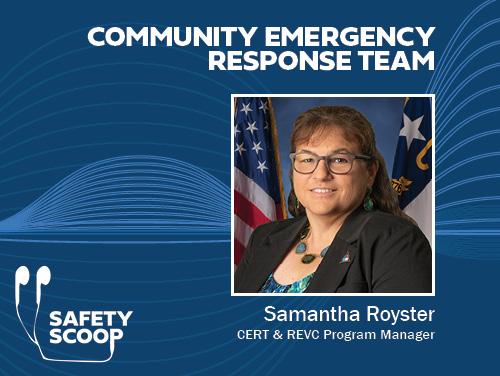
Kirsten: What do fire extinguishers, traffic control, acting and first aid have in common? The answer is that they are all components that a Community Emergency Response Team member, or CERT member, may be called on to do or use any time there is a need. Initially, Community Emergency Response Team programs were developed to assist communities in taking care of themselves in the aftermath of a major disaster when first responders are overwhelmed or unable to respond because of communication or transportation difficulties. As the CERT concept has taken hold across the country, CERTs have become much more than originally envisioned. CERTs have proven themselves to be an active and vital part of their communities’ preparedness and response capabilities. In this episode, I sit down with the North Carolina Division of Emergency Management’s CERT Program Manager Samantha Royster to learn about these teams that are active across North Carolina.
Samantha, to get started, I’d just like you to introduce yourself to our listeners, um, your role and how long you’ve been with Emergency Management.
Samantha Royster: Yeah, so, I’m really happy to talk with you today. My name is Samantha Royster, and I am the CERT program coordinator, CERT with a “C,” for the state of North Carolina. And so, that means what I do in my role is I help programs get started.
So, if you lived in a county that did not have a CERT program and you were interested in starting one, that's a big part of my job and why I'm here is to help new teams get started across the state. Or if you do have an existing team and you're looking for some training or you have some ideas or questions about how to run your CERT program, myself and my colleague are here for that as well.
I have been with North Carolina Emergency Management for 10 years. This past April was my 10-year anniversary with NCEM, and I've been in this same role the whole time. And I–I really love it, and I find it just very rewarding work.
Kirsten: Wow! Congratulations on your 10-year anniversary!
Samantha: Thank you!
Kirsten: Can you just give me the rundown of what is a Community Emergency Response Team, and how were you first introduced to it?
Samantha: The first part of that, what is a Community Emergency Response Team? So, in order to start a team, the first thing that someone would need is a sponsoring organization. In North Carolina, that is most often a fire department. And that sponsor—I know the word sponsor we tend to think of a monetary kind of contribution to it, but it doesn't necessarily have to be monetary—what it means is that agency or organization basically has ownership of the CERT program, meaning that they help to decide after CERT Basic Training, which every volunteer must take to become a member, beyond that what kinds of training does that agency want them to have so that they can be an asset in their own community.
For example, in Apex, the fire chief asked the team to do a specialized training in firefighter rehab, so that if there's a large fire where they're going to be on scene for an extended period of time, the firefighters will have to rotate in and out of actually fighting the fire, and they, between the times that they’re in, they have to come out of the fire and take their gear off and cool down and hydrate and get their vitals checked, and those are the sorts of things that CERT volunteers can do to help out and then free up ambulances, EMTs and paramedics to actually help people who might be injured at the fire. So, that–that's a role that Apex CERT has taken on.
Many communities use CERT volunteers for things like helping to shut down the streets in your town when you're going to have a parade. Before I got involved with CERT and Emergency Management, I never really thought about how much goes into just shutting down the main street of your town to have a parade. There’s so much you have to think about in terms of closing the streets to traffic and making sure that your first responders can still get around town even with those closures, and they're just so many different things that CERT volunteers can do.
The way I first got involved was I actually worked in veterinary medicine for many years. I had basically every job except actually being a veterinarian, and I had sort of plateaued in that career, and I was looking for something different. And I have always really admired first responders and was sort of trying to get more involved in that. And I, uh, lived in Apex at the time, and they had a citizen’s police academy, and I took that. And they had started a group called CAPA which is Citizens Assisting Police in Apex, and I joined that. And then the fire department put on this CERT Basic Training class, and I took that as well. And I really, I just fell in love with it, and that was in 2010.
[Laughs]
So, I've been involved with CERT for 14 years and, um, and worked at Emergency Management for 10 years, so very deeply involved on a personal and professional level.
Kirsten: Got it; thank you for sharing and for going through some of those examples, as well, that you've seen, uh, CERT teams be involved with. Um is there–are there any other general type of emergencies that these CERT–CERT teams can assist in responding to?
Samantha: Absolutely! Um, we, well, we do have a basic training class that goes over kind of the broad strokes of things that, um, CERT volunteers can do. When I'm talking to emergency managers across North Carolina about a CERT program, I basically encourage them to think any time they feel like, “Boy, I wish I had even five or ten people to help me get this job done,” think about your CERT volunteers.
Kirsten: Common tasks CERT members are trained for include but are not limited to distribute and/or install smoke alarms and batteries to those living in low-income housing, assist with evacuations and traffic control, promote community awareness of potential hazards and preparedness measures, supplement staffing at special events like festivals and parades, act as victims in training exercises and drills, assist with vaccine clinics.
Samantha: We never taught about or even talked about doing things like vaccine clinics and then 2020 came along, and you know that there's a lot more involved in a vaccine clinic than actually getting the shot in your arm. So, there's traffic control. There's parking. There's observing the patient after they've had the vaccine to make sure there's no reaction. There's data entry where you have to, uh, you know, keep track of who’s getting the vaccine and entering all that information in. And CERT volunteers helped with all of that during COVID and, especially in North Carolina, put in thousands of hours in COVID response. So, really, um, there's, uh, things that CERT volun-volunteers can do are almost endless. We do have a few parameters that we–we say are beyond the scope of CERT, but–but they’re–the–the range is pretty broad.
Kirsten: I'm assuming here, but CERT teams are not just confined to North Carolina. I mean, these teams exist across the nation. Is that correct?
Samantha: That is correct, yes. Um, the very first CERT program started out in Los Angeles with the–the LA Fire Department there, and that was 1985, so it's been around a really long time.
[Laughs]
We’re about to have our 40th anniversary next year, so pretty excited about that. There are CERT programs in every US state and territory and, em, CERT is actually growing internationally, as well. My husband and I (my husband is a paramedic and–and helps me also with teaching parts of the CERT program), we got the opportunity to travel to Moldova back in 2019 to teach CERT in Romanian. So, we do not speak Romanian, but we had interpreters with us the whole time and, um, that was–that was also very fulfilling.
Kirsten: What a great opportunity. So, why is it important, um, to have these teams, uh, nationally or internationally, as you just shared?
Samantha: So, um, I think, especially with what's just recently happened with Hurricane Helene, which is of course larger than any of us have ever experienced in our lifetimes, when we have a big event like that, our first responders and emergency managers, they're really spread thin and there just aren't enough of them to be everywhere. And so, we want to train people how to take care of themselves and their families before, during and after a disaster so they can help themselves.
Um, if you look at Western North Carolina, you couldn't even pick up the phone and call 911 for weeks because there were no phone lines. There–there was no power. There were no cell towers, so you could not even call for help. Um. And a lot of times, we see even in eastern storms that if you can call 911, they may have to sort of triage the calls and say, “Well, we have more pressing needs and we can't get to you right now. So, we've got your information, but we just can't get there quite yet.” So, we want people to have the skills and the knowledge and the confidence to be able to take care of those things themselves until those first responders can arrive on scene and–and administer more advanced aid if necessary.
And you just never know what's going to happen. Um, it–it was developed, as I said, in Los Angeles primarily for earthquake response. Uh, we do have little, teeny earthquakes here in North Carolina, but as you know, they have very large earthquakes in–in California. And so, it could be that there could be a large, um, say, a large apartment building, so you have a lot of people possibly trapped in there after an earthquake. And we want them to know what to do to take care of themselves until the fire department can get to them.
Kirsten: Do you need any special skills to be part of CERT teams, or are there any special requirements for individuals who want to get involved?
Samantha: That's one of my favorite things about CERT is it truly is accessible to anyone. Generally, for deploying out to a disaster, you do need to be over the age of 18; however, we have seen folks as young as 12 taking CERT Basic Training. We have, um, school-based, uh, generally high school-(usually)-based teams, and I've even had students up into their eighties take CERT training.
There are no prerequisites. You don't have to have any knowledge coming in. Um, it doesn't even matter about your own physical abilities. I have taught folks who were blind, deaf, blind and deaf, individuals who use wheelchairs or walkers. Um. There are just so many skills that people can use by taking CERT training, and even if someone might not be physically capable of, say, holding a fire extinguisher to put out a fire, when they take CERT training, they know how it works and they could talk someone else through it and tell them how to operate that extinguisher to put the fire out or how to do a head-to-toe assessment on someone who maybe has passed out on the floor and the person is using a wheelchair, so they can't get on the floor to help them, but they can talk someone else through it and have the knowledge to know how to do that and then to know how serious is it. Do we need to call 911? What’s happening here? And just knowing how to get advanced care for that person.
Kirsten: And what you just spoke about, I think that really speaks to that “C,” the community part of the…
Samantha: Yeah.
Kirsten: …acronym, the–the community-building and everyone getting involved together.
Samantha: Absolutely! Throughout Emergency Management, we talk a lot about the whole of community and how important it is that we as emergency managers, our plans need to encompass everyone in the community from the youngest to the oldest, from the fittest to people who maybe have mobility issues, and everybody in between and just make help accessible to everyone.
Another thing we've been doing here in North Carolina that I'm really excited about is, um, last summer we started offering the CERT Basic Training class in Spanish as well. We have a large Hispanic population across North Carolina, and they’ve trained now I believe close to 200 individuals in multiple classes since last year in CERT in, ah, 100% done in a Spanish-speaking class. So, it's really exciting to be able to reach out to that community.
Kirsten: That is exciting news. Are there any skills that you think are really valuable that people can bring to these teams?
Samantha: You know, I think the most important skill is enthusiasm and being able to work as part of a team. We see that so often in CERT volunteers if they're just willing to pitch in and help out in whatever they need.
We do have two of the eight units in CERT Basic Training are based in medical knowledge. One–one of those is on triage and how to sort when you have multiple victims that need help, how do you know who needs help first? Who’s in the most serious condition? And the second medical chapter is about treating. So, once we have sorted the people, how do we give treatment to those who need it? So, there is sort of a heavy emphasis on medical skills, but you don't necessarily have to bring those skills to the class. We'll teach you in basic training everything you need to know for the level of the CERT responder. Now, I have had several students who had never done any medical training before, and they took CERT Basic Training, and they enjoyed it so much they went on to do further training and have become EMTs and paramedics because of finding their enjoyment for that in CERT training.
Kirsten: Oh wow! That's so interesting that this training has inspired people to pursue, um, things professionally.
Samantha: Yeah, it is.
Kirsten: If we can go back now to Hurricane Helene response, um, and just speak kind of specifically to, um, how CERT has assisted in the last several weeks. Um, as–as we're recording today, how has CERT been utilized during the, um, response for Hurricane Helene?
Samantha: I would love to talk about that. One thing that's a little challenging is because of the devastation and–and incredible damage to Western North Carolina, we have not deployed any CERT volunteers out to the damaged areas. Um. The people that are working out there are mostly firefighters who have, say, urban search and rescue and know how to deal with collapsed structures or swift water rescue teams. So, while we may not have had them directly in those areas, there are some really important and exciting things they've been doing.
One that may not sound super exciting but is a really important task to get done is at our State Emergency Operations Center, or our EOC—we love our acronyms in emergency management—we have a front desk. So, everybody who comes in the building has to sign in there, and many people are coming to the EOC right now that don't work there on a regular basis, so they don't know where they're going or where they're supposed to be, and we need people at that front desk who are knowledgeable and welcoming and have a great attitude and are friendly. And since September 30th, that desk has been staffed 12 hours a day, every single day, by CERT volunteers. It warms my heart to see them when I come in, um, when I come into the office. And they're just doing a fantastic job there helping people with whatever questions they may have.
Um, a bigger job that has involved a larger number of people is there was a–a call center set up. It's the 211 call center, which generally after a disaster, you can call 211 for resources. Say you need some food or medical assistance, that’s a phone number where you can reach out for those resources. Well, in Western North Carolina, there were some 911 centers that were damaged, and so people were not able to reach out directly for help with missing persons, and as you may be aware, there were a large number of missing persons. At one point it was in the several hundreds of people that were unaccounted for. So, if you had a loved one in Western North Carolina (say they lived in Asheville, and you hadn’t heard from them), you could call 211 and file a missing person report or a welfare check request, and that information would be taken down and acted upon. And then a couple of days later, you would get a call back (most likely from a CERT volunteer) asking, “Have you heard from your loved one? Is there an update on this case?” Hopefully the person can say, “Yes, we found them, and they're safe and everything's great,” and we can close that ticket out. That's what we always hope for.
There are unfortunately many instances where the person is still missing, and so the CERT volunteer then has a website where they're filling in a form as they're talking to the person and then those calls get escalated up to the search and rescue dashboard. And we had over 400 volunteers involved in that endeavor across primarily Franklin County and Wake County where they were making the calls from, and they put in close to 3,700 hours just making phone calls. And the call volume, it's–it's almost–it's almost too hard to wrap your head around, but there were some 6,000 phone calls made by these volunteers following up with–with people who were making reports, not all of them within North Carolina. The 211 also had a phone number you could call from out of state, and even they were getting calls from around the world. I think the furthest away was from Japan, someone calling to check on a loved one they knew lived in Western North Carolina. And every one of those calls got a personal callback by an actual person. Not all CERT volunteers; there were others involved as well, but I have to give the shout-out to the CERT volunteers.
[Kirsten laughs]
Samantha: Um, they made that personal connection with the person on the other end of the phone, and I think that was–that was just a tremendous job.
Kirsten: I–I think it's important to remember that these are volunteers. Um, they're not being paid.
Samantha: That is correct.
Kirsten: Were these 400 volunteers from North Carolina?
Samantha: The ones that I'm speaking about, they–they live here now, yes. So, they're probably involved with a CERT program here in Central North Carolina. Or in the case of Franklin County, um, they–it's one of our newest, youngest CERT
programs in the state. The Youngsville Fire Department started a CERT program just this year, and they only have maybe 30 members at this time, but they brought in about 300 people from their community to help with these phone calls. And now many of those folks want to take CERT training because they were able to get involved in the process and see what a great asset the CERT volunteers are, and they want to be part of it, too.
Kirsten: So, just 400 people from North Carolina. So, I think that speaks to how many individuals across the state are already part of these programs, but what about people who are either listening or have seen news about these teams. How can they get involved if they're interested?
Samantha: That is a great question and one of my favorites. Um, if you're in North Carolina, you can visit readync.gov, and when you get there, go up to the right. There's a tab that says “get involved,” and a menu will pop down, and you can click on “CERT.” And we have a list there on that page that lists the current existing CERT programs in North Carolina. If you don't happen to see your own county represented there, then we have an email address there as well. Uh, it's just CERT (C-E-R-T) at ncdps.gov [cert@ncdps.gov]. And we, my-myself and my colleague, will be happy to work with you and your community to help get a program started. If you're outside of North Carolina, you can go to ready.gov/cert (that's FEMA's CERT website), and you can search there by your ZIP code. So, wherever you live, you put in your zip code, and it will show you the CERT programs that are closest to you.
Kirsten: Perfect. Well, Samantha, it is so apparent that not only do you have so much knowledge—I mean, 14 years with CERT, 10 years with Emergency Management—but also just an overwhelming passion for this work. I wanted to give you the opportunity to close out with any success stories that come to mind or just something that when you think or talk about it just makes you so proud to be involved in this type of community outreach and community, um, programming.
Samantha: There are so many stories I could think of over the last 10 to 14 years of my involvement with CERT. And I have to say that this–this response to Helene has got to be up there in–in the top five on the list. To see so many people give so much of their own personal time to help out others in need, it, um…
[Exhales]
I can get really emotional if I think about it, because I am a little sappy that way, but just knowing there's so many people out there that care about their communities is…
Whenever I start a CERT Basic Training class, the very first night when we do our introductions, I always ask people… Yeah, I want to know their name and where they're from, but I always ask them, “Why are you taking a CERT Basic Training class? Why are you here?” And for the most part, what I hear is people saying,
“I'm here because I want to know what I can do to give back to my community,” and that just makes me so proud that–that we live in a culture where volunteerism is so huge. Um, if you look back at the history of this country, it was really founded on the backs of volunteers, and it just makes me really proud that it's still so alive today and that people are always looking for a way to give back.
Kirsten: Anything else that you would like to share with our listeners before we close out?
Samantha: Um, yeah, I… First of all, I may be biased, but I think everybody should take CERT Basic Training because whether you choose to join a team or not, what you'll learn in the training is some really good basic skills for life to keep yourself safe, to take care of your family and, you know, just things that you need to know. And it doesn't matter how old you are or how young you are or your abilities or different abilities. We welcome everybody to CERT training, and I want to see everybody take the class.
Kirsten: Well, thank you for joining. I really appreciate you taking the time to speak with me.
[Music begins]
Kirsten: And thanks to all those volunteers out there who are helping with the response effort.
Samantha: Thank you, Kirsten. I enjoyed talking with you.
Conclusion
[Music]
Kirsten: This is the Safety Scoop, a podcast written, produced and edited by the NCDPS communications team. The mission of the North Carolina Department of Public Safety is to safeguard and preserve the lives and property of the people of North Carolina through preparation, prevention and protection with integrity and honor. Follow the department on social media for a closer look at ongoing initiatives and resources. We’re on Facebook, X and Instagram at NC Public Safety. If you enjoyed today's episode, be sure to subscribe to the Safety Scoop on your favorite podcast app. I'm your host, Kirsten Barber. Thanks for listening.
[Music]