
Repairing Communication Networks After Helene - Safety Scoop Transcript
Introduction
Kirsten Barber: Before the episode starts, I'd like to let our listeners know that part of this episode includes a discussion about response to the devastating impacts of Hurricane Helene in Western North Carolina. This storm was nothing the state has ever experienced before, and while we will recover, it will take a long time to rebuild and return to the way things were. Some of you listening may not be ready to hear about these topics right now, and that's okay. If that's you, I invite you to skip this episode and come back another time, if you'd like. Natural disasters are traumatic for individuals, families and communities, and there is no right or wrong way to feel. If you're experiencing stress, anxiety or feeling overwhelmed after Helene, call 1-800-985-5990 to talk to someone today. Phone lines are open 24/7.
[Music]
Kirsten: You're listening to the NCDPS Safety Scoop, a podcast that dives into the stories of the people, programs and resources within the North Carolina Department of Public Safety. Each episode, we’ll give you the scoop from department personnel on how NCDPS enhances the safety of the people of North Carolina.
[Music]
Season 3 Episode 11
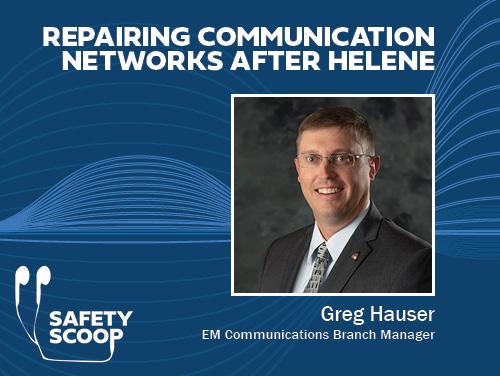
Kirsten: This episode of the Safety Scoop includes another discussion with NC Emergency Management personnel. This time, I got to sit down with Greg Hauser, communications branch manager, and learn about the magic behind communications networks.
After a grueling three-week response to impacts of Hurricane Helene with no end in sight at the time, Greg took to LinkedIn to post the following. He writes: “These past couple of weeks have truly humbled me personally and professionally. The North Carolina first responder communications team will have the opportunity to tell their story, and I can't wait to hear it. I can tell you that all of the grinding long days, sweat equity, meetings, friendship and disagreements all led to the day before Helene impacted our friends and family in Western NC. The days following have brought our entire team together to work as one. We have even added some new faces. The days ahead will require more hard work, more long days and more sweat. Our teammates in Western NC deserve nothing less than that.”
Greg didn't know I would see this post or even reach out to him, but this is his chance to tell his team’s story. For those listening, this conversation was recorded on October 18th, the week after Greg's post. Now in November, when this episode is published, while there have been significant improvements on repairing damaged networks in Western NC, there is still work to be done. I went into this conversation knowing very little about first responder communications and how various communication networks function even in the best of situations. Greg does a fantastic job explaining what goes on behind the scenes as well as sharing his passion for public service through his work with NCEM. Here's Greg.
Greg Hauser: Hey everybody, uh, my name is Greg Hauser. I currently am the communications branch manager with North Carolina Emergency Management. I’m also the statewide interoperability coordinator. I've been here for six years, and I was only about five or six months into my job when Hurricane Florence hit, so I got, um, some really good experience right off the bat.
Kirsten: And when you say state—I probably will not get this right—state interoperability coordinator…?
Greg: You got it right.
Kirsten: Can you share what that actually means?
Greg: So, every state has one of me. Every state and territory has a statewide interoperability coordinator. So, it's our job to broker relationships, to make sure people are talking together, uh, and planning for some of these really complex instance or things. So, are our firefighters able to talk to police officers on an emergency, or are the executive-level people within an agency able to communicate with their workers? Uh, is the technology able to fit what you need it to do? All of those things. Of course, you throw in some policy there, you know, some things that you need in order to–to make these plans work: policy, governance, training, exercises.
That is all our job, and I am honored to have two of my coworkers, our deputy statewide interoperability coordinators. So, Amanda Winans and Brandy Osborne are on the team. We work really hard. We have worked really hard leading up to this event to make sure all of our–our first responder communications folks are–are prepared, trained, are communicating. And ultimately, it's pretty neat to see, but ultimately our team is–is really tight-knit and we're all–we’re all friends, you know. So, it's a bummer that we have to come together for this type of event but–but we do.
Kirsten: In your day-to-day, as we call it in EM, “blue sky days,” can you give an example of things that you do in your role?
Greg: Yeah, so, simply put, it is our job, or my job, to make sure North Carolina is prepared for its worst day. That was the goal that is given to us by our leadership. And to make sure that any gap or any unmet need that a local emergency management coordinator or a local fire chief or a local sheriff or a local 911 center supervisor or manager… All of those things have to be put on the table, and then we have to talk about those–those things, and we have to get ready. Uh, we have to–we have to really walk potential issues all the way down into a–a possible solution, whatever it takes. It–it takes a lot of sweat equity, right? It takes a lot of phone calls. It takes a lot of emails. It takes a lot of meetings. But those–those things are worth it if we can get people in a room talking, just a simple discussion/conversation about–about how they operate. That's–that's very beneficial.
Kirsten: Your branch that you are in under Emergency Management is Communications.
Greg: Yes.
Kirsten: That is a very broad category. Help me understand what kind of communications you guys oversee.
Greg: Sure, that's a great question. So, our job, our piece of communications, is making sure 911 calls get answered, making sure a citizen can use their device to get an emergency alert, making sure, uh, the radio system (so, like, the walkie talkies that you see on TV, like if a law enforcement officer is talking into their radio), all of those things. And to throw in, uh, some more partners, our piece of communications is also AM/FM radio and over-the-air TV, cable and then all of the wireline or wireless service providers. So, simply put, how you use your smartphone and how you get the internet to that phone is a responsibility of–of our branch. Not necessarily to do the work, but again, when we talk about relationships and interoperability, we have to have the right people in the room leading into suh–an event such as this, and that's what we do. We have all of the–the right people having the right conversations to make sure that we're talking about communications.
You know, and a lot of people sometimes think, well, communications is like that crisis communications or what our, uh, our public information officers do a great job at. So, if you think of it as we're–we're the network or we’re the–we’re the method that a public information officer can use to get that message out.
Kirsten: Thank you. So, to someone like me who does the type of communications that you were just referring to for external affairs and public information, talking about this network seems a little intimidating.
Greg: Very much.
Kirsten: What kind of experience do you need for a role like this or for those who are partners with you?
Greg: Yeah, that's another great question. Actually, I need to know a little about a lot of things. So, for someone to succeed in my position, you have to have the biggest Rolodex in the building. And for those that may not know what a Rolodex is, it's an old thing where you flip through your… There's, uh, like a wheel. It's pretty neat. It's got, like, cards and phone numbers and addresses and stuff. That was before smartphones, so I just wanted to toss that in there. But, um, so, I have to have all of my friends, all of the super smart people, they all have to be arm's length from me. To start, I have Amanda and Brandy, my–my, uh, coworkers. Like, starts there, then they go out and they have amazing networks of people.
So, you don't have to know everything. You can't. We cannot in our profession. If you go into a profession in public safety, and if you think you know it all, or you think you have it figured out, you'll be quickly corrected with something like this. So, the more you surround yourself with smart people, friends, people that will give you honest feedback, the better off you're going to be, the better off we are, and that's what makes our team so great. We have the people that understand what the technology is. They understand the networks, like you were talking about. ‘Cause I'm–I don't. I know what you need to make the recipes work, but I don’t know how to cook, if simply put. So, the more people we get together, have those conversations about how networks work and how a cell phone can talk to all over the country or walkie-talkie can talk all over the state of North Carolina. We need to put those people in the room, and that–that's what we do.
Kirsten: What do you like most about your job?
Greg: I love putting a team together that you empower, you trust, you give them the tools that they need to succeed and then you get out of the way. Um, for me, throughout this whole–my whole six years here at this organization, you know, we've–we've done a lot of work, a lot of training, a lot of meetings, a lot of travel, a lot of exercising, a lot of sleepless nights leading up to a point for which the team is ready. Like, we have awesome technologists, and we have firefighters and police officers that are… You know, we're a little bit nerdy in the first responder communications world, uh, so, but that's okay. We own that, um, but the point for which you can let these folks be empowered, and you can say, “Guys, this is not going to be good, but we're going to do it together. And we're–we're not afraid. We're going to go after it.”
And then at that point, you know, the three of us and, you know, myself, we can–we can get out of the way, and we can just let them go and do what they're really, really good at to help the citizens of North Carolina. It's really powerful to me and, you know, it's–it's pretty refreshing that, you know, throughout this whole event and leading up to this event where you can just say, “These are my friends. This is what we've done. This is what we work so hard for, and that was our final exam.” And having no–no concern if people were ready, you know, bringing in new people into a–a welcoming environment where people can trust each other to make a mistake. Uh, that's–that's really important in what we do, uh, and it's important for the citizens that need our help. So, it's really cool to see that.
You know, that and–and just being a part of something so massive you can't wrap your head around. I mean, I'm just one little sliver of this entire thing, and it just–it just all works if we all trust each other. So, that's–that's really, for me, it's helpful for me. It's–it's very, very rewarding. Public safety in general is–is normally like a family business, right? So, I was born and raised around public safety. Like, my father and my uncle, my aunt, you know, my brother-in-law, my sister all are in some type of public safety whether it's law enforcement, nursing, firefighters. You know, my grandfather was a firefighter. Um, you know, my mother was a–a dental hygienist, so she always helped people. And I think that's the–that's the mentality that if we take within our communications team, you know, that–that everyone has a–everyone has a role and take that public-first or that–that citizen-first approach to, like, have a conversation first. Right? Learn the per–learn someone's story, uh, and there's probably some really cool, really cool things behind that.
Kirsten: That's fantastic. I think what you've been speaking to, a great aspect of your role in communications is that there are opportunities to also see the physical successes and the physical impact of your work. Can you speak a little bit into that?
Greg: Absolutely. You know, our job as first responder communications folks, whether it's technical-level or strategic-level people… I'll give you a good in a–in a–in a challenge. So, a lot of times, for example, the show of success in what you do is the ability for a citizen to post pictures of devastation. Right? You know you have succeeded because those networks are there. But in turn you're now seeing some horrific things. Right? So, you-you've got to–we've got to understand that that's a–that's actually a success for–for my team, um, and–and folks worked hours and hours t-to get us to that point. So, that's–that's a little bit, I mean, it's a huge win. There's a lot of pride in that, but there again, you know, it's tough for a team to–to see that or make it tangible.
So, our networks in North Carolina are awesome. And when I say networks, like the walkie-talkie thing I was talking about before. North Carolina has a great statewide radio network. And when I say radio, I mean like the walkie talkies, what they talk on, right? So, if you see–if you're driving down the road and you see a tower with a blinky light on it, there’s probably some important stuff on there, um, and it's our job to keep those blinking, keep the lights blinking. So, the North Carolina State Highway Patrol runs that network. It's called VIPER, so it's pretty cool sounding, right? So, Voice Interoperability Plan for Emergency Responders, and that's a network of radio towers all over the state. And–and they busted their tail trying to make sure that those stayed on the air throughout this whole event, and they did. So, that's just one of the many, many wins in–in our team.
You know, then we have the 911 network. So, it's some–a lot of times, the public or–or other first responders, they may not understand what 911 is or does, right? So, if someone dials 911, there's a lot of magic that happens in that, and there's people behind that magic, right? Whether it's a 911 telecommunicator (of which I was one for–for 17 years), there's someone who has to field that call, you know, and talk through that issue with a citizen, regardless of what it is. So, there's a lot of things that go behind that. Right? So, within North Carolina, uh, DIT, there's a whole group of people that run a statewide 911 network, um, that is a spiderweb of networks that all come together at one point. So, which, 911 calls, if they can't be answered in an affected area, they can be answered ten counties away so that someone is always there. There's always a telecommunicator that's going to answer that call.
So, there's a lot of heroic activity that people will never see. It's really refreshing, you know? As a–as a 911 telecommunicator, you never get the closure. I saw a lot of things that happened, you know, in the past. You hear these tough things and there's never really any closure to it. Um, so, those people are heroes in my opinion. You know, they're–they're the unsung heroes. They're the lifeblood of a first response. Without that, you know, the fire trucks don't go, the police cars don't go. Um, so, tho-those networks are vital, and they stayed up for this event, um, and it's–it's amazing.
Same–the same with AM radio. I–I saw a story, I think it was about an AM station in Western North Carolina, that stayed on the air the whole time. And you know, that was one of the few networks that was working, so they were able to broadcast out and people were able to call in and get information. I mean, that's a huge win for–for that method of communicating during the disaster, so those people need to be recognized for that.
And then when you talk about roads being destroyed, you can't get fuel to a tower site on the top of a mountain to keep the red light blinking if there's no road there. So, there was a team of people that were just their sole purpose was to make sure that we could get fuel up those bumpy roads or roads that are gone to make that red light continue to blink. Setbacks? Absolutely. There's always going to be setbacks in something like this, but the wins are almost too many to count which is pretty cool.
Kirsten: This is something that our state has not seen ever, this type of devastation. Can you give what you can? Can you give people an idea of the extent of the damage to the communication network after the storm?
Greg: Sure. I can just say that where we started, you know, the–the first day or two after the western, uh, part of the state felt the impacts, we were in a devastated state. So, there was very little that was working. Obviously, our–our citizens’ ability to use devices was impacted. You know, you–we were almost cut off from those normal comfort levels, you know, picking up your smart device and looking at your email or–or cruising social media. Um, we were not in a good place. Uh, and there are things that still worked, obviously, for public safety which we are super proud of, but for those hardest-hit areas, I've never seen anything like it. And we measure–we–we measure degradation in the first responder communications world as a percentage, and it's usually measured in a percentage of what is working. So, for example, in a normal hurricane environment, if we're right around 75% of working, that's of concern. So, that's when normally we have to start getting–getting those right people in the right places to make those fixes or make those assessments. Just to give the listeners the idea, we had 11 counties that were at zero. Uh, so, nothing. And–and that was very concerning for me. That was something that myself and my counterparts all over the country and territories have never, ever experienced before.
So, right off the bat, we knew that this was going to be a challenge, and it was going to be something where we needed to think outside the box on. So, we plan. Emergency management, by nature, people who work in emergency management are planners. We always plan for, like, the worst thing. We plan for all of those things, and then we walk through that plan to the best of our ability when something happens. This changes the plan. So, we–we followed our plan. The processes changed a little bit, but again, we knew we have the ability to get in there and fix problems. It was just going to take time, and that's really frustrating to see that amount of work that needed to be done with little time to do it.
I think for any listener that's not in public safety, the inability for you to communicate as you would normally, and myself included. So, if I have my smart device, and I'm–I'm wanting to, uh, you know, read my email or make a phone call and I can't, m-my mentality changes. Like, how I feel, physically feel, changes. You feel like something is not right, and we felt that. I felt that here in my office in Raleigh, North Carolina. I felt it even though I had everything that I needed here, but I could feel it on behalf of everyone there, and it was scary. Right? And so, I think for a listener that is, you know, not in public safety or even in public safety, we’ve got to start having a conversation with our family, with our places of employment. What happens if we're isolated for a period of time? And when I say period of time, 24 hours, 48 hours. What does that me–what does that mean, and how do we just start talking about that?
It's amazing some of the initiatives and things and in elementary school, like stop, drop and roll, and exit drills in the home and those types of things. Right? Those are ingrained in us at a young age. I think now as technology starts to evolve, we're starting to take technology for granted or starting to let those decisions or our inability to access the technology affect our physical thought processes, our mental status, and that's when we make bad decisions. You know, that's when we start to get uncomfortable, and it affects our decision-making ability. So, I think it's important we just start to have—especially within your family, within your community—just have a conversation. And it's–it is a little bit uncomfortable, um, and I don't–I don't necessarily have the answers, but I think together as a community, you can come up with some answers.
I think it's good for to understand that there are people that are fighting to get those networks back up. We understand the criticality of it from top to bottom within our–within our branch, within our function. Um, it just takes time, and that's really… That's a frustrating piece for someone like me in a strategic role ‘cause if I could get out there and fix a cable or do whatever there, you know, make the red light blink again on the tower, we would do it, all of us, from top to bottom on our team, would do it. Um, it just takes time and expertise to get out there.
Kirsten: In storms past, what I've heard is that when these county- or citywide networks have been down, there are (I did not even know this), um, ham radio…
Greg: Yeah!
Kirsten: …uh, teams that can step in and assist and get information out. Can you speak a little bit about these teams and kind of what they do and how they partner with the state?
Greg: 100%, I love the ham radio community. I'm a ham radio operator myself, W3FIE, and I have a story about that, but amateur radio operators are as a part of public safety communications as are some of our most skilled technologists. Our amateur radio community is vital. It is vital to the success, and we saw it during this event. I guess one of the tag lines or one of the slogans of amateur radio is “when all else fails.” I don't necessarily agree with that. Uh, we integrate amateur radio operators (specifically, it's called auxiliary communicator) in North Carolina. We've adopted that. We’ve–we have a segment of the amateur radio community that is specially trained. Uh, they take the courses through FEMA independent study, and they really know how to integrate into the team and work as a primary piece of the puzzle for us. So, I’m super proud of them. And those folks were engaged. They're here at state EOC. They're in the coordination centers, out in the field and they're even helping emergency management officials there locally. So, I know, uh, there was networks happening, information passing all over Western North Carolina from our amateur radio community. Huge win.
And if you’ll indud-indulge me, so, my call sign (W3FIE), I'm really proud of it. Uh, when I met my wife, then girlfriend, her grandfather was a big amateur radio operator in Philadelphia. So, James Stone, uh, the original W3FIE, and, uh, so when she found out what I did for a living, she said, “Oh, you would have loved my grandfather.”
And I'm like, “Really? What, you know, what did he do?”
“He was an amateur radio operator, and I used to remember him in the basement, you know, saying, ‘CQ, this is W3FIE.’” So, I went and got my ham radio license, uh, and my mother-in-law for one, uh, holiday gifted me James Stone's call sign, so I am now W3FIE. I never got to meet him. He passed away before I met him, but it's super cool, and I'm really proud just to broadcast with that–that call sign, and I know the importance and the weight, you know, that it carries when I do.
Kirsten: What a great way to honor his legacy as a operator. That's an amazing story. I'm really glad that you shared that with everybody. There have been some successes…
Greg: Yes.
Kirsten: …with Helene response, specifically, but we know there have been challenges.
Greg: Yes.
Kirsten: Can you talk through what some of those challenges are and how they're being addressed?
Greg: Sure, so I think, um, for us, challenges are we need more people. We need more training. We need more people to get out there, right? We overcome those challenges with a solution. So, I think for us, it's… We can always use more equipment. We can always use, uh, more technology, but we need more people. And for something like this we have the–the people in the right places, but now we're talking, you know, seven-day deployments times four weeks. That is really difficult. You know, a lot of these people are coming from all over the country. 39 different states! They’re leaving their families and their employers. Their agencies are letting them come and help us. That's huge, you know? That is a great way to overcome some of those challenges.
We've learned a valuable lesson, at least in first responder communications, that we need to engage technology a little bit more and we need to take that on as a focus. And we need to really talk about those–those processes because historically public safety has been a little bit behind in technology, using technology. Right? There's a lot of tradition in public safety. So, sometimes what is normal is comfortable, and I think getting out of our comfort zone and getting a little bit uncomfortable with some of those technological advances and technological tools, maybe that we can start using, all of those things are now being discussed, which is good, um, but they were a challenge.
And simply getting from point A to point B. Uh, some of our teams, the initial tactical teams (we call them strike teams), so teams of two communications folks (nerds, if you will), um, they get in a vehicle and then they go out and help. They want to make sure that they're making contact with those local emergency management officials. They had a lot of difficulty just getting to a lot of these places. Um, so, chainsaws, shovels, you know, tricky driving trying to get to a lot of these people, but they worked their tails off. Um, I heard one of my colleagues say, “You know, they rushed the ball three yards and then there was a cloud of dust and then they got back in the huddle and then they ran another three yards and then they got beat up again and then they ran it.” They did that day after day after day, uh, just trying to get from point A to point B.
So, it’s little stuff like that, and of course any time that normal way of communicating is impacted, it's a challenge. You know, and–and we talk about some of the social media stuff and the misinformation and stuff. That's a huge challenge, too, right? It's–it's a morale killer for a lot of our first responders. Just they’re pouring their life into this thing and then they–they have to see it. Um, it's very apparent, um, that that's a challenge. But we're not afraid. At least in our group, we’re–we're not afraid. We're going to go after it full speed ahead, and we’ll–we'll figure it out.
Kirsten: With the amount of devastation that Western North Carolina has seen, what does this recovery timeline look like to your expertise?
Greg: Yeah, so, I think recovery is right now. Right? And it–kind of our mantra within our team moving into this was, um, make–make today better than yesterday, and tomorrow will be even better. So, for us to–to always take today as a win and get something out of it and keep moving forward, we have to take that mentality. And then at some point, tomorrow is going to be… We're going to–we're going to get there, but it takes all of us to do that.
Kirsten: You had shared that you want to tell the–the story of your team on LinkedIn. Is there anything else that you want to share before we move on?
Greg: Gosh. It took a lot of hard work. I think I said it previously, but we knew this day was coming within our team. You know, when we go to a training or a meeting or we all get together—um, and for those of you that are listening that are on the ESF2 team (and ESF is Emergency Support Function; two is Communications), I think everyone on the North Carolina ESF2 team, we talk every other week on Wednesday; we have for four years leading up to the day before Helene hit—it's almost like we were–we were preparing for something we didn't know what was going to happen, but I guess deep down all of that time spent by all of our team, one hour every other week, so all of that led into that point of now we got to–we got to put it into play.
Kirsten: You are definitely not a team of one. You have so many individuals who are helping behind the scenes in the field every day, all day. Um, anything that you want to say to them and give them their time in the spotlight?
Greg: Yeah, absolutely. So, first off, you know Brandy Osborne, Amanda Winans you know are the–the team that makes up NCEM communications, you know. And our folks in the 24-hour watch, uh, and that's a location here in Raleigh, where, you know, we’re constantly making sure locals have what they need. And thanks to the team members, it could be a firefighter in Durham or a–or a–a 911 center manager in Charlotte or a team of 911 dispatchers from Richmond County, like, all of these people, you know, Scotland County. I–I would be remiss if I tried to name all of our folks, but we have–we have folks in New Bern and Greenville, Wilmington, New Hanover County. Um, we have folks in the National Guard that are constantly training with us. We have private sector partners. And again, I'd be remiss if I tried to name all of them, um, but if you see a commercial during the Super Bowl for a–a commercial, you know, telecom or telecommunications partner, whether they do cell phones or networks or any of that, they're on our team, uh, an-and it's super refreshing. And amateur radio offers the same, thank those. Those folks are volunteers. They volunteer their time, and they do it without hesitation.
And I'll give you a couple stories, um, about kind of tying it back to the statewide interoperability coordinator thing. You know, I go out of town. My leadership, they support us to–to go out of town to some of these meetings, and we meet every other year. And the amount of support that we've gotten from other states, you know, one of my counterparts from the state of Wisconsin was here, and she came to help out just to kind of be that little voice in our head to say, “Look, you might want to consider this instead.” Super helpful!
And we train together. So, again, state of Alabama; one of our exercises in the mountains last year, the state of Alabama sent a team here, communications professionals, here to train, and it was great. It was a great experience, and they were here during Helene. Surrounded ourselves with our friends because we knew that we could trust them to help, and they did. They spent 14 days in, uh, Buncombe County helping the citizens. Same with the state of Connecticut. Sent a communications teams. Those are our friends. They came and did awesome work. Florida, same. Even during their own disaster, they sent us a team to help Western North Carolina. I can't thank these guys enough. Like, and again, I–I apologize to the team if I missed anyone, but you guys know who you are. And a lot of times, what we do is in the background, and that's kind of how we like it. We don't necessarily want to be seen. We don't want the credit, but we're here. We're–we’re always here. We're kind of the–the nerds in the background which is–which is what we want.
Kirsten: Thank you for coming on the podcast and just enlightening me on everything that–that you do and the fantastic work that your teams are doing across the state on blue sky days and during hurricane response.
Greg: Yeah, thank you for the opportunity. You know, I know–I know there's a lot of people still hurting in the west, and you know, we–we don't–we don't take that lightly, and our thoughts are–are with those folks. And any chance we can get to help the citizens of Western North Carolina, that's–that's what we do, and that's what we're going to do until the last person is–is taken care of. So, thank you.
Conclusion
[Music]
Kirsten: This is the Safety Scoop, a podcast written, produced and edited by the NCDPS Communications team. The mission of the North Carolina Department of Public Safety is to safeguard and preserve the lives and property of the people of North Carolina through preparation, prevention and protection with integrity and honor. Follow the department on social media for a closer look at ongoing initiatives and resources. We're on Facebook, X and Instagram at NC Public Safety. If you enjoyed today's episode, be sure to subscribe to the Safety Scoop on your favorite podcast app. I'm your host, Kirsten Barber. Thanks for listening.
[Music]