
Helo-Aquatic Search & Rescue
North Carolina Helicopter Aquatic Rescue Team (NCHART)

The North Carolina Helicopter & Aquatic Rescue Team (NCHART) was formally established in 2004, with its initial program structure developed early that year and its first operational responses occurring shortly thereafter. Since its inception, NCHART has served as a critical component of North Carolina’s emergency response framework and the North Carolina Search and Rescue System.
The program integrates specialty-level Urban Search and Rescue, Swiftwater Rescue, Wilderness Search and Rescue, and Mountain Rescue capabilities with State aviation assets to provide a coordinated, aviation-enabled rescue capability across the state. Together, these entities form a mission-ready rescue package capable of conducting helicopter hoist and short-haul operations in complex, high-risk environments.
This partnership includes:
• North Carolina Emergency Management
• North Carolina National Guard
• North Carolina State Highway Patrol
• Local Response Agencies.
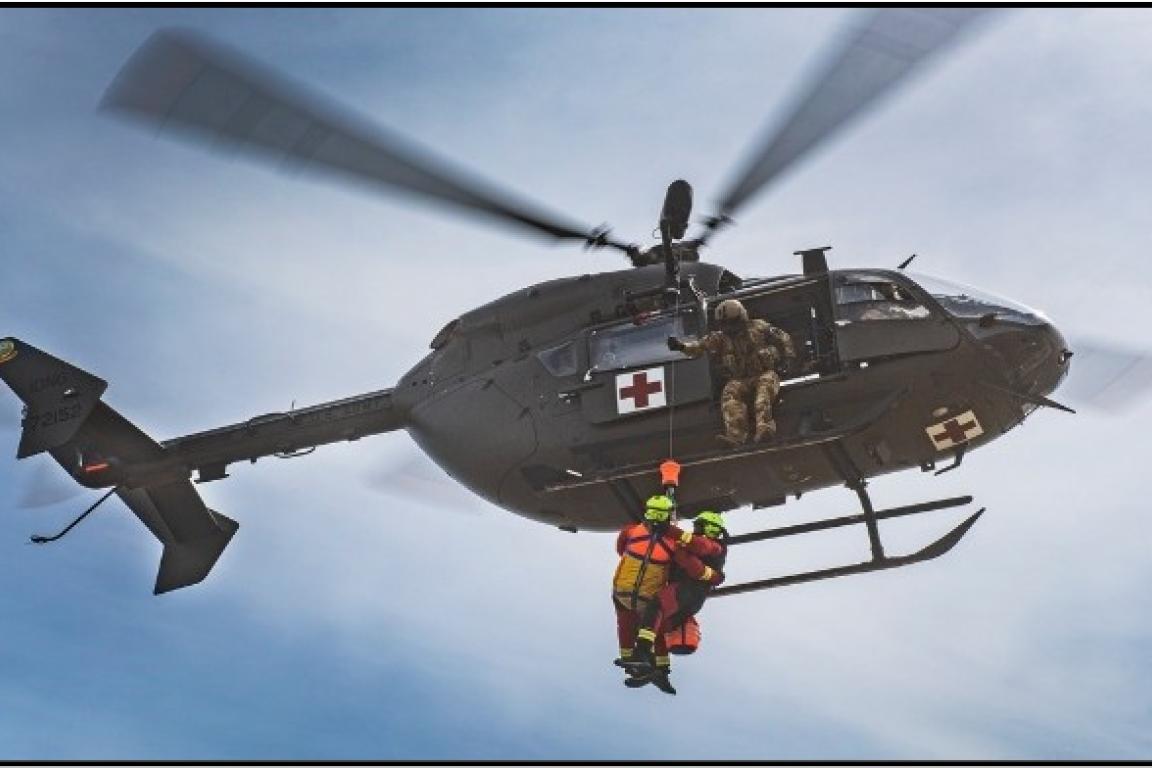
NCHART utilizes multiple aircraft platforms based on mission needs. The North Carolina Army National Guard provides UH-60 Black Hawk and UH-72 Lakota helicopters, while the North Carolina State Highway Patrol provides Bell 429 and Bell 407 helicopters. These aircraft are configured and staffed to conduct helicopter-based rescue operations, including hoist and short-haul missions in urban, wilderness, mountainous, and flood-impacted environments.
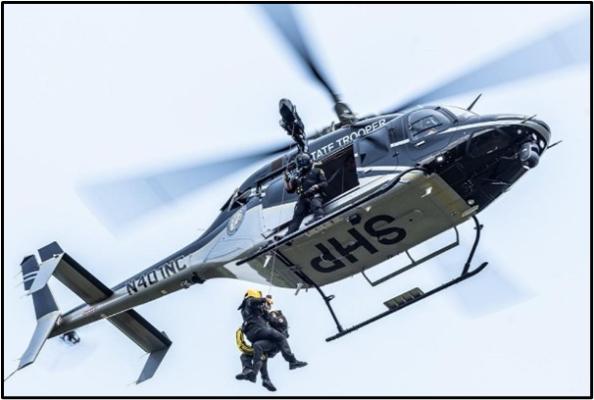
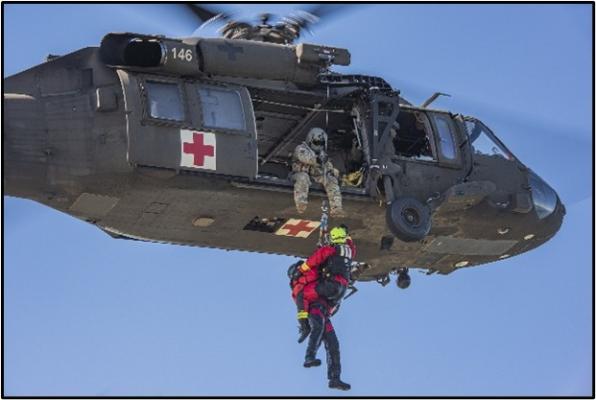
Partnership remains fundamental to the success of the NCHART program, and the accomplishments of the team. The professional standards upheld by its members reflect a level of commitment essential to sustaining this critical statewide capability in support of the citizens of North Carolina.
Training
NCHART trains monthly to maintain operational readiness across four levels of mission complexity, progressing from basic open-environment operations to highly complex, dynamic rescues involving moving water, confined terrain, and precision hoist operations. All technicians must remain current in the following mission categories to maintain deployable status.
- Level 4 training is the most basic of the four levels and includes day/night operations in open, land-based environments. These areas have limited confinement and represent the most basic hoist or short haul operation.
- Level 3 training is the most basic of water operations and includes day / night operation in open static water environments. These areas have limited confinement in a static water area and represent the most basic water operations for hoist or short haul operation.
- Level 2 training is confined to land-based rescues where extremely precise operations are required to perform the rescue. Examples of Level 2 training are day/night cliff rescues, buildings, windows, and tree-based rescue.
- Level 1 training represents the most complex helicopter-based rescues in a day/night operation. These rescues involve moving water operations where the entire rescue is performed in a dynamic environment that may or may not be also in a confined area. These rescues require extreme precision and coordination between all crew members to safely execute the mission.
NCHART Selection Process
Selection into NCHART is conducted through a structured three-phase process designed to ensure candidates meet administrative, technical, and operational standards.
Phase I consists of an administrative review of all submitted applications. Sponsoring agencies are responsible for ensuring each applicant submits a complete application packet, including all required certifications and a Letter of Support.
Helicopter search and rescue technicians must be members of the Urban Search and Rescue, Swiftwater Rescue, Wilderness Search and Rescue, or Mountain Rescue programs and must have a letter of support from their sponsoring agency.
Additional requirements include:
- current EMT-B certification,
- Swiftwater Rescue Technician certification (NFPA 1670 / NFPA 1006),
- Rope Rescue Technician certification (NFPA 1670 / NFPA 1006),
- Hazardous Materials Awareness (NFPA 472 / OSHA 1910.120(q)(6)(i)),
- NIMS ICS 100, 200, 700, and 800.
Phase II evaluates the candidate’s knowledge and physical readiness. Candidates are assessed and scored against their peers in swimming proficiency, physical fitness, and rope rescue and rigging skills. Candidates who successfully advance through Phase II are interviewed by the NCHART Technician Selection Committee. Those selected are formally invited to Phase III.
Phase III begins with a 50-hour Basic NCHART Indoctrination Course designed to provide foundational knowledge and skills required to function safely and effectively as an NCHART Technician. Upon successful completion of the indoctrination course, candidates are designated NCHART Technicians in a probationary, non-deployable status for a period of one year. During this probationary period, each technician must complete all required tasks identified in the NCHART Helicopter Search and Rescue Technician Task Book and demonstrate proficiency in accordance with the NCHART Standard Operating Guidelines. Failure to demonstrate satisfactory performance or failure to complete the task book within the established one-year period will result in removal from the program.
NCHART- Helicopter Search and Rescue Technician (HSRT) Program Application
Interested in Applying?
Individuals interested in submitting an application for the NCHART- Helicopter Search and Rescue Technician (HSRT) Program are encouraged to review the application announcement and submission requirements. Application materials and information
Deadline: April 30, 2026 at 5pm