
Over the decades, Samarcand has served many different purposes. Today, we are happy to provide some of the finest training opportunities to all North Carolina agencies who serve to protect North Carolina and its interests.
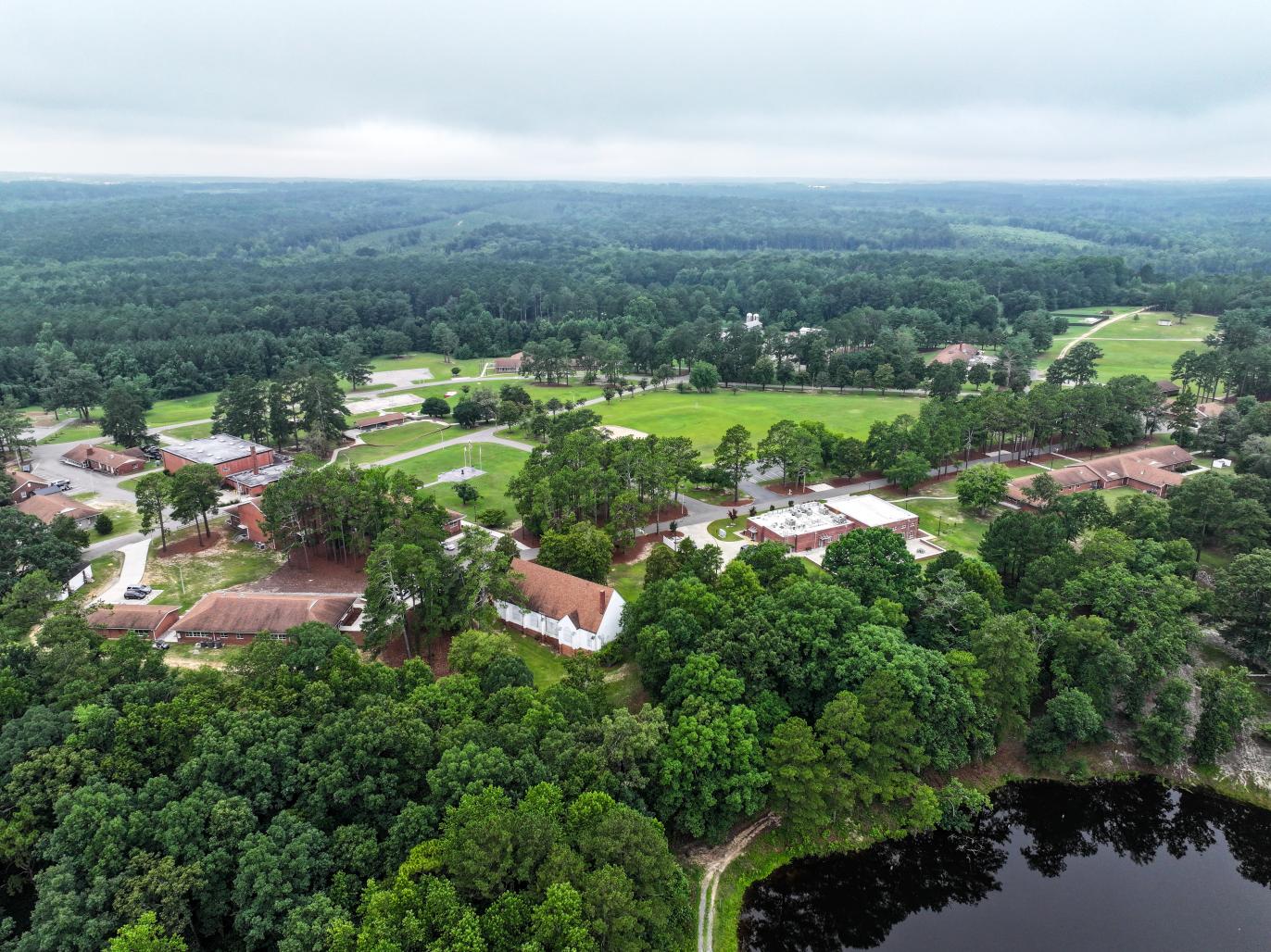
Located in the geographic heart of North Carolina, Samarcand Training Academy’s Main Campus spans over 460 acres of lush pine forest with the facilities tucked quietly within.
Samarcand Training Academy also features a 113-acre satellite campus just 15 minutes away. That campus has priority training facilities for the NC Center for Safer Schools and provides one of the most unique public crisis response training experiences in the country.
Read the Full History
The newest training facility with the North Carolina Department of Public Safety, consisting of 20 buildings, is located on approximately 430 acres in Jackson Springs (Moore County), North Carolina, and is called Samarcand Training Academy.
- Samarcand was originally opened in 1914 as an open-air school for boys by Headmaster Charles Henderson and was known as Marienfeld Open-Air School from 1914-1916.
- In 1917, the North Carolina Legislature purchased the 230 acres from Henderson and in 1918 it became the State Home and Industrial School for Girls and Women, a correctional institution for young women.
- In 1974 the state changed the name of the institution to Samarkand Manor and placed it under the purview of the North Carolina Department of Human Resources, Youth Division.
- Samarkand became one of five state training schools designed to rehabilitate delinquent children (both male and female) between the ages of 10 and 17.
- The school shifted its emphasis to treatment and therapy. • In the early 2000s Samarkand had approximately 190 clients (40 females and 150 males) and 210 staff members.
- In 2011, the Division of Juvenile Justice closed Samarkand Manor and the property remained vacant.
Conversion from Juvenile Rehabilitation to DPS Training Facility
- In 2012, Moore County Legislator James Boles Jr., submitted a bill to the North Carolina Legislature to provide funding to convert Samarkand Manor into a Corrections and Law Enforcement Training Center for the newly formed Department of Public Safety.
- Session Law 2013-360 appropriated approximately $10.4 million dollars for DPS to renovate 14 buildings as well as build a firearms range.
- This Phase I conversion project included the renovation of six classrooms, dormitories to house 94 overnight students, and food services capabilities (cafeteria.)
- Initial construction began in late 2014 and the Academy began conducting commuter classes in August 2015 with the implementation of Basic Correctional Officer Training.
- In April 2016, a cafeteria and the first of several dormitories opened and overnight accommodations became available for additional training programs.
- The final student dormitory in Phase I was completed in November 2016 and 94 student beds became available.
- The Vocational Annex renovation was completed in January 2017, and the Academy’s 300-degree Use of Force Training Simulator was open for training events.
- The final building, an Instructor dormitory with 10 bedrooms, was completed in May 2017.
- Phase I was subsequently completed with the opening of the Instructor Dormitory in May 2017 and the Firearms Training Center in June 2017.
Phase II
In March 2016, the citizens of North Carolina voted to approve ConnectNC, a $2 billion dollar capital improvement bond proposal, which included $8.5 million for the continued renovation of Samarcand.
- These funds were utilized to construct a brand new, free standing dining hall able to seat 300 guests which opened in August 2019.
- Demolish three (3) dilapidated buildings (Leonard, Ireland, and Gardner.)
- Renovate the Hope Cottage to house 22 beds upstairs and a weight/physical fitness room downstairs. This building opened in late November 2017.
- Renovate the Carroll/Infirmary building to house 26 beds; a classroom; a mat room; separate gender shower and bathroom facilities; and a recreational room, essentially making the building self-sustaining. This building opened in November 2018.
- Renovate the Tufts building to house 24 beds; a classroom; a mat room; separate gender shower and bathroom facilities; and a recreational room, essentially making the building self-sustaining. This building opened in the winter of 2019.
- Renovate the remaining Vocational building to add two classrooms; a mock courtroom; student and instructor break rooms; and office cubicle farm for additional instructors. Slated to be completed in the summer of 2021.
- Renovate an existing structure to serve as a Simunitions Building on the main campus for conducting tactical room clearing and building searches. This training site opened in the spring of 2020.
- Construct an Obstacle and Conditioning Course for the fitness training of Corrections and Law Enforcement personnel to develop personal fitness and confidence skills.
- Other funds were provided by the North Carolina State Bureau of Investigation to construct and install four Arson Burn Cells and a Flash-over Cell enabling arson and fire investigators to participate in real-world arson training scenarios. With the completion of Phase II in the summer of 2021, Samarcand Training Academy will have 11 classrooms; dormitories to provide overnight accommodations for 180 trainees and 14 adjunct instructors; five psychomotor skills mat rooms; two fitness centers with cardiovascular and weight equipment; a dining hall with a capacity of 300 diners; a state of the art firearms training center with two outdoor ranges; a state of the art VirTra 300LE use of force training simulator with scenario authoring capability; a two-story simunition training building; and a 15-station obstacle course.
Firearms Training Center
- In September 2015, the North Carolina General Assembly approved an additional $2.89 million dollars to construct a state of the art Firearms Training Center.
- The Center consists of two shooting ranges - a 12 lane range with shooting points out to 50 yards with steel bullet traps and stationary targets, and a 24-lane range with shooting points out to 300 yards, consisting of steel bullet traps and an inverted turning targetry system.
- The turning targetry is operated by a computer system located in the Range Control Tower and has the capability to be activated remotely.
- Included in the range package are mobile lighting stations which provide both white light and blue light illumination for qualification and tactical firearms training, a concrete pad out to 25 yards for utilization of vehicles as a shooting platform, and wooden barricades.
- Lastly, a 3,000 square foot range house consisting of a classroom, restrooms, Range Master office, weapons cleaning room, firearms marksmanship training simulator, and temporary storage have been built.
- A ribbon cutting/grand opening ceremony was held and the firearms training center officially opened in June of 2016.
The Vocational Annex renovation was completed in January 2017, and the Academy’s VirTra 300 degree Use of Force Training Simulator was open for training events.
- State of the art use of force training simulator with five screen, fully immersive 300-degree environment.
- The system contains over 240 real-life scenarios for law enforcement and corrections, to include Active Shooter and marksmanship training capability.
- Seamless high-resolution video
- Debrief and record a trainee’s performance, judgment, and reaction time
- Multi-directional surround sound for unsurpassed audio realism with a raised platform
- Arsenal of “tetherless” recoil kits available for most handguns and long guns.
- Beginning in 2019, the Academy began to focus on training School Resource Officers as part of the statewide safer school’s initiative and culminating in providing training for over 47 School Resource Officers and 35 hours of dedicated Active Shooter training.
- In the spring of 2019, Samarcand added an update to the VirTra software package known as V-Author, which has a scenario authoring suite to allows users of the VirTra Simulation equipment to create, edit, and train with content specific to agency training objectives and environments.
- Several customized training scenarios have been created and utilized in training School Resource Officers, NC SBI Agents, NC Wildlife Officers with the Division of Law Enforcement, and several other law enforcement agencies.
Two-story structure with interior switch back stairwell and an open landing on second floor.
- Exterior breaching doors. o Front Door - Mechanical breaching with ram and/or pick. o Side Door – Mechanical breaching with pick o Rear Window – Mechanical breaching by breaking and raking
- Noise Flash Diversionary Device (NFDD) landing area inside foyer of front entrance.
- State-of-the-art interior lighting system that can be controlled remotely with smart devices.
- Dedicated room with floor and wall mats to conduct psychomotor skills training in suspect control.
- All rooms are upfitted with safe Crown Nottaline foam training furniture designed to replicate potentially dangerous items found in the typical home environment.
- 270-degree perimeter safety fencing with open access on the rear of the building for land navigation and woodland approaches.
- Dedicated parking area for training in vehicle interventions and suspect control.
Samarcand's Mission
Mission Statement: To flex to meet the training needs of the State of North Carolina’s public safety profession.
Vision Statement: We will strive to continually improve professional training services and state-of-the-art training resources through comprehensive collaboration with our training partners.
Core Values: We fully embrace the core values of the Department of Public Safety. Our core values are intended to focus on our mission of training in support of the greater mission of DPS.
- Love of Learning: Love of learning drives people to grow and develop. This value facilitates diversity and innovation.
- Empowerment: Creativity through empowerment to share diverse perspectives is the best path to continual growth, development, and innovation.
- Diversity: Through embracing diverse perspectives, backgrounds, upbringings, and cultures, we can most fully innovate.
- Innovation: Constantly striving to find “a better way” serves the mission and vision and ultimately the profession and the communities served.
- Collaboration: Only through trust-building and trustworthiness can we grow in concert with those we serve and partner with.
- Humility: With humility comes a heart of service, a commitment to life-long learning, and continuous growth and development.
- Gratitude: Being thankful in all circumstances allows learning through both adversity and success; as well as building resilience.