
NC Office of Violence Prevention Implementation Plan
2025 - 2027 Implementation Plan
In 2023, Former Governor Roy Cooper signed an executive order establishing the Office of Violence Prevention (OVP) within the NC Department of Public Safety. The OVP was tasked with enabling the reduction of violence, harm from violence, and firearm misuse across the state through a public health approach. This included the establishment of a community violence advisory board to support the office as well as the development of a strategic plan to guide the office’s work.
In November of 2024 the OVP released its 2024-2027 Community Violence Prevention Strategic Plan to achieve its stated goals and has developed an implementation plan to provide a blueprint for putting that plan into action. The following document provides an overview of that implementation plan and an update on it’s progress.
Background
The NC Community Violence Prevention Strategic Plan outlines three priority goals to lead our state towards the shared vision of a North Carolina where all communities have the tools, resources and expertise needed to create and maintain safety and wellbeing:
- Enhancing Collaboration and Coordination
- Strengthening the Community Violence Prevention Workforce
- Preparing and Empowering Local Communities
Building on this framework, the OVP has developed objectives and strategies that guide implementation. The following 3-year implementation plan was created to develop effective and sustainable systemic processes for the OVP, in collaboration with partners across the state, to take a public health approach to address community violence. This document serves as a roadmap, detailing how the OVP is acting on its strategic plan across the 2025-2027 timeframe.
Planning and Implementation
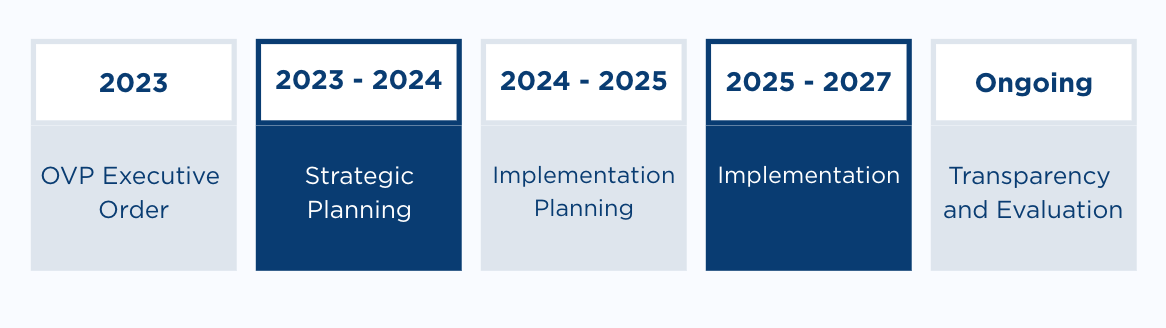
The OVP is currently implementing the strategies outlined in this document and has worked on strategy and implementation since 2023 in the following ways:
2023: Executive Order establishing the NC Office of Violence Prevention.
2023 - 2024 Strategic Planning: NC OVP collaborates with the Community Violence Advisory Board and the North Carolina Department of Health and Human Services to develop a strategic plan based on research, partner input, and NC public health and criminal justice surveillance data.
2024-2025 Implementation Planning: The OVP Team began implementation efforts while developing plans. Planning included team retreats, stakeholder meetings, collaboration with other state offices, developing assets, mapping capabilities, and working with a doctor of public health researcher with the UNC Injury Prevention Research Center to design tools for mapping, tracking, and executing activities
2025-2027 Implementation: Although implementation activities began at the end of 2024, structured work based on identified needs began at the beginning of 2025. Many of the activities that were started during planning remain a part of ongoing OVP efforts across all three priority goals.
Transparency & Ongoing Evaluation: The OVP evaluates activities and tracks progress to measure effectiveness, and adjust as needed. The OVP hosts stakeholder and community events to share implementation progress, publishes a newsletter to keep everyone up to date, and provides regular updates to its website.
Activity Descriptions
All OVP implementation activities fall within six general categories that are necessary for achieving strategic goals, objectives, and strategies. Each category includes a wide range of activities:
| Objective | Description |
|---|---|
| Communication | Engagement activities that foster transparent dialogue between agencies and community partners, including sharing newsletters, resources, webpages, data, and important information |
| Convenings | Large gatherings that bring together regional and statewide stakeholders to build community, foster collaboration, and strengthen partnerships |
| Partnership Development | Opportunities to build working relationships between law enforcement/public safety, public health, community-based organizations, research and academic institutions, and non-traditional sectors |
| Education | OVP sourced or developed trainings, webinars, and presentations designed to build knowledge about best practices and provide professional development opportunities |
| Technical Assistance | Specialized support, resources, and expertise to help organizations build capacity to achieve their mission and program goals |
| Toolkits | OVP sourced or developed resources to support prevention efforts across the state and help strengthen programs and initiatives, including county violence profiles, practice guides, templates, and other practical tools |
| Evaluation | Assessments across the state to better understand impact, needs, and scalability of existing community violence prevention initiatives |
Goal #1: Enhance Collaboration and Coordination
| Strategies | Progress | Related Activities |
|---|---|---|
| Establish a state government workgroup on violence prevention comprised of representatives from key state agencies that will convene and collaborate to ensure awareness and alignment of complimentary violence prevention initiatives | 70% | Communication; Partnership Development |
| Coordinate and make more publicly accessible relevant state data and resources to inform or support violence prevention work | 80% | Communication; Toolkits |
| Provide guidance and technical assistance on best practices for data sharing among local entities to inform and support community violence prevention work | 80% | Partnership Development; Education; Technical Assistance |
| Strategies | Progress | Related Activities |
|---|---|---|
| Work with research and academic institutions to enhance the research capacity of local violence prevention programs and ensure data driven best-practices are utilized for program implementation, evaluation, and quality improvement | 30% | Partnership Development; Education; Technical Assistance; Toolkits |
| Provide opportunities to build intentional, productive working relationships between law enforcement/public safety, public health, and community-based organizations | 50% | Convenings; Partnership Development; Technical Assistance |
| Engage non-traditional sectors that intersect with the risk and protective factors of community violence (business, philanthropy, etc) to increase their involvement and support of prevention activities across the state | 40% | Communication; Partnership Development; Technical Assistance; Toolkits |
| Strategies | Progress | Related Activities |
|---|---|---|
| Regularly host a statewide convening to provide learning and networking opportunities for people and entities leading, implementing, or funding violence prevention efforts across the state and around the country | 33% | Convenings |
| Maintain a multidisciplinary community violence advisory board comprised of representatives leading and implementing local community violence prevention work | 60% | Partnership Development |
| Facilitate the establishment of local cross sector partnerships to strengthen violence prevention ecosystems within communities | 40% | Convenings; Technical Assistance |
Goal #2: Strengthen the Community Violence Prevention Workforce
| Strategies | Progress | Related Activities |
|---|---|---|
| Provide guidance on recommended foundational and supplemental competencies for people leading and implementing local community violence prevention activities | 100% | Education; Toolkits |
| Work with partners and organization leaders to encourage and enable access to professional development training for violence prevention staff | 35% | Partnership Development; Education; Technical Assistance; Toolkits |
| Strategies | Progress | Related Activities |
|---|---|---|
| Provide training and technical assistance to ensure local programs are accurately measuring implementation and impact | 50% | Education; Technical Assistance; Toolkits |
| Utilize a variety of communication channels to highlight progress of community violence prevention efforts throughout various communities | 40% | Communication; Partnership Development |
| Conduct assessments across the state to better understand impact, needs, and scalability of existing community violence prevention initiatives | 25% | Evaluation |
| Strategies | Progress | Related Activities |
|---|---|---|
| Work with partners to integrate roles dedicated to community violence prevention activities into a variety of relevant settings (schools, health departments, faith-based organizations, community centers, youth-serving organizations, police departments, correctional facilities, etc.) | 25% | Education; Technical Assistance; Toolkits |
| Support the development and growth of professional networks/ associations for the various segments of the state's community violence prevention workforce | 45% | Convenings; Partnership Development; Technical Assistance |
Goal #3: Prepare and Empower Local Communities
| Strategies | Progress | Related Activities |
|---|---|---|
| Utilize a variety of communication channels to increase awareness of the public health approach and how it can be employed to address and prevent violence in local communities | 40% | Communication; Education |
| Develop guidance to increase awareness and improve use of data resources | 25% | Education; Toolkits |
| Work with local communities to assess capacity and readiness for community violence prevention efforts, taking into account geographic, cultural, and systemic factors | 30% | Education; Toolkits |
| Strategies | Progress | Related Activities |
|---|---|---|
| Disseminate existing and emerging resources from trusted entities | 50% | Communication; Education; Technical Assistance |
| Provide opportunities for new and existing programs to engage with and learn from subject matter experts (webinars, regional meetings, site visits, etc.) | 50% | Convenings; Partnership Development; Education; Technical Assistance |
| Work with partners to develop tailored trainings for a variety of sectors | 25% | Education; Technical Assistance; Toolkits |
| Support and amplify NC S.A.F.E. (Secure All Firearms Effectively) campaign messaging and training efforts | 60% | Communication |
| Strategies | Progress | Planned Activities |
|---|---|---|
| Provide technical assistance for city, county, and community leaders to support the development and implementation of multi-faceted strategies to prevent violence in communities | 35% | Education; Technical Assistance; Toolkits |
| Disseminate and advocate for funding opportunities to initiate and expand efforts to prevent violence in communities across the state | 40% | Communication; Partnership Development; Education; Technical Assistance |
| Provide guidance and education on how local, state, and federal policies and laws can enable or impact violence prevention efforts | 100% | Education; Technical Assistance |
This page was last modified on 09/15/2026